A slot game can look complete from a design and development perspective but still have problems that QA discovers. That’s where slot game testing becomes a necessary step before the game launch. Testing a game application covers many aspects of development, from login and security protocols to in-game purchases, bonus features, level progression, and integration.
Before launch, developers need to verify every stage of the game development through slot game QA testing. Testing shouldn’t happen only at the final stage before launch as a final validation step; it should happen throughout development.
Here is a slot game testing guide, why it’s important, and the different types of testing required to verify gameplay functionality and performance.
What Is Slot Game Testing?
Slot game testing is a process of validating a game’s functionality, mathematical behavior, technical performance, security, integrations, compatibility, compliance, and user experience to ensure it operates correctly and meets required gaming and compliance standards. Online slot game testing is different from QA or RNG testing because it involves testing every process. Let’s see how it differs from other testing procedures.
| QA Testing | Mathematical/RNG testing | Slot Game Certification |
|---|---|---|
| Validates software behavior | Validates game logic and randomness | Verifies compliance with applicable technical/regulatory standards |
Why Is Testing Important Before Launching a Slot Game?
Slot game quality assurance is important before launching a game. The reasons are:
- Preventing critical bugs: Identify and fix errors, crashes, and any software defects before launch and correct them.
- Protecting transaction accuracy: Verifying that each transaction, bet, win, and player balance is recorded and accounted for.
- Verifying game mathematics: The core game mathematics of slot games, such as volatility, RTP, payout calculations, and game logic, are validated before it reaches the market.
- Ensuring consistent player experience: Ensuring that the game mechanics, animations, and game logic work the same way as intended when players launch the game.
- Reducing downtime: Aiming to reduce downtime and loading issues that could interrupt gaming.
- Supporting certification: Prepare the game for independent testing and regulatory compliance.
- Protecting operator reputation: Slot game testing is required to ensure the game performs the expectations of players and matches industry standards to protect the operator’s reputation and market image.
- Identifying compatibility problems: Check for any compatibility issues across devices and operating systems.
What Should Developers Test in a Slot Game?
Here is a slot game testing checklist of why developers should test a game before launch.
- Functional behavior: Verify the functionality of the game through slot game functional testing at every stage of development.
- Game mathematics: Slot game mathematics testing, such as RTP, volatility, and payout calculations are working correctly or not.
- RNG: Slot games are based on a random number generator, and it is crucial for slot developers to run RNG testing before launch.
- Bonus features: Whether all bonus features are integrated properly.
- Wallet transactions: Checking and verifying all wallet transactions for accurate records.
- APIs: Slot game API testing to check that all third-party APIs are functional.
- Performance: Slot game performance testing is required to test the overall performance of the platform.
- Security: Slot game security testing to identify vulnerabilities and protect player data and transactions.
- Compatibility: Slot game compatibility testing verify functions correctly across browsers and operating systems.
- UI/UX: Evaluate navigation, controls, and responsiveness to ensure a consistent player experience.
- Localization: Slot game QA testing also includes checking regional settings for accuracy across target markets.
- Compliance: Validate game rules, RNG implementation, RTP disclosures, and technical requirements through slot game compliance testing.
- Analytics: Verify that gameplay events and player activity are tracked and reported accurately.
- Recovery and error handling: Test how the game handles network interruptions, server failures, and unexpected crashes in real time.
Functional Testing for Slot Games
| Testing Area | Checklist |
|---|---|
| Game Launch |
|
| Spin Functionality |
|
| Paytable |
|
| Game States |
|
Online slot game testing to determine whether implemented game behavior matches the approved mathematical model. Mathematical testing should verify implementation against the intended model, rather than simply looking at a small number of game sessions.
Slot game mathematics testing includes:
- RTP: Verify whether the on-paper return to player matches the approved mathematical model.
- Hit frequency: Validate how frequently the spin results in a winning outcome.
- Volatility: Check whether the distribution of wins aligns with the intended risk and payout profile.
- Paytable: Confirming the payouts match the published paytable.
- Win probabilities: Validating the winning probability against established wins.
- Bet ranges: Ensuring that the minimum and maximum bets are applied across game models.
- Bonus frequency: Verify how frequently the bonus feature gets triggered compared to the expected payout.
- Maximum win configuration: Confirm that maximum payout limits and win multipliers function as specified.
- Jackpot calculations where applicable: Validate jackpot contributions, triggers, and conditions where applicable.
RNG Testing for Slot Games
A Random Number Generator (RNG) is a mathematical implementation that produces random outcomes that determine the slot game payouts. This includes symbol positions and payout combinations that verify the RNG functions correctly, outcomes are unpredictable, and its implementation meets applicable fairness and certification requirements.
- RNG testing in slot games involves testing of:
- Randomness
- Distribution
- Unpredictability
- Implementation
- Integration with game outcomes
Note: Internal QA testing and independent RNG certification are not necessarily the same thing. Depending on the jurisdiction and distribution model, independent testing/certification may be required.
Bonus Feature Testing
Bonus feature testing includes verifying various bonuses that get triggered during every spin. Slot game testing checks the reward calculations, feature transitions, retriggers, and bonus-round recovery to ensure accurate outcomes and consistent gameplay. Some of the slot game bonus features include:
- Free spins
- Multipliers
- Wilds
- Scatters
- Bonus rounds
- Pick features
- Cascades
- Expanding symbols
- Buy features where applicable
- Progressive jackpots
Every bonus feature is tested based on:
- Trigger conditions
- Payouts
- State transitions
- Balance updates
- Re-entry behavior
- Interrupted sessions
Wallet and Transaction Testing
Wallet and transaction testing verifies that the wallet balance for every player, including bets, winnings, refunds, and balance updates, is processed accurately between the slot game and the casino platform. It verifies duplicate transactions, failed requests, and transaction recovery to prevent incorrect balances shown in the wallet and correct them for financial data consistency.
Here is a slot game testing checklist for wallets and transaction testing:
| Testing Area | Checklist |
|---|---|
| Bets |
|
| Wins |
|
| Refunds |
|
| Insufficient Balance | Verify that the game handles insufficient funds correctly. |
| Interrupted Transactions | Test what happens when:
|
Slot Game API and Integration Testing
Slot game API and integration testing verifies how well the integration system is connected with the casino platform to offer various services. It checks whether the API is responding well and communication works in real time through timely data exchange to ensure reliable integration and consistent gameplay.
This online slot game testing process ensures connectivity between the game and various APIs such as the casino platform, PAM, wallet, casino game aggregator, CRM, analytics, & reporting.
API Error Testing
The API error testing analyzes various aspects of failure in API connectivity, including testing of timeouts, invalid sessions, authentication failures, duplicate transactions, invalid requests, and server unavailability.
Integration Recovery
Integration recovery testing verifies that the game resumes its normal operation after any failure or technical issues. It checks whether player sessions, game states, and transaction records are restored correctly to prevent duplicate bets, missing winnings, and balance discrepancies.
Performance and Load Testing
A game may work correctly with one tester but fail under high traffic.
Test:
- Game loading speed
- API response times
- Concurrent sessions
- Server load
- Memory usage
- CPU usage
- Network performance
- Recovery after high load
Stress Testing
Stress testing is a slot game testing process where the game is tested beyond the expected traffic to test performance and identify bugs. It is done to test for system failures and recovery time taken. Load targets reflect how the system reacts to load and the available infrastructure to ensure the system can handle peak demand and recover gracefully from failures.
Security Testing for Slot Games
Slot game quality assurance includes testing every aspect of testing such as:
- Authentication: Verifying that only legitimate users can access the platform.
- Authorization: Ensure that only authorized users with KYC login credentials can access the platform.
- API security: Test API endpoints for unauthorized access and data exposure.
- Encryption: Ensure encryption is used to protect data and the privacy of players.
- Session management: Check session timeouts for protection against session hijacking.
- Input validation: Ensure inputs are validated to prevent malformed requests.
- Access controls: Verify that permissions restrict access to administrative tools, player records, and system configurations.
- Sensitive data handling: Ensure that all sensitive data is handled carefully and stored securely.
- Logging: Verify secure login without exposing passwords or data.
- Vulnerability testing: Identify and assess weaknesses in game software & APIs before deployment.
Mobile and Cross-Browser Testing
Slot game optimization for mobile devices is a must in the iGaming industry. With the number of mobile users growing, every slot game test should include compatibility testing for mobile and cross-platform gameplay. This involves testing orientation, touch controls, UI scaling, text, animations, loading speed, and overall performance
This includes testing for:
| Testing Area | Checklist |
|---|---|
| Devices |
|
| Operating systems |
|
| Browsers |
|
UI/UX Slot Game Testing
Test whether players can easily understand and use the game.
Check:
- Bet controls
- Spin button
- Balance
- Paytable
- Settings
- Sound controls
- Autoplay where applicable
- Bonus instructions
- Error messages
Localization Testing
Slot game localization testing is a way of testing whether the game matches the local market expectations. If the game supports multiple markets, test:
- Languages
- Translations
- Currency
- Number formatting
- Date/time formats where used
- Text expansion
- RTL languages
- Localized graphics
- Audio
Note: Also verify that localized content doesn’t break the UI.
Compliance and Certification Testing
Passing internal QA does not automatically mean the game is legally certified for every market. It requires slot game compliance and certification testing to ensure all compliance standards are fulfilled. However, certification requirements depend on the jurisdiction and deployment model. Every game is tested based on the market in which it is launched.
Potential areas of slot game QA testing include:
- RNG requirements
- RTP disclosure
- Game rules
- Responsible gaming information
- Technical standards
- Reporting
- Game certification
Analytics and Tracking Testing
Analytics and tracking testing verifies every action taken and reports to the operator for further evaluation.
Test whether the game correctly sends:
- Game launches
- Sessions
- Bets
- Wins
- Game rounds
- Errors
- Player events
- Revenue data
Note: Verify:
Game data → Casino platform → Analytics/reporting system is consistent.
Recovery and Edge Case Testing
Can the game safely recover without losing or duplicating a player transaction? The answer lies in testing it before launch.
Recovery and edge case testing checks how a slot game responds to unexpected situations, and how fast it recovers from that situation. This includes various scenarios that can affect the performance of the game and interrupt gaming. It verifies that game states and player balances remain accurate after recovery, preventing any type of lost wins or money getting lost or unaccounted for.
Test scenarios such as:
- Player disconnects during a spin
- Wallet becomes unavailable
- Browser closes during a bonus
- Server restarts
- Session expires
- Duplicate API request occurs
- Player reconnects
- Network becomes unstable
- Game is updated during an active session
How to Test a Slot Game Before Launch: Step-by-Step Process
Here is the slot game testing process to test your game before launch.
Step 1: Review the Game Requirements
Confirm the game’s GDD, slot mathematics, technical requirements, and the target markets.
Step 2: Create Test Cases
Cover functional, technical, and business scenarios.
Step 3: Test Core Gameplay
Verify every gameplay activity, including spins, bets, wins, and bonuses.
Step 4: Test Mathematics and RNG
Validate against the approved models.
Step 5: Test Integrations
Verify all integrations such as wallet, API, PAM, and analytics.
Step 6: Perform Performance Testing
Test expected and peak loads.
Step 7: Perform Security Testing
Check vulnerabilities and access controls.
Step 8: Test Devices and Browsers
Cover supported platforms.
Step 9: Complete Compliance Testing
Perform applicable certification and market checks.
Step 10: Run Final Regression Testing
Confirm that fixes haven’t introduced new problems.
Slot Game Pre-Launch Testing Checklist
A practical slot game testing checklist for operators:
Game functionality
- Game launches
- Spins work
- Bets work
- Wins are calculated correctly
- Paytable is correct
- Bonus features work
Mathematics
- RTP verified
- Volatility verified
- Paytable verified
- Win probabilities verified
- Maximum win verified
RNG
- RNG implementation tested
- Randomness reviewed
- Required independent testing completed
Integrations
- PAM tested
- Wallet tested
- API tested
- Aggregator tested
- Analytics tested
Technical
- Performance tested
- Security tested
- Mobile tested
- Browser compatibility tested
- Recovery tested
Compliance
- Target jurisdictions reviewed
- Required certification completed
- Responsible gaming information checked
- Technical requirements verified
Readers Of This Blog Also Read


Common Slot Game Testing Mistakes
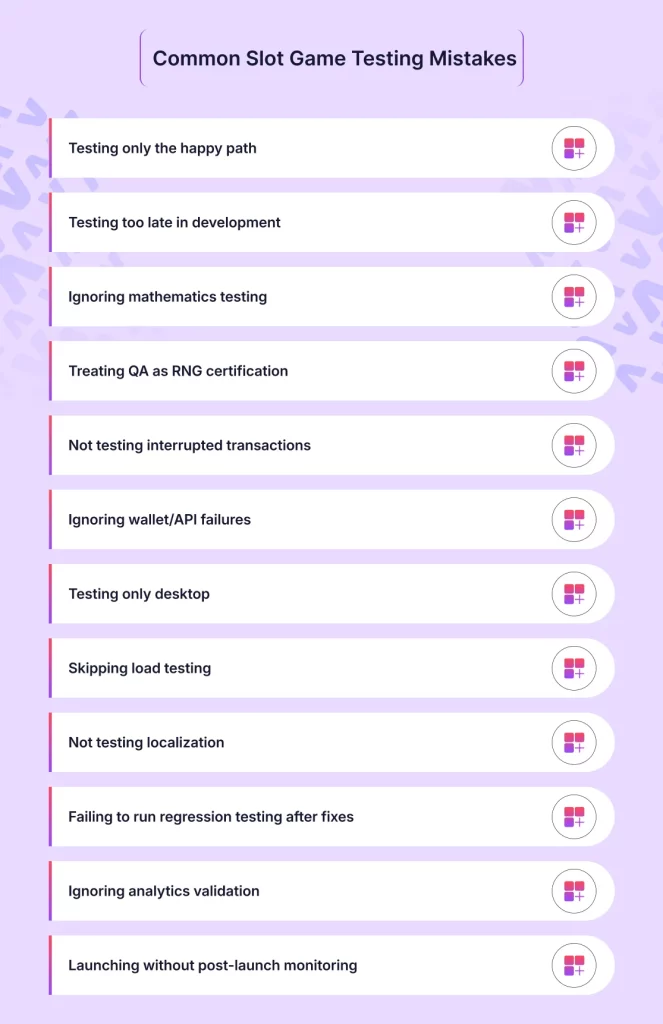
Slot game quality assurance is a must for operators who are looking for long-term success in the iGaming industry. However, one should avoid these slot game testing mistakes to ensure high-quality development and launch.
- Testing only the happy path
- Testing too late in development
- Ignoring mathematics testing
- Treating QA as RNG certification
- Not testing interrupted transactions
- Ignoring wallet/API failures
- Testing only desktop
- Skipping load testing
- Not testing localization
- Failing to run regression testing after fixes
- Ignoring analytics validation
- Launching without post-launch monitoring
What Should Developers Do After Launch?
Slot game testing doesn’t end on launch day. Developers should track data continuously and monitor various aspects of game performance to run tests and correct issues.
Monitor:
- Errors: Any type of game error or functional error occurring or reported.
- Game sessions: Check if there is any disturbance during game sessions.
- API failures: Check for API failures and integration malfunctions.
- Transaction issues: Verify all transactions are recorded correctly and updated.
- Performance: Slot game QA testing continues after launch while checking overall performance.
- Player complaints: Resolve player queries and complaints immediately for quality assurance.
- Game crashes: Check if game crashes are common and correction measures need to be taken.
- Mobile issues: Check if the system is showing any mobile and cross-platform issues.
- Analytics anomalies: Check if the system reports correct analytics and data.
Note: Establish a process for:
Monitor → Identify → Fix → Retest → Deploy
How to Choose a Slot Game Development Company With Strong QA Capabilities
Choose a slot game development company that integrates quality assurance (QA) throughout the development lifecycle, from initial game design to post-launch monitoring. Evaluate potential partners using the following criteria:
- QA methodology
- Test automation
- Mathematical testing
- RNG testing
- API testing
- Security testing
- Load testing
- Mobile testing
- Certification support
- Regression testing
- Post-launch monitoring
- Bug tracking
- Documentation
When it comes to choosing a slot game development company that meets all your QA needs, GammaStack stands as a renowned company known for providing high-quality slot game testing methods to deliver high performance. With 14+ years of experience serving top iGaming businesses across the globe, GammaStack’s slot game development services are best in the industry. We offer an in-depth explanation of our slot game testing process and provide evidence of test coverage rather than relying on general quality claims.
FAQ section on slot game quality assurance
What is slot game testing?
Slot game testing is a process of validating a game’s functionality, mathematical behavior, technical performance, security, integrations, compatibility, compliance, and user experience to ensure it operates correctly and meets required gaming and compliance standards.
What should be tested before launching a slot game?
Developers should test functional behavior, game mathematics, RNG, bonus features, wallet transactions, APIs, performance, security, compatibility, and UI/UX.
How is RNG tested in slot games?
RNG testing in slot games is done by checking the game’s randomness, distribution, unpredictability, implementation, and integration with game outcomes
How do developers test slot game RTP?
Developers run large-scale simulations to compare the game’s theoretical RTP with its observed payout percentage. They also validate the mathematical model, paytable, and payout calculations to identify discrepancies.
Does slot game QA include certification?
Yes, Slot game QA testing includes certification testing based on the target market and checks all types of certification, including functionality, game mathematics, RNG implementation, and compliance requirements.
What is the difference between slot game QA and RNG certification?
| Slot Game QA | RNG Certification |
|---|---|
| Ensures the slot game functions correctly and delivers a consistent player experience. | Verifies that the random number generator produces statistically random and unpredictable outcomes. |
How long does slot game testing take?
The timeline for the slot game testing process depends on game complexity, bonus features, platform integrations, target markets, and certification requirements. This also depends on the testing company and its procedures.

India
USA
Malta
Latvia
Let's Work Together. Win Together
Ready to transform your ideas into next-generation solutions? Drop us your details and we’ll get back to you within 48 hours!