⚡ Quick Answer
Creating a slot game for a new market is not simply a matter of translating the interface — slot games are stories that need to connect authentically with audiences regardless of where the target market is located. Slot game localization is the process of developing online slots to meet the regional requirements of that market, covering language, currency, cultural references, visual design, UX, technical setup, and regulatory expectations, turning a generic game into a shared, locally relevant experience. The process includes researching the target market, defining the extent of localization, choosing the translation language, adapting theme, visuals and UX, adjusting currency, reviewing RTP and volatility, checking local regulations, making technical adaptations, testing, and finally launching. There’s no universal cost or timeline for localization since both depend on how extensively an operator needs to adapt the game, and operators generally choose between localizing an existing slot or developing a new title from scratch for the target audience, with the right choice depending on financial flexibility and how the existing game already performs. Common mistakes include mistaking translation for full localization, skipping expert review, ignoring text expansion and RTL language needs, avoiding necessary theme changes, and neglecting mobile UX.
🔑 Key Takeaways
- Effective localization goes far beyond translation, involving language, currency, themes, visuals, audio, UX, and game presentation adapted together for the target market.
- Slot game localization is defined as developing online slots to meet a region’s requirements — language, currency, cultural references, visual design, UX, technical setup, and regulatory expectations all included.
- Operators localize slot games for various commercial purposes, using it as a strategic tool to expand and strengthen their presence in new markets.
- Localization follows a defined set of steps: researching the target market, defining the extent of localization, choosing the translation language, adapting theme/visuals/UX, adjusting currency, reviewing RTP and volatility, checking local regulations, technical adaptation, testing, and final launch.
- Cost and timeline have no universal benchmark: both depend entirely on how extensively an operator needs to localize a given game for each target market.
- Operators face a build-vs-adapt decision when entering a new market: localize an existing slot or develop a new title for that audience, with the right choice depending on the operator’s financial flexibility and how the existing game is already performing.
- 5+ common mistakes undermine localization efforts: treating translation as if it were full localization, skipping expert review, ignoring text expansion and RTL language handling, avoiding necessary theme changes, and neglecting mobile UX.
Creating a slot game for a new market is not simply a matter of translating the interface. They are different stories that connect with audiences no matter the location of the target market. Localization makes the connection more real, turning games into shared experiences spread across borders.
Effective localization can involve adapting language, currency, themes, visuals, audio, UX, game presentation, and many other requirements. The goal is to make the game feel appropriate for the target market while maintaining the underlying game integrity. Localized slot games enable operators to target specific markets and player preferences more effectively.
Slot game localization is a crucial part of the slot game development process, which follows as:
Research → Plan → Design → Localize → Develop → Test → Certify → Launch → Optimize
In this article, we will cover all the steps of localization, why it matters, and explore the gaps that operators miss.
What Is Slot Game Localization?
Slot game localization is the process of developing online slot games to meet the regional requirements of the target market, including language, currency, cultural references, visual designs, UX, technical, and regulatory expectations. The process is beyond simple language translation and involves localize online slot games by modifying different elements of the game experience to make it feel relevant, familiar, and compliant for local players.
Translation vs Localization
Translation involves converting the content of the game into the local language by changing it from one language into another, such as content of game, game options, instructions, menus, or bonus descriptions.
However, localized slot games involve a process of localization that adapts the overall slot game experience to meet the local preferences and requirements of the target market.
Online slot game localization includes:
- Language: Localized slot games involve adapting the overall content of the slot game platform to the local language.
- Currency: Supporting local currency transactions and monetary formats.
- Cultural references: Adapting themes, designs, and symbols to local preferences.
- Visual design: Modification of colors, layouts, and other visual elements as per local choices.
- Audio: Adjusting to local language audio changes such as audio songs, voice-over, etc.
- UX: Slot game market adaptation by adapting UX designs, such as adjusting navigation, gameplay interfaces, etc.
- Regulatory information: Localize casino games by displaying market-specific responsible gaming features.
- Market-specific requirements: Localized casino content as per local technical, payment, certification, accessibility, and operational requirements where applicable.
Localization vs Customization
| Factors | Slot Game Localization | Slot Game Customization |
|---|---|---|
| Definition | Localized slot games focus on adapting content for a specific market or region. | Customization usually refers to changing a game for a particular operator or brand. |
| Focus | It focuses on making the game suitable and relevant for local players without changing its core gameplay. | It involves changes to game mechanics, themes, features, branding, integrations, or the overall user experience. |
Why Do Operators Localize Slot Games?
Casino game operators use localized slot games for various commercial purposes, including:
Enter new markets
Slot game localization for different markets offers operators opportunities to enter new markets seamlessly.
Improve player experience
Localized casino games offer better user engagement and improved player experience.
Increase content relevance
Localized slot games increase content relevance for local gamers who can connect with the titles easily.
Improve engagement
It improves overall user engagement by making it more consumer-focused with local casino preferences.
Support multilingual casinos
With multilingual slot games, games are offered in the local languages no matter where the game is launched.
Meet market requirements
With market-specific slot games, operators meet the market needs by offering localized slot games.
Differentiate content
Localized casino games allow operators to offer different content in each market, customized as per the local preferences.
Expand the potential audience
Slot game market adaptation allows expansion of business into different market segments.
Note: Slot game localization doesn’t automatically increase revenue. It creates better market fit and stronger conditions for engagement and adoption.
How to Localize Slot Games?
Here are the steps for slot game localization for different markets:
Step 1: Research the Target Market
Localized slot games need more than just changing the language. Operators need to understand the market before changing the game.
Analyze:
- Player preferences
- Popular themes
- Preferred game formats
- Language
- Currency
- Betting behavior
- Mobile usage
- Competitor portfolios
- Local regulations
- Cultural considerations
Study Competitor Slot Portfolios
Look at:
- Popular themes
- Mechanics
- RTP ranges
- Volatility
- Jackpot formats
- Game providers
- Localization approaches
Step 2: Define What Needs to Be Localized
Create a slot game localization checklist. It includes:
| Content | Visuals | Audio | Technical | Compliance |
|---|---|---|---|---|
| -Game title -Paytable -Instructions -Bonus descriptions -Rules -Help screens -Responsible gaming messages |
-Symbols -Characters -Backgrounds -Typography -UI elements |
-Voiceovers -Sound effects -Music |
-Currency -Number formats -Date formats -Language support -Device compatibility |
-Regulatory disclosures -Required game information -Certification requirements |
Step 3: Choose the Right Language and Translation Approach
Slot game development for different markets involves slot game translation and choosing the right language for translation. Operators need to understand that only literal translation isn’t always enough. They need to consider:
- Native-language review
- Gaming terminology
- Cultural context
- Text length
- UI constraints
- Right-to-left languages where applicable
Build a Localization Glossary
Maintain consistent translations for:
- Bonus terms
- Game features
- Paytable terminology
- Responsible gaming language
- UI labels
This helps prevent inconsistent terminology across multiple games.
Step 4: Adapt Slot Themes for Local Audiences
A theme that performs well in one market may not have the same appeal elsewhere. Localized slot games also need theme adaptation as per the local market demands.
Operators need to evaluate some key areas such as:
- Characters
- Symbols
- Storytelling
- Cultural references
- Historical references
- Humor
- Colors
- Imagery
Slot game localization doesn’t mean stereotyping a market. Themes should be based on actual research rather than assumptions about what a country’s players “like.”
Step 5: Localize Online Slot Game Visuals and UX
Slot game market adaptation also includes adapting to local preferences, including visual appeal and slot game UX.
Casino game operators need to consider:
- Text length
- Font support
- Button labels
- Layout
- Navigation
- Symbol readability
- Mobile screen sizes
RTL Markets(Right-to-Left Markets)
For languages such as Arabic, localization may require consideration of:
- Right-to-left text
- UI layout
- Navigation
- Text alignment
- Icon positioning
This is a useful technical differentiation from simple translation.
Step 6: Adapt Currency and Betting Information
Slot game localization strategy also includes adaptation to the local currency for payments and monetary transactions. For example, the same numerical value may need to be presented differently depending on the market. Don’t imply that every market uses a unique currency. Currency localization needs careful technical handling.
Consider:
- Currency symbol
- Decimal conventions
- Number formatting
- Bet display
- Win display
- Balance display
Step 7: Review RTP, Volatility and Game Mathematics
The slot game mechanics include slot game RTP and slot game volatility, which are the basic mathematics of slots. Localization doesn’t necessarily mean changing the mathematical model.
However, operators and developers should assess whether the game configuration fits:
- Target market
- Operator strategy
- Regulatory requirements
- Player expectations
Potential configurable elements may include:
- RTP versions
- Bet ranges
- Volatility
- Game settings
Any change to certified game mathematics should be handled according to applicable certification and regulatory requirements.
Step 8: Adapt the Game for Local Regulations
Localized slot game development includes adapting to the specific jurisdiction’s rules and local regulations. Every market has different regulatory requirements that every operator needs to comply with before launching their casino platform in that market.
Different markets may have different slot licensing and compliance requirements around:
- Licensing
- Game certification
- RNG testing
- RTP disclosure
- Responsible gaming
- Game rules
- Technical standards
- Advertising
- Age restrictions
Example Table for Market Compliance Matrix
| Requirement | UK | Malta | Ontario |
|---|---|---|---|
| Game certification | Required | Required | Required/varies by setup |
| Local language | English | English; other languages as applicable | English/French requirements may apply |
| Currency | GBP | EUR | CAD |
| RNG testing | Required | Required | Required |
| Responsible gaming messaging | Required | Required | Required |
Step 9: Localize the Technical Integration
Localized slot games also involve technical adaptation based on local market conditions. The game itself isn’t the only thing that needs adaptation; slot game integration is equally important.
Consider:
- Casino platform
- Game API
- Wallet
- Currency
- Authentication
- Reporting
- Player sessions
- Game history
- Analytics
This becomes especially important when the same game is distributed across multiple operators.
Step 10: Test the Localized Slot Game
After the game is localized as per local casino preferences, localization testing is the next step, which happens at several levels of slot game development.
| Linguistic testing | Functional testing | Visual testing | Technical testing | Compliance testing | Device testing |
|---|---|---|---|---|---|
| -Translation accuracy -Grammar -Terminology -Text truncation |
-Buttons -Game logic -Bonus features -Paytable |
-Layout -Fonts -Symbols -RTL behavior |
-Currency -API -Wallet -Sessions |
-Required information -Disclosures -Certification requirements |
-Mobile -Desktop -Different browsers |
Step 11: Test the Localized Slot Game With Real Users
After the process of online slot game localization is done, it needs to be tested in different markets and with real users before the final launch. Where appropriate, conduct market testing.
Evaluate:
- Game comprehension
- Theme relevance
- UX
- Navigation
- Language quality
- Feature understanding
Tip: Use user feedback alongside behavioral data.
Step 12: Launch in Phases
Instead of immediately localizing an entire portfolio, consider a phased slot game localization strategy. This reduces the risk of investing heavily before validating market demand. Divide the launch into four different phases, which include:
- Phase 1
Localize a small number of high-potential games.
- Phase 2
Measure performance.
- Phase 3
Identify successful categories.
- Phase 4
Expand localization to additional games.
How Much Does Slot Game Localization Cost?
The cost of slot game localization for different markets depends on how extensively the operators need to localize casino games for each target market. A basic multilingual slot game may require only translation and linguistic QA, while a highly localized slot game development can involve new graphics, audio, currencies, UX changes, technical development, regulatory testing, and slot game certification.
The cost depends on how deeply the game needs to be adapted.
There is no single generic price; operators looking to know the estimates should consider the localization costs across the following areas:
| Translation | Creative adaptation | Technical development | Testing | Compliance | Maintenance |
|---|---|---|---|---|---|
| -Text -Paytables -Help content |
-Graphics -Symbols -Audio -Animation |
-Currency -Language -UX -API changes |
-Linguistic QA -Functional QA -Device testing |
-Certification -Regulatory testing -Documentation |
-Updates -New translations -Regulatory changes |
Key Cost Drivers for Slot Game Localization
The final localization budget is therefore influenced by the number of target markets, languages, word count, creative assets, technical changes, QA scope, certification requirements, and ongoing update frequency. For budgeting purposes, operators should request a market-specific slot games quote rather than relying on a fixed “per-game” localization price.
How Long Does It Take to Localize a Slot Game?
There is no universal timeline estimate for online slot game localization. A quick and simple localization involves just translating the languages for regional slot games and basic QA, which may require less work compared to market-specific adaptation involving new graphics, visuals, audio, technical changes, and regulatory certification. The overall duration is not fixed, as it depends on how deeply the localization is done and the number of games and jurisdictions involved.
Key Factors That Affect the Timeline of slot game localization are:
Number of languages
Total number of languages that the slot game is converted.
Amount of text
The overall content and text are considered for localization.
Visual changes
How far the visual changes go also affects the timelines.
Audio
The sounds and voices need to be adapted to local audio preferences.
Technical changes
Currency support, language switching, UX modifications required.
Certification
Slot game certification is different for different markets, which also affects the timelines.
Target jurisdictions
The total number of targeted jurisdictions according to the slot game operators.
Number of games
The total number of new slot titles that are added.
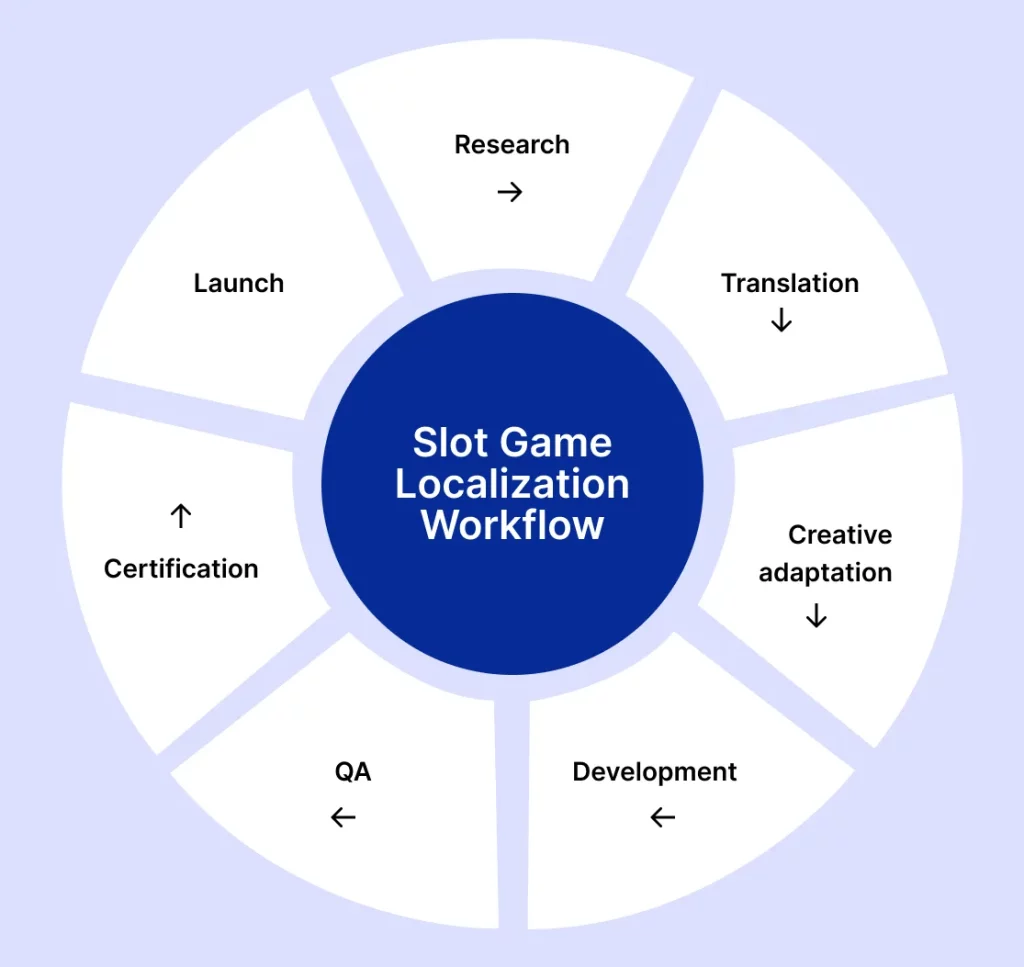
Slot Game Localization Workflow
The slot game localization process also significantly affects the timelines. The process is as follows:
Research → Translation → Creative adaptation → Development → QA → Certification → Launch
Should You Localize an Existing Slot or Build a New One?
Localized slot games are a process of converting the slot game to suit the target market. However, there is always an option to build a new slot game for the specific target market based on the latest information available.
Operators entering a new market generally have two options: localize an existing online slot or develop a new title specifically for that audience. The correct approach depends a lot on the operator’s financial flexibility and the performance of the existing game.
Operators can choose to localize an existing game when:
- The underlying game already performs well
- Mechanics fit the target market
- Technical architecture supports localization
- Only moderate adaptation is required
On the other hand, casino operators can choose to build a new game when:
- The market needs a fundamentally different concept
- Existing content doesn’t fit local preferences
- A strategic market opportunity exists
- Exclusive content is important
Another approach is a hybrid option where operators can adapt proven mechanics with slot game reskinning while creating market-specific themes and features.
Common Slot Game Localization Mistakes
Localizing a slot game involves more than slot game translation, as it involves changing the whole process, including currency, text, login steps, and overall adding new systems. A small mistake in design, compliance, or UX can affect the user experience and can result in an unpleasant player experience. Some of the common mistakes that operators should avoid during localizing slot games include:
Treating translation as localization
Slot game translation is different from localization as it involves cultural references, currencies, visuals, audio, UX patterns, and market-specific requirements.
Using machine translation without expert review
Automated translation may add incorrect translations, terminology, or unnatural phrasing, which may leave a bad impression on users.
Ignoring text expansion
During slot game translation, the original text, after being translated, may take up more space. If the layout is not designed in such a way, it may cause overlapping of words.
Ignoring RTL layouts
Right-to-left layouts are used in languages such as Arabic and Hebrew, which require right-to-left interfaces. If ignored, it may cause an inconsistent or unusable experience.
Assuming the same themes work everywhere
Every theme has its own target market. The themes, symbols, colors, characters, and narratives may have different meanings across markets. The themes also need to be changed as per local requirements.
Ignoring local regulations
One of the most important aspects of slot game localization is complying with local rules and jurisdiction regulations. Operators should not miss this as it may include legal risks.
Changing certified game elements without proper review
Changing game elements such as gameplay logic, mathematical configurations, or RNG-related components without review may cause changes to the slot game mathematics, which can drastically affect user experience.
Forgetting mobile UX
Mobile slot game localization is crucial to ensure that the game is accessible through mobile devices.
Localizing only the game but not the supporting content
The supporting content, such as user guides, game information, or tips, needs to be also localized along with the game titles.
Launching without market testing
Pre-launch reviews, player feedback, usability testing, and controlled market testing are crucial before launching the game in the target market.
Localizing too many games before validating demand
Localizing an entire slot portfolio before understanding market demand can increase unnecessary costs and operational complexity. Know which games have more demand in that market and then initiate localization.
Readers Of This Blog Also Read
Slot Game Localization Checklist
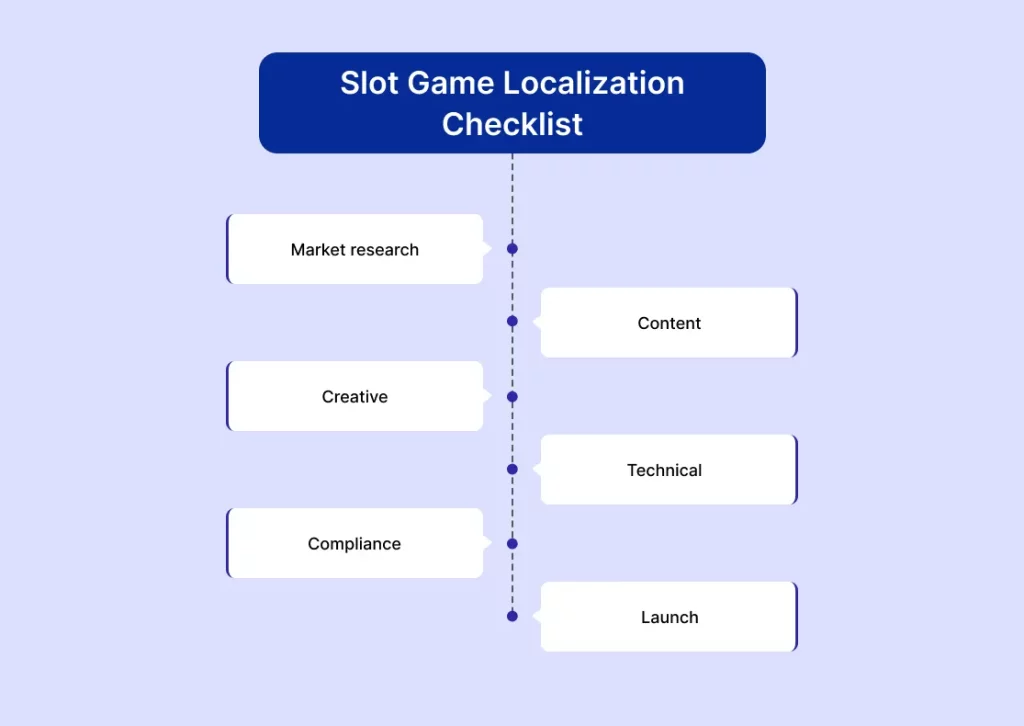
Market research
- Target market identified
- Player preferences analyzed
- Competitors reviewed
- Portfolio gaps identified
Content
- Game text translated
- Paytable localized
- Instructions localized
- Responsible gaming messaging reviewed
Creative
- Themes reviewed
- Symbols reviewed
- Graphics adapted where necessary
- Audio localized
Technical
- Currency
- Number formatting
- Language support
- RTL where required
- Mobile UX
Compliance
- Regulatory requirements reviewed
- Certification completed
- Required disclosures implemented
Launch
- QA completed
- Market testing completed
- Analytics configured
- Performance monitored
How to Measure the Performance of Localized Slot Games?
After launch, operators need to track a range of KPIs, not just revenue. This includes:
Game launches
Track how many games were launched in the target market and each game’s performance.
Active players
Total number of active players for a specific game and for a specific duration.
Sessions
Total session duration spent on a particular slot title.
Bets
Total number of bets placed by players on the slot game after localization.
GGR
Gross gaming revenue is a key indicator of revenue generation after the game is localized.
NGR
Net gaming revenue measures the revenue remaining after applicable deductions such as bonuses, promotional costs, taxes, or other agreed adjustments.
Repeat play
How often players come back for repeat plays.
Retention: Player retention is key to knowing how many players have been retained by the platform after slot game localization.
Conversion
How many users or visitors are converted into customers.
Market-specific performance
Market-specific slot games evaluate how the localized slot performs within the target market.
How does GammaStack Help with Slot Game Localization?
At GammaStack, we build slot game platforms to meet your specific needs of the target market by offering localized slot games that don’t just work in the market but seem like they truly belong. Our casino game localization services enable operators to launch in any market without worrying about the local regulations. At. GammaStack, we combine innate cultural understanding, thorough testing, and smart AI tools to offer solutions that meet your business objectives.
Final Takeaway
Successful slot localization is not about translating a game. It’s about adapting the complete player and operator experience to the target market.
The process is:
Research → Localize → Develop → Test → Certify → Launch → Measure → Optimize
And operators should prioritize markets where:
Player demand + commercial opportunity + regulatory feasibility + portfolio fit
justify the localization investment.
FAQ section on Localized Casino Games
What Is Slot Game Localization?
Slot game localization is the process of adapting an online slot game for a specific market by modifying its language, currency, visuals, audio, UX, and other market-specific elements. It may also include regulatory and technical adaptations required for local deployment.
How Do You Localize an Online Slot Game?
The localization process typically involves researching the target market, deciding localization needs, choosing the localization approach, adapting themes, localizing visuals, currency, reviewing RTP & volatility, and overall adapting to the target market before launch.
What Is Slot Game Translation vs Localization?
Slot game translation converts written content into different languages depending on the local language of the jurisdiction. Localization involves changing the gaming experience and adapting it as per local preferences, including language, currency, cultural references, visuals, audio, UX, and regulatory requirements.
Why Should Casino Operators Localize Slot Games?
Online casino operators should localize slot games for various reasons, including:
- Enter new markets
- Improve player experience
- Increase content relevance
- Improve engagement
- Support multilingual casinos
- Meet market requirements
How Much Does Slot Game Localization Cost?
There is no fixed localization cost because pricing depends on the number of languages, text volume, creative changes, audio, technical development, QA, certification, and the number of games and jurisdictions involved.
How Long Does It Take to Localize a Slot Game?
The timeline depends on factors such as the number of languages, amount of content, visual and audio changes, technical modifications, testing, certification, and target jurisdictions.
Do Localized Slot Games Need to Be Recertified?
It depends on the target market and local jurisdiction laws. The slot game certification process and requirements need to be verified before launching the game.
Should Operators Localize Existing Games or Develop New Games?
Operators entering a new market generally have two options: localize an existing online slot or develop a new title specifically for that audience. The correct approach depends a lot on the operator’s financial flexibility and the performance of the existing game.
What Elements of a Slot Game Should Be Localized?
Common elements include language, paytables, instructions, currency formats, graphics, symbols, animations, audio, navigation, UX, responsible gaming messages, promotional content, and market-specific regulatory information.
India
USA
Malta
Latvia
Let's Work Together. Win Together
Ready to transform your ideas into next-generation solutions? Drop us your details and we’ll get back to you within 48 hours!