⚡ Quick Answer
Slot game certification is the process of independently testing an online slot game’s RNG, RTP, payout logic, math model, security, and responsible gaming features to confirm it meets fairness and regulatory standards before launch. It matters because certification builds player trust, secures regulatory approval, prevents fraud, and is required in most regulated jurisdictions such as Malta, the UK, US, and Canada — without it, a game simply cannot be legally launched. Certification is distinct from licensing: certification verifies the game itself (via independent testing labs), while licensing authorizes the operator’s business to run gambling services (via government regulators). The process runs through 8 steps — development, RNG testing, RTP verification, security testing, compliance audit, certification report, regulatory submission, and market launch — and is typically handled by major labs like GLI, eCOGRA, iTech Labs, or BMM Testlabs. Timelines run roughly 9-22 weeks end-to-end depending on complexity and jurisdiction, and costs vary based on the number of games, target markets, testing scope, and lab chosen, so operators should focus on avoiding common mistakes like incorrect RTP claims, weak documentation, and poor RNG implementation rather than fixating on a fixed price.
🔑 Key Takeaways
- Certification tests 7 core aspects of a slot game: RNG, RTP, payout logic, game mathematics, security controls, software integrity, and responsible gaming features.
- Certification and licensing serve different purposes: certification (issued by independent testing labs) verifies a game’s fairness and technical compliance, while licensing (issued by government regulators) grants legal authorization to operate a gambling business.
- Certification delivers 6 key benefits: player trust, verified fair gameplay, regulatory approval, easier global market expansion, stronger operator reputation, and fraud prevention.
- The certification workflow runs through 8 steps: game development, RNG testing, RTP verification, security testing, compliance audit, certification report, regulatory submission, and market launch.
- 4 major testing labs dominate the space: GLI (broadest global reach across 6 regions), eCOGRA (strong fairness/player-protection reputation), iTech Labs (advanced RNG testing, faster turnaround), and BMM Testlabs (longest track record, broad regulatory acceptance).
- 9 documents are typically required for certification: source code, RNG documentation, RTP report, math model, game rules, security report, technical documentation, game assets, and a compliance checklist.
- The full certification timeline runs approximately 9-22 weeks: development (3-8 weeks), internal QA (1 week), RNG testing (1-2 weeks), lab audit (2-5 weeks), and regulator approval (2-6 weeks).
- Certification cost is driven by 5 factors rather than a fixed fee: number of games being certified, target jurisdiction(s), testing scope, lab selection, and any additional audits or re-certification needs.
- 5 common mistakes operators should avoid: incorrect RTP claims, weak or incomplete documentation, missing jurisdiction-specific compliance features, poor RNG implementation, and incomplete certification reports.
- Re-certification is typically required after major software updates, changes to game mathematics, RNG modifications, or when entering a new regulated jurisdiction — a single certification does not automatically transfer worldwide.
In the regulated iGaming space, regulation is the most vital aspect of casino business. It is not only a legal requirement but also a trust mechanism that protects the players and operators.
Slot game certification ensures that online slot games operate fairly, without any manipulation, and in-accordance of the juisdiction’s compliance standards. This also validates that the games outcomes and payouts are fair and as intended. For operators, certification is not only a regulatory requirement but a business necessity. Certified slot games help secure gaming licenses, operate legally, and build long-term credibility with regulators, partners, and players.
This slot game certification guide covers everything you need to know including slot game certification process, testing standards & bodies, challenges, slot game certification costs, and best regulatory practices to prepare your slot game business before a launch.
What is Slot Game Certification?
Slot game certification is a process of testing and validating online slot games to ensure that they meet the technical, security, fairness, and regulatory standards required by gaming authorities. Dedicated testing authorities does slot game testing on various aspacts of the game, including:
- Random Number Generator (RNG)
- Return to Player (RTP)
- Payout logic
- Slot game mathematics
- Security controls
- Slot game software integrity
- Responsible gaming features
The testing authorities after conducting their tests issue an online slot game certification to the operators who submit it to licensing bodies. This certificate acts as a approval for launching their casino business.
Why Do Regulators Require Slot Game Certification?
Gaming regulators or slot game operators require certification to:
- Verify that the RNG produces truly random outcomes.
- Confirm that RTP and payout calculations match declared values.
- Ensure game rules and bonus features function correctly.
- Validate cybersecurity and data integrity measures.
- Prevent fraud, game manipulation, and software vulnerabilities.
- Protect consumers and promote responsible gambling.
- Maintain compliance with jurisdiction-specific gaming laws.
Slot Game Certification vs. Licensing
| Feature | Slot Game Certification | Slot Licensing |
|---|---|---|
| Purpose | Verifies the fairness, security, and technical compliance of a slot game | Grants legal authorization to operate gambling services |
| Issued By | Independent testing laboratories | Government gaming regulators or licensing authorities |
| Focus | Individual game software and technical systems | Casino operator, platform provider, or gaming business |
| Outcome | Certification report confirming the game meets regulatory standards | Official license permitting gaming operations |
| Evaluation Aspects | RNG, RTP, game mathematics, security, software integrity, and payout logic | Business operations, financial stability, compliance policies, AML/KYC, and responsible gaming |
Why Slot Game Certification is Important?
Online slot game certification is important for several reasons:
Player trust :
Certifies slot games builds players trust as independent testing authorities ensures that outcomes cannot be manipulated.
Fair Gameplay:
Certification verifies that the game’s Random Number Generator (RNG), Return to Player (RTP), and payout mechanics function correctly, ensuring every spin is random, unbiased, and fair.
Regulatory approval :
Most gaming authorities in various jurisdictions require slot game operators to obtain regulatory approval before launch or deployment.
Global market expansion :
Slot game certification allow business with a better chance of entering multiple regulated jurisdictions.
Operator reputation :
Regulated online slot games enhances an operator’s credibility with players, regulators, business partners, and game aggregators.
Fraud prevention :
Certification protects both players and operators from any fraud. This helps identify potential security issues, reduces the risk of fraud.
How Slot Game Certification Works (Step-by-Step)
How are slot games certified? Here is the summary of slot game certification workflow.
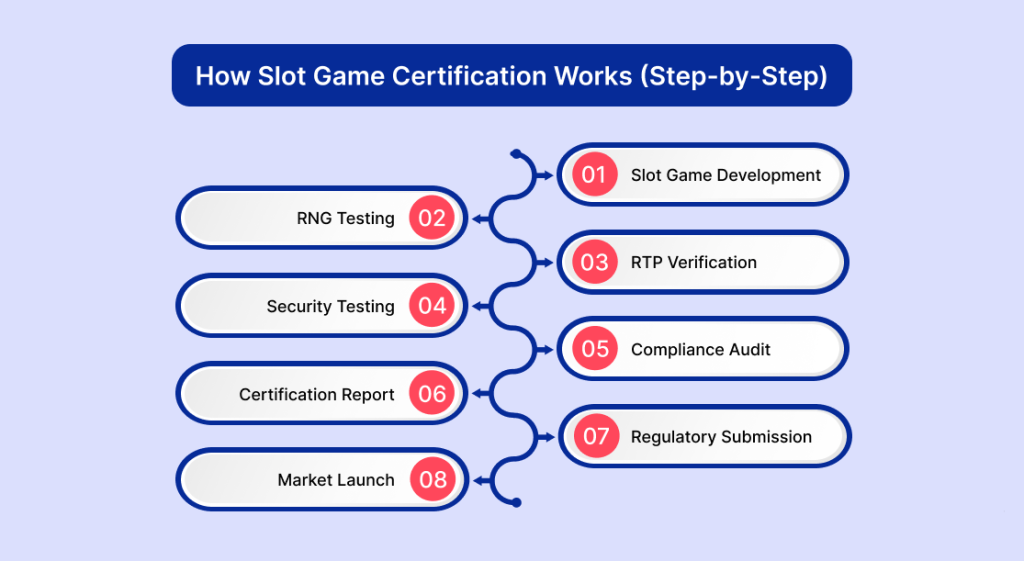
Step 1: Slot Game Development
The process begins with the slot game development the includes building the slot game from scratch. This involves game mechanics, mathematical model, graphics, bonus features, and backend functionality. Slot game developers builds games on random number generator(RNG), define the Return to Player (RTP), customize paylines, and integrate various security features. This is where all basic regulatory requirements are integrated into the working of the slot game mechanics.
Step 2: RNG Testing
Independent testing authorities evaluate the games on random number generator to confirm that every spin is fair and free from any manipulation. They test the working of the games, and outputs through playing it for various rounds, ensuring no patterns or biases exist that could affect gameplay.
Step 3: RTP Verification
Testing agencies verify the game’s actual return to player(RTP) with the one advertised by the operator. By analyzing extensive gameplay simulations, they confirm that payouts align with the mathematical model which allows the fair returns to players in the long run.
Step 4: Security Testing
Security experts ensure that the game’s software is free from vulnerabilities that could compromise fairness or player data. This includes reviewing encryption methods, secure communication protocols, and protecting the system from any type of tampering or hacking.
Step 5: Compliance Audit
Slot game compliance audit is another crucial step in the slot game certification workflow that ensures the game passes the technical standards and regulations of the target jurisdiction by the online casino game testing authorities. Auditors verify compliance on various levels including gaming rules, responsible gaming requirements, payout disclosures, etc.
Step 6: Certification Report
Finally, in this stage of the slot game certification process, after the testing is completed by the authorities, they submit a detailed report. This report summarizes the testing methodology, results, compliance findings, and confirms whether the game meets all required standards.
Step 7: Regulatory Submission
The certification report, technical documentation, and supporting compliance materials are submitted to the relevant gaming regulator or licensing authority. Regulators review the documents and may request additional information or clarification before granting approval to deploy the game.
Step 8: Market Launch
After the slot game certification process is completed, the casino operators can move ahead to launch the product in the approved market. Operators continue to monitor game performance, maintain compliance, and may need to undergo re-certification if they update or integrate any new feature to the game.
Top Slot Game Certification Labs
Who certifies slot games? Top online casino game testing labs include:
| Testing Agency | Overview | Regions Supported | Key Advantages |
|---|---|---|---|
| GLI | One of the world’s leading independent gaming testing and certification laboratories. GLI provides testing, inspection, and compliance services for slot games, online casinos, sportsbooks, lotteries, and gaming platforms. | North America, Europe, Asia-Pacific, Latin America, Africa, Middle East | • Globally recognized by hundreds of regulators<br>• Comprehensive RNG, RTP, and security testing |
| eCOGRA | An internationally respected certification agency focused on online gambling fairness, player protection, and responsible gaming. It is widely trusted by online casino operators and players. | Europe, Africa, selected international markets | • Strong reputation for fairness testing<br>• Independent RNG and RTP verification |
| iTech Labs | A globally accredited testing laboratory specializing in RNG certification, game mathematics, cybersecurity, and regulatory compliance for online gaming products. | Asia-Pacific, Europe, North America, Latin America | • Advanced statistical RNG testing<br>• Faster certification turnaround |
| BMM Testlabs | One of the oldest independent gaming certification organizations offering testing services for slot games, online casinos, lotteries, sportsbooks, and gaming systems. | North America, Europe, Asia-Pacific, Latin America, Africa | • Decades of gaming certification experience<br>• Broad regulatory acceptance worldwide |
Readers Of This Blog Also Read


Documents Required for Slot Game Certification Process
Here is the checklist of documents required in the slot game certification process:
- Source code
- RNG documentation
- RTP report
- Math model
- Game rules
- Security report
- Technical documentation
- Game assets
- Compliance checklist
Slot Game Certification Timeline
How to certify a slot game? Here is the estimated timeline for the same.
| Stage | Estimated Time |
|---|---|
| Development | 3–8 weeks |
| Internal QA | 1 week |
| RNG Testing | 1–2 weeks |
| Lab Audit | 2–5 weeks |
| Regulator Approval | 2–6 weeks |
Slot Game Certification Cost
The cost of slot game certification depends on various factors depending on the complexity of the project and the regulatory requirements of the target market. Instead of focusing on the fixed slot game certification cost, one should focus on the factors that influence the costing. This includes technical, compliance, and operational factors.
| Factors | How It Affects Slot Game Certification Cost |
|---|---|
| Number of Games | Certifying multiple slot games generally increases the overall cost, as each game requires independent testing of its RNG, RTP, game mathematics, bonus features, and software functionality. |
| Jurisdiction | Every regulated market has its own technical standards and compliance requirements. Launching in multiple jurisdictions may increase the overall certification effort. |
| Testing Scope | The broader the testing requirements, the higher the certification cost. Standard testing typically includes RNG validation and RTP verification, while advanced assessments involve deeper levels of testing. |
| Lab Selection | Different testing laboratories have varying certification processes, service offerings, turnaround times, and global recognition. |
| Additional Audits | Major game updates, new features, regulatory changes, or expansion into new markets may require supplementary audits or re-certification. |
Common Certification Mistakes to Avoid By Slot Game Operators
During slot game certification workflow, there are some common mistakes that operators should avoid. Addressing these issues early helps operators achieve faster approvals, reduce rework, and ensure a smoother launch process.
Incorrect RTP -
Validate RTP calculations through extensive simulations before submitting the game for certification.
Weak documentation -
Prepare comprehensive and up-to-date documentation covering game logic, RTP, RNG, security, and payout mechanics.
Missing compliance features -
Review the compliance requirements of each target jurisdiction during development and implement all mandatory features.
Poor RNG implementation -
Use a proven RNG solution and perform internal statistical testing before independent certification.
Incomplete reports -
Verify that all certification reports are complete, accurate, and aligned with regulatory submission requirements before filing.
Slot Game Certification Checklist
✓ RNG Tested
✓ RTP Verified
✓ Security Passed
✓ Responsible Gaming Features
✓ Documentation Complete
✓ Regulatory Submission
How GammaStack Helps in Offering Certified Slot Games?
GammaStack offers the certified slot games build for operators that offers players trust and enhances credibility of the casino platform. GammaStack also offers slot game certification guide for operators to obtain license and regulatory requirements. With more than 14 years in the iGaming industry, GammaStack’s slot game development services ensures slot game compliance with strong game mechanics and intuitive design with regulatory readiness. Top benefits include:
- Certified RNG
- Online casino game testing guidance
- Compliance-ready architecture
- Integration with testing labs
- Documentation support
- Faster launch
- Multi-jurisdiction compatibility
Frequently Asked Questions(FAQs) on Slot Game Certification Guide
How long does slot game certification take?
The slot game certification timeline depends on the game’s complexity, testing scope, and the requirements of the target jurisdiction. Well-prepared games with complete documentation generally complete the process much faster than those requiring revisions or additional testing.
What is RNG certification?
RNG (Random Number Generator) certification verifies that a slot game’s outcomes are truly random, unbiased, and unpredictable.
Who certifies slot games?
Some of the most recognized slot game certification labs include:
- Gaming Laboratories International (GLI)
- eCOGRA
- iTech Labs
- BMM Testlabs
What is GLI certification?
GLI certification is the approval issued by Gaming Laboratories International after a slot game successfully passes its technical, security, RNG, and compliance testing. It is widely accepted by gaming regulators across numerous jurisdictions.
Is slot game certification mandatory?
Yes, in most regulated online slot games markets, certification is mandatory before a slot game can be legally launched. It demonstrates that the game meets fairness, security, and regulatory requirements established by licensing authorities.
How much does slot certification cost?
There is no fixed cost for slot game certification. The overall expense depends on factors such as the number of games, target jurisdictions, testing scope, certification laboratory, and any additional audits or re-certification requirements.
Can one certification work worldwide?
Not always. While certifications from globally recognized laboratories are accepted in many jurisdictions, each regulator has its own approval requirements. Operators may need additional testing or regulatory submissions when expanding into new markets.
What is RTP certification?
RTP (Return to Player) certification confirms that a slot game’s actual payout percentage matches its advertised RTP over a large number of simulated plays. This ensures payout accuracy and compliance with regulatory standards.
How often must slot games be re-certified?
Re-certification is typically required after major software updates, changes to game mathematics, RNG modifications, or when entering a new regulated jurisdiction.
Which jurisdictions require certification?
Most regulated gaming markets require certified slot games before approval. These include jurisdictions such as Malta, the United Kingdom, United States, Canada, Sweden, Romania, Spain, Italy, Denmark, and several other regulated iGaming markets.
The Author