Live betting turns every second of a match into a new opportunity — and into new risk. Bettors who can read momentum, exploit short-lived pricing gaps, and manage their live bankrolls consistently beat those who treat in-play wagering like pre-match guessing. The bettors who understand in-play dynamics are consistently extracting value that pre-match bettors leave on the table.
This guide, written from the perspective of a team that has built live betting technology for 80+ sportsbooks across 45+ countries, covers how live betting works, sport-by-sport strategies, reading momentum shifts, cash-out tactics, in-play bankroll management, and the key mistakes that cost bettors money. We don’t just know what tips work; we know why the odds move the way they do at the platform level.
What Is Live Sports Betting? (In-Play / In-Game Wagering Explained)
Live sports betting (also called in-play betting or in-game wagering) is the practice of placing bets on a sporting event while it is actively in progress. This is the opposite of pre-match betting, which closes before the event starts.
Here is how it works:
- Dynamic Odds: Unlike pre-game odds set days before tipoff, live betting odds update continuously. They react in real-time to goals, red cards, injuries, momentum swings, and weather changes.
- The Bettor’s Edge: Pre-match markets are set by statistical models with no live information. Live markets incorporate new information every second. However, algorithms are not perfect; they sometimes overreact or underreact to in-game events. This creates exploitable pricing gaps for attentive bettors.
- Market Availability: Most sportsbooks suspend markets briefly after major events (goals, touchdowns) to recalculate odds, then reopen them within seconds. Markets are fully closed only at the final whistle.
- Market Variety: Live betting includes the same fundamental types as pre-match – moneyline, point spread, over/under, but they update in real time. It also introduces dozens of micro-markets, such as next corner, next yellow card, and next scoring method. that don’t exist pre-match.
Live Betting vs. Pre-Match Betting — Key Differences
To understand why live betting requires a different skill set, look at how it stacks up against pre-game betting.
| Factor | Pre-Match Betting | Live / In-Play Betting |
|---|---|---|
| When you bet | Before the event starts | While the event is in progress |
| Information | Historical stats, lineups, form | Pre-match data + live match developments |
| Odds movement | Slow, over hours/days | Real-time, every few seconds |
| Decision time | Hours to research | Seconds to minutes |
| Market variety | Standard (moneyline, spread, totals) | Standard + micro-markets |
| Cash-out | Limited or none | Yes – position management in real time |
| Edge type | Research and line value | Momentum reading and odds lag exploitation |
When Does Live Betting Have an Advantage Over Pre-Match?
- Spotting Line Value: When you see a pre-match favorite playing well but trailing, the live odds may offer value.
- Hedging: When a pre-match bet is going wrong, hedging live can create a lock or reduce loss.
- Confirmation: When you need to watch a game to confirm momentum before committing funds.
How Live Betting Odds Work — What Every Bettor Needs to Understand
You cannot beat the system if you don’t know how it works. Here is the technology driving the numbers on your screen.
The Role of Algorithms in Live Odds
Modern sportsbooks use automated trading algorithms (bots) that ingest live data feeds—ball position, shot attempts, possession stats, speed, and fatigue indicators. These algorithms recalculate odds in real time based on probability weighting. They are not watching with human intuition; they are processing data points. This creates opportunity: algorithms sometimes overreact to a single event, for example, a yellow card triggers a sharp odds shift, or underreact, such as a goalkeeper is visibly struggling, but the odds haven’t moved yet.
Why Odds Get Suspended During Live Events
When a major event occurs, such as a goal, a red card, or an injury, the algorithm briefly suspends the market to recalculate from the new baseline. Suspension lasts milliseconds to several seconds. A slow platform suspends wagering for 10–30 seconds, preventing traders from acting at the most opportune moment. Platform speed matters.
Understanding Live Odds Lag
Odds lag is the brief window between when an in-game event happens and when the algorithm fully reprices the market. In fast sports like basketball or tennis, this lag can be exploited. If you spot a key development before the algorithm reflects it, you can get value odds.
Expert Tips and Strategies for In-Game Wagering
Here are the actionable strategies for successful live betting that set winning live bettors apart.
Tip 1 — Watch the Game Live
This sounds obvious, but it is the fundamental discipline: never place a live bet based solely on the scoreboard. The score doesn’t tell the story. A team losing 0-1 in football could be dominating possession 75%–25% with 12 shots on target. The algorithm knows the score, but the odds may not have fully corrected for the likely direction.
What to watch for: Key events such as momentum runs, physical mismatches, goalkeeper confidence, team shape, and substitution patterns.
Key indicators: Shot count, corner count, possession percentage, and the physical pace of the game.
Tip 2 — Bet Into Momentum, Not Against It
Momentum means one team is currently controlling the game’s dynamics: winning duels, creating chances, and dictating tempo, regardless of the score.
The Strategy: When momentum shifts, the algorithm will reflect it soon. The edge is identifying the shift slightly before the odds fully move.
Football Application: A team concedes a goal and then dominates the next 10 minutes. The algorithm priced the trailing team’s moneyline higher after the goal, but the live match tells you they are the better side.
Basketball Application: If Team A goes on a 12-0 run, the spreads shift sharply. But if the run started from unforced errors, the other team won’t repeat, the shift may have overshot.
Tip 3 — Understand the “Favourites Drifting” Opportunity
One of the most consistent value patterns: a pre-match favourite falls behind early, and its live odds lengthen significantly, often beyond what the probability warrants. Live algorithms heavily weight the score. If a superior team is 0-1 down after 15 minutes, the live market may offer them at 3.50 (implied 28.6%) when their actual win probability remains above 45%.
Tip 4 — Master the Cash-Out Feature Strategically
Cash-out allows you to settle a bet early at the current market value. It is a risk management tool, not a profit button.
- Full Cash-out: Exit the position completely.
- Partial Cash-out: Secure some profit while leaving the rest to run.
When to Cash Out?
- Smart: Your team is winning 2-0 in the 80th minute, but the opposition just put their best scorer on the field.
- Value Leak: You are 1-0 up at halftime with a dominant performance. The sportsbook’s offer is usually slightly below the fair mathematical value.
Tip 5 — Line Shop Across Multiple Sportsbooks in Real Time
Sportsbooks use different algorithms and data providers, so their live odds vary. In fast-moving markets, price discrepancies of 0.15–0.30 odds points are common in the seconds after a major event. Keep 2–3 apps open and check the best price.
Tip 6 — Exploit Total Goals/Over-Under Markets in Key Game Phases
Live totals are often mispriced after an unusual first half. Example: goalless first half in a match expected to be high scoring — second-half over lines can offer value if the underlying chance creation supports it.
Tip 7 — Use Pre-Match Research as Your Live Betting Foundation
Bettors who watch cold are at a disadvantage. Your pre-match checklist should include:
- Head-to-head history and recent form
- Key absences or returns
- Tactical formations and known weaknesses
- Second-half performance stats vs. first-half
This context helps you tell whether a live shift is genuine or momentary noise.
Tip 8 — Bankroll Management Specifically for Live Betting
Live betting creates a psychologically intense environment. Decisions are fast, and emotions run high.
- Separate Bankrolls: Allocate a separate live betting bankroll from your pre-match funds. A common split is 60% pre-match, 40% live.
- Unit Sizing: Keep live bet unit sizes at 1–3% of your total live bankroll per bet. Never more.
- The No-Chasing Rule: The game does not owe you a recovery. Each live bet should be evaluated on its own merits.
- The Session Limit: Set a maximum live betting spend per session. When you hit it, close the app.
Tip 9 — Leverage Live Player Props
Live player props are often the least efficiently priced markets because algorithms focus on game-level outcomes.
Key live prop opportunities:
- Anytime Scorer (Football/Soccer): When a striker who didn’t score pre-match creates good chances in-game, the live market often lags.
- Over/Under Shot Attempts (Basketball/Football): A player on a hot shooting night has live props that may not have adjusted.
- First Set Winner (Tennis): Valuable when a player who lost the first set takes a sharp lead in the second, the live odds for the match winner often lag.
Tip 10 — Know When Not to Bet Live
Discipline is also about identifying when not to bet.
- Avoid live betting when the odds are moving too fast for you to process.
- Avoid it when you have no pre-match research context.
- Avoid it if you are betting out of boredom rather than conviction.
Live Betting Strategies by Sport — Sport-Specific In-Play Tips
Different sports require different lenses. Here is how to approach the major leagues.
Live Football/Soccer Betting Tips
- The Golden Window: The first 15 minutes are when the algorithm is most uncertain and live value is most available.
- Red Card Strategy: The market overreacts to red cards. A defensive player sent off in the 85th minute matters less than an attacker sent off in the 30th.
- Corner Markets: Teams that generate high corner counts in the first half tend to maintain that pattern. Live corner totals that don’t reflect first-half trajectory are often underpriced.
Live Basketball Betting Tips
Basketball offers the most frequent opportunities due to constant scoring.
- The Momentum Run: NBA games feature 8–15 point runs. Bettors who identify the start of a run can bet live spreads before the market fully adjusts.
- Foul Trouble: When a key player picks up their 4th foul early, the live moneyline often doesn’t fully reflect the minutes reduction.
- Quarter Betting: Quarter lines are less efficiently priced than full-game lines because algorithms devote less priority to them.
Live Tennis Betting Tips
Tennis is considered highly exploitable for live bettors due to granular data.
- The Serving Pattern: A player who holds serve easily in the first set is likely to continue. If they are behind, their live odds may be inflated.
- Break of Serve Overreaction: When a player loses serve, odds shift sharply. However, elite players often break back immediately.
- Physical Tells: A player requesting medical timeouts carries retirement risk; the algorithm doesn’t price this well.
Live American Football (NFL) Betting Tips
- Halftime Live Totals: The most consistent value is in halftime adjustments. Coaches with strong adjustment track records create second-half scoring patterns that differ from the first.
- Turnover Adjustment: Teams with two first-half turnovers often see their live moneyline priced too low. Turnover luck doesn’t reliably predict second-half rates.
Live Cricket Betting Tips
- Run Rate Strategy: When a batting team’s required run rate climbs to a difficult level (9–12 runs per over), the live odds often underweight the volatility of T20 scoring.
- Wicket Overreaction: The fall of a key wicket causes sharp odds movement. If the incoming batter has a strong high-pressure record, the market move may overshoot.
Live Betting Market Types Explained
Understanding the tools available to you is half the battle.
Live Moneyline / Match Odds
A real-time bet on who wins outright.
Live Point Spread / Handicap
Betting on the margin of victory, adjusted in real-time.
Live Totals (Over/Under)
Wagering on whether total points will exceed or fall short of the live line.
Live Next Score / Next Event Markets
Micro-markets like next team to score, next player to score, or next corner.
Live Player Props
Real-time player-specific wagering, such as passing yards, shot attempts.
Live Parlays / Accumulators
Combining two or more live markets into a single bet.
Live Totals — Period / Quarter / Half Betting
This is betting on a specific game segment, often less efficiently priced.
Readers Of This Blog Also Read
Common Live Betting Mistakes to Avoid
Live betting’s fast pace separates the profitable from the casual. Avoid these specific pitfalls to protect your bankroll.
Mistake 1 — Betting Without Watching the Game
Placing a bet based solely on a scoreline you see on an app. You miss the context: the goalkeeper who looks nervous, the key player limping, or the team that is dominating possession despite being down a goal.
The Fix: Have the live game on a second screen. If you can’t watch, you shouldn’t be betting. As the game unfolds, your eyes catch the micro-shifts in momentum that the algorithm’s data feed might lag on.
Mistake 2 — Chasing Losses in Real Time
You lose a pre-match bet, so you jump into the live market during the same game trying to win it back. This is the fastest way to tilt. You are no longer betting with logic; you are betting with frustration.
The Fix: A pre-match loss is a sunk cost. It has zero connection to the next live market. Treat your live bankroll as a completely separate entity. If you lost pre-match, close the app for 15 minutes. Do not let one loss become five.
Mistake 3 — Over-Trading (Betting on Every Market)
Live betting offers dozens of micro-markets, such as next corner, next yellow card, etc. The action is constant, and the temptation is to bet just to stay in the game. This dilutes your focus and increases the volume of low-quality bets.
The Fix: Adopt a sniper mentality, not a machine-gun mentality. Before the game, identify 2-3 specific scenarios where you have an edge (e.g., “If Team X concedes first but dominates possession, I bet the moneyline”). Only bet when those specific triggers are pulled.
Mistake 4 — Ignoring Suspended Markets as Signals
You see, the market is suspended and just waits impatiently for it to reopen so you can place your pre-planned bet.
The Fix: View a suspension as a news flash. It means a goal, red card, or injury just happened. In the 2-3 seconds before the market reopens, ask yourself: “Did the algorithm overreact to this?” If a star player is stretchered off, the shift is correct. If a defensive player gets a soft yellow card, the shift might be an overreaction you can exploit.
Mistake 5 — Relying Solely on Statistics Without Context
You see a team has 65% possession and assume they are dominating, so you back them. But they have zero shots on target, which means they are struggling to penetrate, not dominating.
The Fix: Stats are a starting point, not the finish line. Combine the data with visual confirmation. High possession without shots is sterile. High pressure without fouls is aggressive. Read the “how” behind the numbers.
Mistake 6 — Using Cash-Out Too Early Out of Anxiety
Your team is up 1-0 at halftime. You are nervous. The sportsbook offers you 80% of your potential winnings. You take it, locking in a profit. The other team never even threatens in the second half.
The Fix: Distinguish between anxiety and actual danger. If the momentum is still with your team, you are paying the sportsbook a cash-out margin to relieve your anxiety, not to manage risk. Cash out only when the game situation has fundamentally changed, such as a red card or a key injury, not just because you are scared to wait.
The Technology Behind Live Betting — What Operators Build
Every tip in this guide depends on one thing: a fast, reliable live betting platform. From an operator’s perspective, building this is one of the most technically demanding challenges in iGaming.
- Real-time odds feeds: GammaStack’s sportsbook platform integrates with Betradar and Lsports, delivering sub-500ms odds updates across 80,000+ live events per month.
- Market suspension logic: GammaStack’s platform is built to minimize suspension windows because every second a market is suspended is a betting opportunity lost.
- Cash-out engine: GammaStack’s engine recalculates fair value positions across all open bets within milliseconds, integrating with leading data providers to ensure accuracy.
- Risk management in-play: Live markets require real-time exposure monitoring. GammaStack’s system monitors live position concentrations and triggers automated hedging when thresholds are breached.
Advantages of Live Betting — Updated and Expanded
Still wondering if live betting is worth your time? Here is why thousands of bettors are making the switch from pre-game wagering—and why operators are prioritizing their in-play platforms.
Dramatically More Betting Markets Per Event
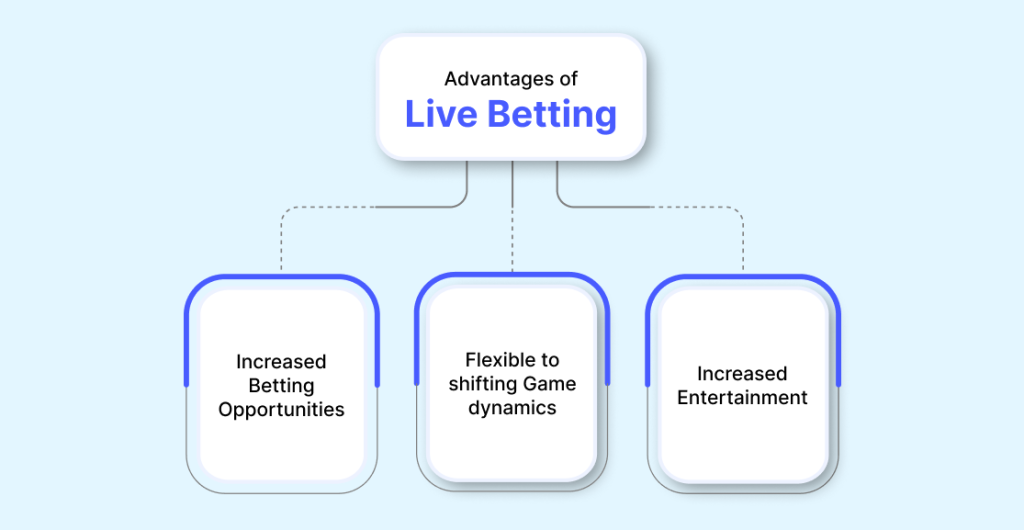
Imagine walking into a store with 40 items on the shelves, then walking into another with 300. That is the difference between pre-match and live betting. A single Premier League match typically offers 40–50 pre-match markets. The same game unfolding in real time generates 150–300 live market events. We are talking about micro-markets like the next corner kick, the next yellow card, or which player scores next. These in-game opportunities simply do not exist before kickoff. You cannot replicate this variety anywhere else.
Better Odds Through Information Advantage
Here is a truth that separates winners from the rest: live bettors who watch the game have information that algorithms miss. It can not feel that the game flow is shifting. This gap between what you observe and what the algorithm knows creates pricing gaps.
Flexible Strategy — Hedge, Trade, and Adapt
Pre-match betting is a one-way street. You place your bet, and you wait. That is it. Live betting gives you options. You can hedge when the game situation changes. You can cash out early to lock in profit or cut losses. You can even double down when momentum swings your way. This flexibility means you are not a passive spectator; you are actively managing your position. Whether the win probability shifts in your favor or against it, you have tools to respond.
Reaction to Late News (Team Changes, Tactical Switches)
You know the frustration. You place a bet 24 hours early. Then, 10 minutes before kickoff, your star striker is dropped, or the weather turns ugly. Pre-match bettors are stuck. Live bettors adapt. Live markets let you react immediately.
Enhanced Match Engagement
Live bettors show 3–5× higher session length than pre-match-only bettors. That means more time spent on the platform, more excitement, and a deeper connection to the action. For bettors, it transforms a casual viewing experience into something electric. You are not just watching history; you are participating in it.
Responsible Gambling in Live Betting
Live betting creates an accelerated decision environment. The same features that make it exciting can lead to problem gambling behaviours faster than pre-match betting.
- Use the tools: Deposit limits, session time limits, and loss limits are available in licensed accounts.
- The 24-hour cooling off: If you find yourself placing bets you wouldn’t normally place, use the self-exclusion feature.
- Get help: If gambling becomes a problem, resources are available at BeGambleAware (UK), GamCare (UK), NCPG (US National Council on Problem Gambling), and GamblersAnonymous internationally.
GammaStack: Reliable Sportsbook Software Development Company
GammaStack is backed by 14+ years of expertise in the iGaming industry, now recognized as one of the renowned sports betting software development company. We provide you with a fully compliant, feature-rich software solution with real-time betting odds configuration as well as real-time betting. Gain access to a quick market entry advantage through our white-label or turnkey software solutions, as well as a fully customized platform with our bespoke solution as per your requirements.
FAQs — Live Sports Betting Tips and In-Game Wagering
What is live sports betting, and how does it work?
It is placing bets on a game while it is in progress. Odds update in real-time based on events like goals, injury reports, and momentum shifts.
What is the best sport for live / in-play betting?
Tennis and basketball are often cited because of their frequent scoring and data points, but football/soccer has the highest volume and frequent momentum swings, making it popular among most bettors.
Can you make consistent money from live betting?
Yes, but it requires discipline, research, and a focus on value rather than action. It is skill-dependent, not luck-dependent.
What does “suspended” mean in live betting?
It means a major event has occurred, and the algorithm is temporarily pausing to recalculate the odds.
How do bookmakers calculate live odds so quickly?
They use automated algorithms fed by real-time data providers like Sportradar and Betradar, processing thousands of real-time event data points per second.
What is the best live betting strategy for beginners?
Start with one simple rule: watch the game before you place a single bet. Beginners often jump into live markets based on the score alone, which is the fastest way to lose money. Instead, pick a sport you already understand, open a live stream, and just observe for 10–15 minutes. Watch how the game flow develops. Once you have a feel for the game, start with tiny stakes on simple markets like the next team to score. The goal is not to win big immediately—it is to learn how live odds move in response to real-time events without risking your bankroll.
When should I cash out a live bet?
Cash out when the risk profile has changed and implied probabilities have shifted, but not out of fear. Avoid cashing out early if the bet is still fundamentally sound.
What is odds lag in live betting?
It is the delay between a real-life event happening and the odds fully updating. Bettors who spot events early can exploit this lag.
Is live betting legal in the USA?
Yes, over 35 states have legalized sports betting, though specific restrictions that vary by state law and regulations.
How do I manage my bankroll for live betting?
Use a separate bankroll from pre-match funds. Stake only 1-3% per bet and set a strict session loss limit.
What is the momentum strategy in live betting?
It involves identifying when a team is playing better than the score indicates and betting on them before the odds adjust to reflect their true performance level.
What shall be the minimum bet amount to place in a live sports betting event?
There is no minimum number or rule to place a bet amount on live events. Considering the highest risk factor, it is always advisable to start small and place a minimal bet, so if you lose it by any chance, that loss is affordable and doesn’t impact your finances.
What are the best in-game betting strategies?
Some of the best betting strategies for live betting are monitoring the game closely, cashing out on time to avoid heavy losses, avoiding betting emotionally, avoiding placing bets impulsively, chasing losses, and setting a bankroll and adding a limit to it.
What is the best live betting strategy for football/soccer?
The golden rule in football is to bet on momentum, not the scoreboard. Another solid approach is to watch the first 15 minutes without betting. This is when the algorithm calibrates itself against pre-game expectations. After that window, if a favorite is struggling or an underdog is surprisingly sharp, you can find favorable odds before the market fully adjusts.
What is the best live betting strategy for tennis?
Tennis is unique because every point resets the game state. The most reliable edge comes from tracking serving efficiency. If a player is holding serve easily—hitting 70%+ first serves and winning quick games—but they are down a break, their live moneyline will often be priced too low. The algorithm sees the scoreboard deficit, but you see the serving dominance.
The Author