Moving to a new casino platform can improve technology, performance, game portfolio, integrations, scalability, analytics, and player experience. But slot game migration also carries risks: downtime, lost player data, broken integrations, missing game history, login issues, wallet problems, poor player experience, and player churn. To a player, the platform is invisible when a login fails or a balance looks wrong. For some, that’s enough to leave.
That’s why migration takes more than moving slot games. It’s usually part of a wider casino platform migration. This step-by-step migration framework helps you reduce disruption and keep your players through the change.
What Is Slot Game Migration?
Slot game migration involves shifting an operator’s existing slot portfolio to a different casino platform. The process also requires planning how player accounts, funds, transaction details, game records, and connected services will function after the move. The goal is to make the transition without disrupting essential player and platform operations.
The migration process typically covers
- Moving Games: Reintegrating existing slot titles and ensuring they launch and function correctly on the new platform.
- Moving Player Accounts: Transferring player profiles, account IDs, statuses, and preferences.
- Moving Wallet Data: Migrating balances, deposits, withdrawals, and transaction records accurately.
- Moving Game History: Preserving relevant records of bets, wins, game rounds, and player sessions.
- Reconnecting APIs: Configuring game, wallet, authentication, and other API connections to work with the new platform.
- Reconfiguring Bonuses: Transferring active bonuses, free spins, loyalty points, and rewards where supported.
- Reintegrating Third-Party Services: Reconnecting payment gateways, PAM, CRM, analytics, and other connected services.
An important distinction: Slot game migration is usually part of a broader casino platform migration. While game migration focuses on the slot portfolio and its integrations, platform migration can also involve player data, wallets, payment systems, backend infrastructure, and other operational components. The exact migration scope depends on the source and destination platforms.
Why Do Operators Migrate to a New Casino Platform?
Operators consider a casino platform change when their current system no longer meets their needs. Better performance, more games, improved integrations, and market expansion are common reasons to plan a casino platform migration.
Better Technology
An outdated platform can limit performance and make it difficult to handle growing player activity. Moving to a modern platform gives operators access to improved infrastructure, better scalability, and more consistent performance. It also provides a stronger foundation for future upgrades and business expansion.
More Game Content
A wider game portfolio gives operators more options to meet player preferences. Migrating casino games to a new platform with access to new providers, game aggregators, and exclusive titles makes it easier to expand the available selection. Operators can also migrate slot games while maintaining access to their preferred game providers as per their provider agreements.
Better Integrations
Disconnected or limited integrations can create operational challenges. A new platform can offer better casino platform integration with essential services, including:
- Player Account Management (PAM)
- Customer Relationship Management (CRM)
- Payment gateways
- Analytics and reporting tools
- Affiliate management systems
These connections help operators manage player activity, payments, marketing, and reporting from a more integrated setup.
Market Expansion
Entering new markets requires a platform that can support different operational and localization requirements. Operators may choose slot game platform migration to access features such as multi-currency support, multiple languages, and integrations suited to their target jurisdictions. This makes it easier to adapt the casino experience as the business expands.
Better Player Experience
Player experience is another major reason to consider a platform migration. Slow-loading games, poor mobile compatibility, and inconsistent navigation can affect player satisfaction. A new platform with mobile-optimized interfaces, faster game loading, and improved user experience can help address these issues and support player retention during migration.
What Can Go Wrong During Slot Game Migration?
Poorly planned slot game migration can disrupt platform operations and player experience. Issues with APIs, player accounts, wallets, and third-party integrations can cause problems even after games are moved. Here are the key risks operators should consider.
Game Availability Issues
Some slot games may not be available on the new platform due to provider agreements, compatibility issues, or incomplete integrations. Operators should confirm game availability and provider support before starting the migration.
Broken APIs and Integrations
The new platform may handle API connections differently from the existing system. Incorrect configurations or missing dependencies can affect game launches, wallet communication, authentication, and other connected services.
Incorrect Game Configuration
Game settings such as betting limits, currencies, game versions, and bonus configurations may not transfer correctly. These differences can affect how games function after migration.
Missing Player Data
Incomplete player data migration can result in missing account details, preferences, or player records. This may create login difficulties and force players through additional verification or registration steps.
Wallet Discrepancies
Incorrect balance transfers or incomplete transaction records can lead to differences between old and new wallet data. Operators must verify balances, deposits, withdrawals, and transaction histories before going live.
Lost Game History
If game records are not transferred or retained properly, players may lose access to their previous bets, wins, rounds, or session history. This can also make transaction reviews and dispute resolution more difficult.
Bonus and Loyalty Issues
Active bonuses, free spins, loyalty points, and rewards may not carry over as expected. Operators need to check which promotions can be migrated and ensure eligible player rewards are handled correctly.
Authentication Problems
Differences in login systems, player IDs, or session handling can prevent existing players from accessing their accounts. This can lead to support requests and frustration during the transition.
Migration Downtime
Unplanned downtime can temporarily prevent players from logging in, accessing games, or making transactions. Without a controlled migration window and clear communication, even a short interruption can affect player trust.
Performance Problems
The new platform may behave differently under real player traffic. Slow game loading, delayed responses, or server issues can affect gameplay, particularly when the platform handles multiple providers and integrations.
Tracking and Reporting Failures
Analytics, affiliate tracking, and reporting integrations may stop recording data correctly after migration. This can leave operators with incomplete information about player activity, acquisition, and platform performance.
Player Confusion
Changes to login processes, navigation, game availability, or account features can confuse existing players. Without clear communication and support, these changes may lead to complaints or player churn.
Why does migration planning matter?
Moving slot games involves more than transferring titles. A solid casino game migration strategy should cover player data, wallets, APIs, bonuses, and integrations, backed by proper testing, backups, and a rollback plan. This helps catch problems early and makes the transition easier for players.
What Data Needs to Be Migrated?
When moving to a new casino platform, operators need to consider more than game data. Player accounts, wallet balances, transaction records, bonuses, and responsible gaming information may also need to be transferred.
Player Account Data
Player account data helps existing users continue accessing their accounts without unnecessary re-registration. Operators should identify which account details need to be transferred, including:
- Player account information
- Player IDs and unique identifiers
- Account status
- Player preferences
Wallet & Transaction Data
Accurate wallet migration is essential to maintain player balances and transaction records. Operators should account for:
- Available wallet balances
- Deposit records
- Withdrawal records
- Transaction history
These records should be validated against the source platform to identify any discrepancies before launch.
Game Data
Game data helps maintain continuity in player activity and historical records. Depending on platform capabilities, migration may include:
- Game history
- Betting records
- Win records
- Game sessions
- Player activity
Bonus & Loyalty Data
Active promotions and loyalty benefits should also be reviewed before migration. Operators may need to transfer:
- Active bonuses
- Free spins
- Loyalty points
- Unclaimed rewards
They should also verify how existing bonus terms and eligibility rules will work on the new platform.
Responsible Gaming Data
Responsible gaming records are important for maintaining player protection measures across platforms. Depending on the jurisdiction and system architecture, operators may need to migrate:
- Player limits
- Self-exclusion status
- Relevant player protection records
These records should be handled carefully to ensure applicable player protection measures remain in place after migration.
How to Prepare for a Slot Game Migration
Before starting a slot game migration, operators should review their existing platform, identify migration requirements, and plan each stage. Proper preparation helps avoid missed dependencies and keeps the transition on track.
Audit Your Existing Platform
Start by reviewing your current casino platform to understand what needs to move and what needs to be reconfigured. Document all the essential components, including:
- Existing slot games and providers
- Game APIs and integrations
- Player account data
- Wallet and transaction systems
- Bonuses and promotions
- Analytics and reporting tools
This audit helps identify dependencies and gives your migration team a clear view of the existing setup.
Create a Migration Inventory
Prepare a detailed inventory of the games and services involved in the migration. Separate active games from outdated or discontinued titles, and record their versions and dependencies. Your inventory should include:
- Active and deprecated games
- Game providers
- Game versions
- Existing integrations
- Technical dependencies
A complete inventory helps prevent missed games, incomplete integrations, and configuration issues during migration.
Define Migration Requirements
Set clear requirements for the new platform before moving any data or integrations. Consider the following areas:
- Data requirements: Identify the player, wallet, transaction, and game records that need to be migrated.
- Technical requirements: Define API compatibility, integration needs, and platform specifications.
- Business requirements: Identify game portfolio, operational, and player experience expectations.
- Regulatory requirements: Review applicable data handling, player protection, and jurisdiction-specific obligations.
Clear requirements help align the migration scope with your operational and business needs.
Create a Migration Timeline
Break the migration into manageable stages, so teams know what needs to happen and when. A typical timeline includes:
Planning
Finalize the scope, requirements, and migration strategy.
Development
Configure the new platform and required integrations.
Testing
Validate games, APIs, player data, and wallet operations.
Pilot
Test the migration with a limited group of players or selected games.
Cutover
Move to the new platform using a controlled migration window.
Monitoring
Track platform performance, game availability, and player activity after launch.
A well-defined timeline keeps teams aligned and makes it easier to track progress throughout the migration.
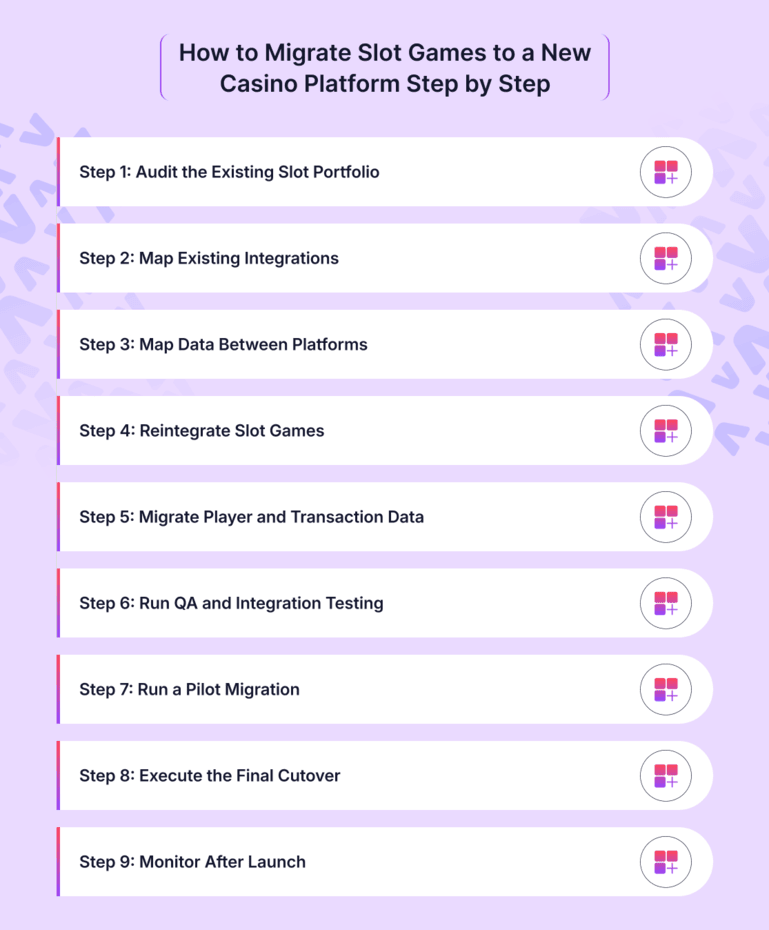
How to Migrate Slot Games to a New Casino Platform Step by Step
A successful online casino migration requires careful planning across games, integrations, player data, and platform operations. Moving everything at once without proper checks can lead to errors and disrupt players. Follow these nine steps to make the transition more manageable.
Step 1: Audit the Existing Slot Portfolio
Start by reviewing your existing slot game portfolio. Identify which games need to move to the new platform and which ones can be retired. Check game providers, versions, availability, and configurations. This helps define the migration scope and avoid unnecessary work.
Step 2: Map Existing Integrations
List all services connected to your current casino platform and identify what needs to be reconnected or configured. Pay particular attention to slot game API integration and other third-party connections, including:
- Game APIs and aggregators
- Player Account Management (PAM)
- Wallet systems
- Customer Relationship Management (CRM)
- Payment gateways
- Analytics and reporting tools
Review the requirements for each casino game integration to avoid connection issues after migration.
Step 3: Map Data Between Platforms
Review how the old and new platforms store player and game information. Plan the slot game data migration by mapping corresponding data fields, account IDs, transaction references, and other identifiers. Check differences in data formats and the new platform’s requirements before transferring records. This is also an important part of casino backend migration.
Step 4: Reintegrate Slot Games
Connect the selected slot games to the new platform and configure their essential functions. Check the following:
- Game launch: Ensure games open correctly from the casino lobby.
- Session handling: Verify that player sessions are created and maintained correctly.
- Wallet communication: Check that bets and wins are reflected accurately in player balances.
- Game rounds: Ensure game rounds and results are recorded correctly.
- Authentication: Confirm that player login and session requirements work as expected.
Proper slot software migration ensures that games and their connected functions work correctly on the new platform.
Step 5: Migrate Player and Transaction Data
Complete the required casino player migration by transferring player accounts and transaction records to the new platform. Validate:
- Player accounts and IDs
- Wallet balances
- Deposit and withdrawal records
- Transaction history
- Game history
- Active bonuses and rewards
Compare migrated records with the source platform to identify missing information or discrepancies before launch.
Step 6: Run QA and Integration Testing
Thorough casino migration testing helps identify issues before players access the new platform. Test the games and connected services across different devices and scenarios.
- Game loading and launch
- Spins and win calculations
- Bonuses and free spins
- Wallet balance updates
- Mobile and desktop compatibility
- API responses and error handling
Check that all essential functions work together, not just that the games launch successfully.
Step 7: Run a Pilot Migration
Before moving the entire game portfolio, start with a limited group of games, providers, or players. Monitor game performance, wallet updates, login functionality, and integrations during this phase. A pilot helps identify casino migration risks in a controlled environment and gives your team time to resolve issues before the full migration.
Step 8: Execute the Final Cutover
Once testing and pilot migration are complete, schedule the final move to the new platform. Choose a suitable migration window to minimize casino migration downtime and communicate any expected service interruptions to players. Ensure that data backups are available and keep a clear rollback plan ready in case critical issues arise.
Step 9: Monitor After Launch
Migration doesn’t end when the new platform goes live. Monitor its performance closely and address issues as they appear. Pay attention to:
- Game errors and availability
- Player login failures
- Deposits and withdrawals
- Game sessions
- Player complaints and support requests
- Player retention
- Revenue and reporting
Regular monitoring helps identify problems early and supports player retention during migration by ensuring players can access their accounts, balances, and games without unnecessary disruption.
How to Prevent Player Loss During a Casino Platform Migration
A casino platform change can disrupt player access, balances, and game history, leading to frustration and churn. Plan your casino software migration carefully to keep essential services accessible and reduce player loss. Here are six ways to do it.
Minimize Downtime
Plan the migration during lower-traffic periods to reduce interruptions to gameplay and account access. Prepare the new platform in advance, test essential functions, and keep a rollback plan ready to address unexpected issues.
Preserve Player Accounts
Make it easy for existing players to continue using their accounts. Migrate account information and player IDs wherever supported, and avoid unnecessary re-registration or complicated login processes.
Preserve Balances and Game History
Ensure slot game data migration covers relevant game records alongside player wallet balances and transaction history, wherever technically and legally possible. Verify the migrated records against the source platform to avoid discrepancies that could lead to player complaints.
Communicate Before Migration
Inform players about the upcoming changes before the migration begins. Clearly explain:
- What is changing on the platform
- When the migration will take place
- Whether players need to take any action
- What will happen to their existing balances
- How they can access their accounts afterward
Clear communication helps players understand what to expect and reduces confusion during the transition.
Make the New Experience Familiar
Avoid changing the entire gaming experience at once. Keep familiar navigation, account access, and key platform features wherever possible. This helps existing players adjust to the new platform without having to learn everything again.
Provide Support During the Transition
Make customer support easily accessible throughout the migration. Ensure your team can handle common player concerns, including:
- Login and account access problems
- Missing or incorrect balances
- Game history queries
- Bonus and free spin issues
- Deposit and withdrawal problems
Quick support helps resolve player concerns before they turn into reasons to leave.
How to Test Slot Games Before Going Live on the New Platform
Use this casino migration checklist to test slot games, platform integrations, performance, and migrated data before launch. These checks help identify issues early and ensure the new platform is ready for players.
Functional Testing
- Verify that all slot games launch without errors.
- Check that spins work correctly.
- Confirm that wins are calculated and recorded accurately.
- Test bonus triggers and bonus rounds.
- Verify that free spins work as configured.
- Check jackpot triggers, updates, and payouts.
Integration Testing
- Confirm that PAM manages player accounts and sessions correctly.
- Verify that wallet balances update accurately after bets and wins.
- Test payment processing and transaction updates.
- Check that CRM receives relevant player activity.
- Verify that analytics records game activity and performance.
- Confirm that the game aggregator connects and transfers game data correctly.
Compatibility Testing
- Test games on desktop devices.
- Test games on mobile devices.
- Check compatibility across supported browsers.
- Verify that game interfaces display correctly on different screen sizes.
Performance Testing
- Measure game loading times.
- Test performance with expected concurrent player volumes.
- Check API response times and error handling.
- Monitor server stability under expected traffic.
Data Validation
- Compare migrated player balances with source platform records.
- Verify transaction records, including deposits, withdrawals, bets, and wins.
- Confirm that player IDs are mapped correctly.
- Check that relevant game history is transferred accurately.
How to Run a Phased Slot Game Migration
Moving all games and players at once can make migration harder to manage. A phased approach lets operators move in stages, test each step, and fix issues before completing the migration.
Five Phases of Slot Game Migration
Phase 1: Internal Testing
Start by testing the new platform internally. Check game functionality, integrations, player accounts, wallet transactions, and performance before involving real players.
Move a small group of players to the new platform. Monitor login access, game availability, balances, and overall experience to identify issues in a controlled environment.
Migrate selected slot games or providers first. Check game launches, API connections, configurations, and wallet communication before expanding the game portfolio.
Gradually move more players to the new platform. Monitor platform performance, player activity, transaction accuracy, and support requests as migration expands.
Once the earlier phases are stable, complete the migration for the remaining players and games. Continue monitoring platform operations and resolve any issues that arise after launch.
Benefits of a Phased Migration
- Lower Risk: Moving in stages limits the impact of unexpected issues on the entire player base.
- Easier Troubleshooting: Smaller migration batches make it easier to identify and resolve problems.
- Real-World Testing: Operators can evaluate platform performance with actual players and gameplay activity.
- Better Monitoring: Each phase provides an opportunity to review game availability, transactions, and player experience.
- Easier Rollback: If a phase causes critical issues, operators can pause the rollout and follow a prepared rollback plan before moving further.
What Happens to Slot Game APIs During Migration?
During a casino platform migration, operators must reconnect and test slot game APIs. This includes checking authentication, game sessions, wallet transactions, and reporting to ensure all integrations work correctly.
Key API Components to Check During Migration
- API Endpoints: Verify that all API endpoints point to the correct services on the new platform and return the expected responses.
- Authentication: Check that API authentication credentials, tokens, and access permissions work correctly after migration.
- Game Launch URLs: Ensure game launch URLs are updated and open the correct slot games without errors.
- Player and Session IDs: Confirm that player IDs and session identifiers are mapped correctly so existing players can access games without session conflicts.
- Wallet API: Test wallet communication to ensure player balances update correctly after bets and wins.
- Bet API: Verify that bet requests are processed correctly and wager amounts are recorded accurately.
- Win API: Check that win notifications reach the platform and winnings are credited to the correct player accounts.
- Game Round Data: Ensure game round IDs, bet records, win details, and related session data are transferred or retained as required.
- Error Handling: Test how APIs handle failed requests, timeouts, duplicate transactions, and connection issues.
- Webhooks: Verify that event notifications reach the correct endpoints and trigger the expected platform actions.
- Reporting: Check that game activity, bets, wins, and transaction data are recorded accurately in reporting systems.
Why Operators Must Test Every API Dependency
A slot game may launch successfully while other API connections remain broken. For example, a game could open but fail to update wallet balances or record completed rounds correctly.
Operators should test the complete integration flow, including game launch, authentication, betting, winnings, session handling, and reporting, to catch problems beyond game launch.
How to Protect SEO and Organic Traffic During a Casino Platform Migration
A casino platform migration can affect more than games and player data. If the website structure or URLs change, operators may also lose search visibility and organic traffic. This is especially important when moving the website to a new platform, rather than simply changing a game provider or integration.
Key SEO Checks During Migration
URL Structure: Review existing URLs and maintain the same structure where possible. If URLs change, map old pages to their relevant new destinations.
Canonical Tags: Update canonical tags to point to the correct preferred URLs on the new platform and avoid duplicate content issues.
Internal Links: Check internal links to ensure they point to the correct pages and do not lead to broken URLs.
Metadata: Preserve or update page titles, meta descriptions, and heading tags to maintain relevant search signals.
Structured Data: Transfer and validate relevant structured data to ensure search engines can interpret page content correctly.
Redirects: Set up relevant 301 redirects from old URLs to their corresponding new pages to preserve link equity and guide visitors.
Indexability: Check that important pages remain accessible to search engines and are not accidentally blocked from indexing.
XML Sitemap: Update the XML sitemap with valid new URLs and submit it to search engines after migration.
Robots.txt: Review robots.txt rules to ensure important pages and resources are not unintentionally blocked.
Page Speed: Test loading times on the new platform and address performance issues that could affect user experience.
Mobile Experience: Check that pages, navigation, and casino games work properly across mobile devices.
Does Every Slot Game Migration Affect SEO?
No. If operators are only moving slot games or changing game provider integrations while keeping the existing casino website and URL structure intact, the SEO impact may be limited. However, when the migration also involves a website redesign, domain change, URL restructuring, or platform replacement, operators should include SEO checks in their migration plan. This helps protect existing search visibility and reduce avoidable organic traffic losses.
How Long Does a Slot Game Migration Take?
The time required for a slot game migration depends on the size and complexity of the existing platform. The number of games and providers, API connections, player data, wallet, CRM, and payment integrations can all affect the timeline. Testing, certification, and regulatory requirements may also add to the process.
What Affects the Migration Timeline?
- Number of Games: A larger game portfolio requires more integration and testing work.
- Number of Providers: Multiple providers may have different API requirements and integration processes.
- API Integrations: The number and complexity of API connections affect migration work.
- Player Database: Larger or more complex player databases require additional data mapping and validation.
- Wallet Integration: Transferring balances and transaction records requires careful verification.
- CRM and Payment Integrations: Reconnecting these services adds to the migration scope.
- Data Complexity: Different data formats and platform structures can increase transfer and validation work.
- Testing and Certification: Games, integrations, and platform functions must be tested before launch. Required certifications can also affect the schedule.
- Regulatory Requirements: Data handling and jurisdiction-specific requirements may add further steps.
Typical Migration Scope
Small Migration: Involves fewer games, limited providers, and fewer integrations.
Complex Migration: Involves multiple providers, a large player database, several integrations, and more extensive testing.
Slot Game Migration Checklist
Use this slot game migration checklist to stay organized, track progress, and avoid missing key tasks during the transition to a new casino platform.
Before Migration
- Audit existing slot games and identify which titles need migrating.
- Review existing APIs and third-party integrations.
- Identify player, wallet, transaction, and game data that needs to be transferred.
- Confirm game provider agreements and migration permissions.
- Define the migration scope, requirements, and timeline.
- Create a backup of essential platform and player data.
- Prepare a rollback plan in case critical issues arise.
During Migration
- Transfer the required player, wallet, and game data.
- Configure slot games and provider connections on the new platform.
- Test APIs and verify all integrations.
- Validate wallet balances and transaction records.
- Test player accounts, login access, and sessions.
- Monitor errors and resolve issues during the transfer.
- Track migration progress against the planned timeline.
After Migration
- Verify player balances and transaction records.
- Confirm that relevant game history is available.
- Test deposits and withdrawals.
- Monitor slot game launches and availability.
- Track player activity and retention.
- Resolve reported issues and integration errors.
- Review platform performance and reporting.
Final recommendation: Do not consider migration complete immediately after the games go live. Verify essential platform functions, player data, and integrations before closing the migration process.
Common Slot Game Migration Mistakes
A poorly planned slot game migration can lead to game downtime, integration failures, data issues, and player churn. Operators should avoid these common mistakes to make the transition smoother and protect the player experience.
1. Starting Without a Complete Technical Audit
Skipping a platform audit can leave important dependencies undiscovered. Review existing games, providers, APIs, player data, wallets, and third-party integrations before defining the migration scope.
2. Migrating Without a Rollback Plan
Unexpected issues can disrupt platform operations. Prepare a rollback plan and data backups so you can respond if critical problems occur during migration.
3. Testing Only the Game Launch
A game opening successfully does not mean every feature works. Test spins, bets, wins, bonuses, sessions, and game history to verify the complete gameplay flow.
4. Ignoring Wallet Integrations
Poorly tested wallet connections can lead to incorrect balances or missing transactions. Verify bet deductions, win credits, and transaction records before going live.
5. Not Validating Player Data
Incomplete or inaccurate data transfers can affect account access and player trust. Compare migrated player records, IDs, balances, and transaction history with the source platform.
6. Forgetting Mobile Testing
Games that work on desktop may have display or performance issues on mobile devices. Test across supported devices, browsers, and screen sizes before launch.
7. Migrating Everything at Once Without a Pilot
Moving all games and players in one go leaves little room to identify issues early. Start with selected games or a small player group before expanding the migration.
8. Poor Player Communication
Unexpected changes can confuse players and increase support requests. Inform them about migration schedules, account access, expected downtime, and any actions they need to take.
9. Not Monitoring Post-Launch Performance
Migration work does not end when the new platform goes live. Monitor game availability, API errors, transactions, player activity, and support requests to identify issues quickly.
10. Failing to Document API Dependencies
Overlooking API connections can cause problems with authentication, wallets, game sessions, and reporting. Document every API dependency and verify that each connection works on the new platform.
How to Choose a Casino Platform Migration Partner
Choose a migration partner with proven experience in casino software migration, game integrations, player data handling, and platform testing. They should understand your existing setup, plan the transition carefully, and provide support after launch.
Key Factors to Evaluate
Migration Experience: Choose a partner with experience migrating casino platforms, slot portfolios, and related services.
API Expertise: Ensure the team can handle API mapping, authentication, game sessions, wallet connections, and third-party integrations.
Game Integration Capabilities: Check whether they can integrate slot games from multiple providers and configure them to work with your new platform.
Data Migration Capabilities: Ask how they handle player accounts, wallet balances, transaction records, bonuses, and game history.
QA and Testing Process: Look for a structured testing process that covers game functionality, APIs, payments, wallets, and platform performance.
Security: Evaluate how the partner protects player information, transaction records, and platform data throughout migration.
Scalability: Choose a platform that can support your growing game portfolio, player base, and operational requirements.
Post-Migration Support: Confirm that technical support is available after launch to resolve integration issues and monitor platform performance.
Rollback Planning: Ask how the team prepares for unexpected issues and whether a tested rollback strategy is included.
Multi-Provider Integration Experience: Ensure the partner can connect multiple game providers and manage their different API and integration requirements.
Why Choose GammaStack for Casino Platform Migration?
GammaStack provides casino software development and integration capabilities to help operators move to a new platform with greater control over their game portfolio and operations. Our team supports slot game integrations, platform customization, API connections, and post-launch assistance based on your migration requirements.
With 14+ years of industry experience and a team of 500+ professionals, GammaStack helps operators plan and build casino platforms around their business needs. Whether you are moving an existing slot portfolio or upgrading your casino infrastructure, we can help define the right migration approach.
- Proven Casino Migration Experience
- Seamless Game & API Integration
- Secure Player Data Migration
- Reliable Post-Launch Support
Readers Of This Blog Also Read

Final Takeaway
Successful slot game migration isn’t just moving games from one platform to another. The games are the easy part. What makes or breaks it is everything around them: APIs, player data, wallets, integrations, testing, player communication, and monitoring. Miss one, and players notice right away, whether it’s a failed login, a wrong balance, or a game that won’t load.
The goal is simple: make the switch so smooth that players don’t notice it happened.
Frequently Asked Questions
What Is Slot Game Migration?
Slot game migration is the process of moving an existing slot game portfolio from one casino platform to another. It often involves transferring player data, wallet records, game history, and reconnecting related integrations.
How Do You Migrate Slot Games to a New Casino Platform?
Start by auditing your existing games, providers, APIs, and integrations. Then map the required data, reconnect slot games, migrate player records, test platform functionality, and gradually move players to the new platform.
Can Player Data Be Migrated to a New Casino Platform?
Yes, player accounts, IDs, wallet balances, transaction records, and relevant game history can be migrated where supported. The transfer depends on the source and destination platforms, data architecture, provider agreements, and regulatory requirements.
How Can Operators Prevent Player Loss During Migration?
Operators can reduce player churn by minimizing downtime, preserving account access and wallet balances, communicating changes in advance, and maintaining a familiar gaming experience. Accessible customer support also helps resolve migration-related issues quickly.
How Long Does Casino Platform Migration Take?
There is no fixed timeline for every migration. It depends on the number of games and providers, API connections, player database size, wallet and payment integrations, data complexity, testing, and regulatory requirements.
What Should Be Tested Before Migrating Slot Games?
Operators should test game launches, spins, wins, bonuses, free spins, jackpot functionality, API connections, wallet transactions, player accounts, and game history. Compatibility, performance, and data accuracy should also be verified before launch.
Can Slot Game APIs Be Migrated to Another Platform?
Yes, slot game APIs can be reconnected to a new platform, provided the required interfaces and integrations are supported. Operators must validate authentication, game launch URLs, player sessions, wallet APIs, bet and win transactions, webhooks, and reporting to ensure everything works correctly.
The Author


India
USA
Malta
Latvia
Let's Work Together. Win Together
Ready to transform your ideas into next-generation solutions? Drop us your details and we’ll get back to you within 48 hours!