
The global sports betting industry has undergone a seismic shift. Not long ago, placing a wager meant a trip to a brick-and-mortar bookmaker or a casino. Today, it’s a digital-first, multi-billion-dollar ecosystem that’s reshaping how fans interact with sports. Driven by a wave of regulatory liberalization, from the United States to Brazil, and supercharged by technological advancements like AI and mobile connectivity, the market is on a trajectory that was unimaginable just a decade ago. This updated analysis cuts through the noise, providing a comprehensive look at the market size, growth drivers, and critical trends shaping the industry from 2026 to 2035.
We will illustrate the sports betting market as the total amount wagered (handle) or the revenue generated (Gross Gaming Revenue) from legal, regulated sports betting activities, encompassing both online (mobile apps, websites) and offline (retail sportsbooks, casinos, betting shops) channels. This excludes unlicensed or “gray” market operators.
Key Statistics at a Glance:
- Market Size (2026): Research and Markets estimates the sector at $125.1 billion in 2026.
- Fastest-Growing Region: North America, with a projected CAGR of 13.21% through 2031.
- Key Driver: The legalization in the US (post-PASPA) and Brazil (2025) has unlocked massive new markets.
- 2035 Forecast: The market is projected to surpass $645.5 Billion, driven by AI, in-play betting, and new regulatory openings
Sports Betting Market Size — Historical Overview (2019–2025)
To understand where the market is going, you have to look at where it’s been. The period from 2019 to 2025 was one of the most volatile and transformative in the industry’s history. The following table illustrates the market’s resilience and explosive recovery following a significant disruption.
| Year | Global Market (approx.) |
|---|---|
| 2019 | $66.0 (pre-COVID estimate) |
| 2020 | $58.0 (COVID dip) |
| 2021 | $79.0 |
| 2024 | 100.9 |
| 2025 | $112.26 |
The COVID-19 impact was significant. In 2020, global sports were largely suspended, and betting revenue is believed to have fallen by 15–20%. For example, analysts note sports betting handle dropped by about one-fifth as major leagues paused. However, the enforced downtime accelerated online betting and eSports. Many operators pivoted to virtual sports and eSports offerings. The Research and Markets report observes that “the pandemic expanded the online sports betting industry due to the rise of esports and virtual sporting events”. Some data showed online casino gambling grew 9% during lockdowns, and UK regulators reported a “massive inclination” toward esports betting in 2020. In short, 2020 was a temporary trough, followed by a sharp rebound in 2021 as traditional sports returned.
Another major historical factor is the PASPA repeal (May 2018) in the U.S. That ruling opened the U.S. market. Since then, American sports betting handle surged from about $13B in 2019 to $135B by 2024 (though note “handle” is total wagers, not revenue). This explosion has lifted global figures. The U.S. is now the world’s fastest-growing market, with over 40 states + DC allowing wagering. In summary, removal of U.S. barriers has been a tremendous growth catalyst, as predicted in historical market analyses.
How Big Is the Global Sports Betting Market? (2025–2035 Forecast)
Calculating the global sports betting market size accurately is difficult. This is due to varying regulations and data collection methods across countries, which results in some variation in the research data.
As estimated by various sources —
- The global sports betting market revenue will reach $125.1 billion in 2026.
- With a CAGR of 5.30%, the market volume is expected to reach $94.89 billion by 2029.
- The number of users is expected to be 231.9 million by 2029.
- As of 2026, the user penetration rate is 2.5%, which will likely soar to 2.9% by 2029.
- According to sports betting revenue statistics, the average revenue per sports betting user is projected to be $389.52.
Global Sports Betting Market Segmentation — By Platform, Bet Type & Sport
A full market report breaks out revenue by key segments:
By Platform Online vs. Offline
Online (digital) betting is dominant and growing fastest. In 2025, about 75% of sports betting revenue was online, and it is estimated to increase at a CAGR of 10.3% from 2026 to 2035, with the remainder via offline channels. As smartphone apps and web betting expand, online gambling is gaining more traction. By contrast, brick-and-mortar betting shops remain important mainly in Europe and parts of Asia, but their share is declining.
By Betting Type
- Fixed-Odds Wagering: This pre-match betting (e.g., classic “win/lose”) holds the largest single share. It remains popular for its simplicity and transparency.
- In-Play/Live Betting: Fastest-growing and now the largest segment by revenue. Bettors can wager as games unfold, which drives engagement. Operators devote major attention to live markets.
- Daily Fantasy Sports (DFS): The quickest growth with a CAGR 10.4% through 2035. DFS appeals to younger bettors who like daily or weekly contests.
- Exchanges & Others: Betting exchanges (peer-to-peer), pari-mutuel, and spread betting are niche/steady, mostly in Europe. Esports betting is also highlighted as a high-growth vertical.
By Sport Type
Football/soccer dominates globally. It accounted for 35% of bets in 2025 because of its year-round leagues and big events such as the World Cup and UEFA Champions League. Other sports matter regionally, for example, the NFL/NBA in the US, cricket in Asia, etc., but none approach football’s sheer scale. Notably, cricket is the fastest-growing sport in betting, driven by Asia. Basketball is big, especially in the US and China; horse racing is mature, and others like tennis and baseball have modest shares. Esports wagering is a small slice now, but expanding with 10.2% CAGR as gaming competitions attract bettors.
By Operator Type
Most revenue goes through bookmakers, both traditional and online. Major operators include Flutter Entertainment – the world’s largest – followed by Entain, DraftKings, BetMGM, Bet365, and others. These top groups and national operators dominate regulated markets. The market is somewhat concentrated – the top 5 global operators handle roughly 60% of online wagering in mature markets.
Sports Betting Market by Region — Full Global Breakdown
The industry’s regional landscape is uneven.
Europe
Europe remains the world’s largest region by revenue share (44-50%). The UK is the most mature and competitive market, while Germany, Italy, France, and Spain are also major players. The region is characterized by strict licensing regimes, high adoption of in-play betting, and increasing scrutiny on advertising and responsible gambling.
North America
This is the fastest-growing major market. With over 40 US states having legalized sports betting, the market is in its hyper-growth phase. Canada has also opened up, boasting the world’s highest user penetration at 52.9%. The region’s growth is a primary driver for the global market’s expansion.
Asia-Pacific
While not the largest by revenue due to regulatory restrictions in some countries, APAC is home to the most bettors. India is the fastest-growing single country, driven by cricket and the IPL. Countries like Australia have high per-capita spending, and Japan is showing signs of liberalization.
Latin America
Brazil is the crown jewel of this region. Its federal regulation, which took full effect in 2025, has created a market of over 200 million people overnight.
Middle East & Africa
This region is defined by mobile-first adoption, particularly in Sub-Saharan Africa, where South Africa, Nigeria, and Kenya are leading markets. The Middle East, with its wealthy and young population, is cautiously watching regulatory trends, presenting a massive potential opportunity for the future.
United States Sports Betting Market — The World's Fastest-Growing Major Market
The United States is considered to be one of the major contributors to the growth of the global sports betting market size, revenue, and user penetration.
Let’s look at some insights.
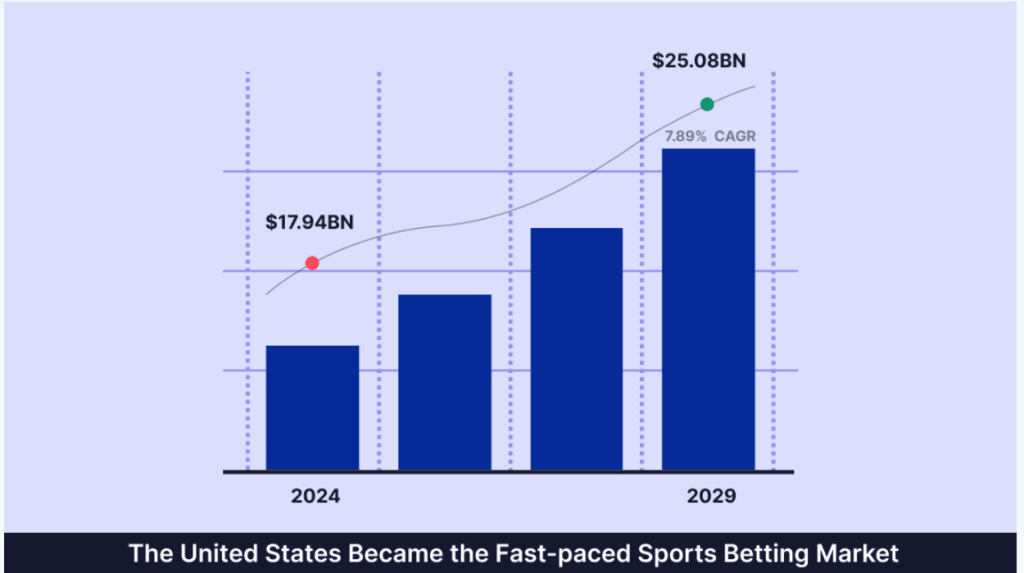
- In 2024, the U.S. sports betting market was valued at $17.94 billion.
- The US sports betting market is projected to expand at a 10.9% CAGR between 2025 and 2030.
- US sports betting revenue statistics reveal that it is forecasted to hit $18.51 billion in 2025 and grow 7.89% annually to $25.08 billion by 2029.
- By 2029, the US sports betting market is expected to have 54.8 million users.
- US sports betting user penetration is projected to rise from 12.3% in 2025 to 15.5% in 2029.
- US sports betting’s average revenue per user (ARPU) is projected at $431.73.
- Canada leads in sports betting user penetration at 52.9%.
- By the end of 2034, North America is projected to hold 24.3% of the global sports betting market share.
Over 50% of US citizens have bet on a sports event at least once, says Statista.
FIFA 2026 Effect
The first World Cup on American soil since 1994 is expected to create an unprecedented demand shock. Surveys indicate 62% of U.S. fans plan to bet on the Cup, and 29% for the first time. Millions of new accounts will likely be opened. Operators are already planning cross-promotion with media to capture this wave.
Key Drivers of Global Sports Betting Market Growth
Several factors are fueling the surge:
Regulatory Expansion
Legalization in new jurisdictions is the single biggest driver. Globally, 70% of sports betting revenue now comes from regulated markets in 2026, up from 55% in 2022. As more countries shift from gray-market betting to formal licensing, a larger share of bets becomes “on the books.” This shift boosts operator confidence and tax revenues. Each legalization event adds millions of bettors and sponsors.
Mobile Betting & Technology
Smartphones have made betting universal. Mobile apps with features like geolocation and one-tap betting have greatly increased turnover. Trends like instant deposits and biometric logins remove friction. Overall, in-play betting itself is a technological driver: one report notes live bets are now 53% of all online wagers and growing at 14.85% CAGR.
AI-Driven Personalization
Sportsbooks increasingly use real-time data to tailor the experience. Analytics show users are 3× more likely to bet when shown a personalized recommendations list. Operators leverage machine learning for dynamic odds, user segmentation, and custom offers. This hyper-personalization of content, UI layout, and promos is a powerful retention tool. It means growth is not just broad marketing but giving each bettor a unique experience. AI also underpins odds-setting and fraud detection, improving margins.
Convergence with Live Media
The merging of streaming and betting is a hot trend. Industry watchers note deals like Amazon’s partnership with BetMGM for Thursday Night Football odds, and FuboTV’s launch of an integrated sportsbook. Single-screen experiences of watch-and-bet keep viewers engaged longer. Broadcasters are launching betting content and in-app wagering, anticipating a future where most live sports viewing includes a side of betting. This integration not only boosts handle but also widens access; users can bet while watching the game on the same device.
Sports Betting Market — Key Players & Competitive Landscape
The competitive landscape is defined by a mix of global giants and nimble, regional specialists.
Global Tier-1 Operators
Top global operators (Tier-1) include:
- Flutter Entertainment (FanDuel, Betfair, PokerStars, Paddy Power) – the largest player worldwide.
- Entain plc (Ladbrokes, Coral, bwin, PartyPoker) – major in Europe and Latin America.
- DraftKings Inc. – US-based leader in fantasy and sports betting.
- BetMGM (MGM Resorts partnered with Entain) – a top U.S. brand.
- Bet365 Ltd. – UK-founded, privately held, huge in online betting (estimated $4–5B global revenue annually).
Others include 888 Holdings (888sport), Kindred Group (Unibet), Betsson AB, and regional champions.
These market leaders have broad portfolios covering multiple regions and channels. Industry consolidation is notable – the top five in mature markets account for ~60% of online bets. M&A has accelerated: for example, Flutter paid $350M in 2023 for a 56% stake in Brazil’s NSX.
Behind these operators is a layer of technology providers. Data companies sell official stats and odds. Platform vendors like GammaStack power many brands’ front ends and enable operators to launch in multiple countries.
Challenges Facing the Global Sports Betting Market
Despite growth, the industry faces some challenges:
Stringent Government Regulations
Stringent government regulations pose an ongoing challenge to the global sports betting market. These regulations limit market expansion and operational freedom for sports betting operators in many countries.
Legal Prohibitions
Sports betting remains prohibited in many regions. This significantly hinders global growth and market penetration.
Compliance and Licensing Costs
Operators face high costs and complications when complying with different regional regulations. Meeting these diverse requirements leads to high costs and complexities.
Gambling Addiction and Social Concerns
Concerns about gambling addiction are leading to stricter rules and responsible gaming measures. These changes impact marketing and how sports betting companies attract customers.
Market Fragmentation
Varying legal frameworks result in fragmented sports betting markets. This fragmentation complicates cross-border operations and market expansion efforts.
Financial Pressures and Competition
Growing investments and competition are pushing sports betting operators to innovate. This pressure is essential for them to stay profitable in a dynamic market.
Match-Fixing & Integrity Risks
As the market grows, so does the potential for corruption. High-profile scandals can tarnish trust. Regulators now demand integrity measures; operators often invest in monitoring services. This vigilance is costly but essential to maintain a fair image.
Advertising & Sponsorship Restrictions
Governments are increasingly tightening gambling ads. Italy, for example, banned all gambling advertising in 2019. The UK and Spain have also imposed strict ad rules. Such restrictions raise customer acquisition costs – providers must rely more on content marketing and partnerships instead of mass media ads. It also slows market penetration in new jurisdictions.
Responsible Gambling & ESG Pressure
Institutional investors and regulators are increasingly scrutinizing operators’ responsible gambling credentials, affecting access to capital and market reputation.
Sports Betting Market Trends 2025–2026 and Beyond
Rapid Online Sports Betting Industry Growth
The online sports betting market is expected to increase from approximately $53.78 billion in 2025 to $93.31 billion by 2030. This represents a compound annual growth rate (CAGR) of about 11.65%. Online sports betting leads the market, providing over 78% of revenue in 2024 and showing the quickest growth.
Legalization and Regulatory Expansion
Sports betting is expanding due to increasing legalization, particularly in the US, with 40 states allowing it. The regulatory changes in Latin America, Africa, and Asia are also driving market growth. This regulatory liberalization significantly boosts market expansion, contributing to the bright future of the sports betting industry.
Technological Advancements
New technologies are revolutionizing personalized betting experiences, risk management, and fraud detection. These include:
- AI-Powered Predictive Analytics
- Advanced Machine Learning (ML)
- Real-time Data Analytics
- Blockchain
- Real-Time Odds Adjustment
- Natural Language Processing (NLP)
- Automated Betting Bots
Mobile and Live Betting
Mobile betting is driving user engagement, and live betting is growing rapidly due to real-time data and convenience. This is majorly contributing to the future of the sports betting industry.
Esports and Virtual Sports
Esports betting is rapidly growing, particularly among millennials and Gen Z, fueled by virtual sports and online tournaments. This trend significantly expands the options available within the sports betting market.
Fan Engagement and Media Integration
Strategic partnerships and endorsements enhance sports betting’s visibility and acceptance. Live streaming and social media integration significantly boost user engagement and retention.
Responsible Gambling Focus
Betting companies use tools to help people bet responsibly due to increased rules. These measures include self-exclusion and checks to protect users.
AI Personalisation & Hyper-Customization
Sportsbooks are using AI to tailor every aspect of the user experience. Interfaces now predict what bets to show you. Data shows bettors are 3× more likely to wager when given curated recommendations. Next steps will be AI-generated betting lines and odds for niche markets. For operators, this trend means increased engagement and retention if they leverage big data effectively.
Brazil & Latin America Regulatory Opening
Brazil’s online sports betting market officially launched under federal regulation in Jan 2025 – the largest market debut since PASPA. Other LatAm countries, such as Mexico, Argentina provinces, etc., are following suit. It signals that LatAm is now a top growth frontier.
Crypto & Blockchain Betting
Crypto payments and blockchain gaming are on the rise, especially where banking is restrictive. Payouts are instant, and provably fair games attract a new segment of bettors. We’ve seen standalone crypto-sportsbooks growing, and traditional operators adding crypto options. This trend could reshape payment processing and user acquisition in emerging markets.
Virtual & Simulated Sports
Platforms offering 24/7 “virtual” matches (simulated football, racing, etc.) are growing fast. They fill the off-season or live-sport gaps, keeping bettors engaged year-round. With better graphics and RNG fairness proof, virtual sports wagering appeals to tech-savvy users. While still a minority of handle, it’s a growing slice of in-play betting, especially in Europe.
Micro-Betting Expansion
Betting on micro-events (next play, next pitch, next corner) is exploding. The trend is that operators offering ultra-fast live markets keep users glued to the app. We expect micro-bets to become a standard feature in all top apps.
Investment Landscape & Operator Opportunities in the Sports Betting Market
Highest ROI entry markets for new operators
- Brazil: A brand new, regulated market with immense scale and still-low entrenched competition.
- Africa: A mobile-first market with a young population and high growth potential.
- Specific US States: As new states legalize, they offer opportunities for early movers.
White-label vs. Custom Build Cost Analysis
New entrants must decide between white-label solutions or building their own infrastructure. White-label providers offer fast launch and lower upfront tech cost, but usually charge revenue share. Custom builds require a big investment and expertise, but give full control. White-label is often ideal for testing a market or a small operator. For example, many European startups use turnkey systems to launch local sportsbooks quickly.
As a leading B2B sports betting solution provider, GammaStack positions itself as a trusted partner in this landscape. With 14+ years of experience and over 80 sports betting platform deployments in 45 countries, GammaStack provides white-label sportsbook solutions as well as custom sports betting software development services.
GammaStack Delivers Feature-Rich Sportsbooks Aligned with Latest Sports Betting Trends
With more than 14+ years of experience, GammaStack delivers efficient, feature-rich sportsbooks designed to match evolving sports betting trends. Key features include:
- Real-time risk management
- Live odds
- Advanced CRM
- Real-time reporting & analytics
- Responsible gambling tools
- Multi-currency and multilingual support
- Seamless 3rd-party integrations
- Choice of sports betting software solutions
- 24/7 end-to-end support
Frequently Asked Questions — Global Sports Betting Market
What is the sports betting market size in 2026?
As per the Research and Markets estimations, sports wagering is set to fetch $125.1 billion in 2026. Despite minor differences between different sources, they all agree that the market will exceed $100B.
Which region dominates sports betting globally?
In terms of revenue, Europe leads the market. It accounts for roughly 44–48% of global sports betting revenue. Countries like the UK, Germany, Italy, and France have long-established betting industries. (By user count, Asia-Pacific has the most bettors, but much of that is in countries without legal markets.) North America is the fastest-growing region, but it is currently smaller in total revenue than Europe.
What is the sports betting market forecast for 2030?
Projections vary, but forecasts typically put the 2030 market in the order of $170–$190 billion. Grand View Research forecasts $187.4B by 2030 (about 11% CAGR from 2025), while Mordor Intelligence sees $171.0B (7.3% CAGR). The main takeaway is a roughly doubled market size by 2030 compared to the mid-2020s, acknowledging differences in scope among reports.
What is the fastest-growing sports betting market?
North America is currently the fastest-growing major region. Analysts project North America’s 13.21% CAGR through the late 2020s, thanks to ongoing state-by-state legalization. By sport, cricket is often cited as the fastest-growing betting segment globally, fuelled by India and other Asian markets. In existing regulated markets, in-play/live betting is the fastest-growing bet type.
How big is the online sports betting market?
Online sports betting accounts for the majority of total sports betting revenue. Current estimates suggest online betting generates tens of billions annually. For example, Mordor Intelligence reports $49.7B in online sports betting in 2026, rising to $92.5B by 2031. In short, online wagering is expected to reach $90–100B within a few years, reflecting the global shift to digital platforms.
How is technology shaping the future of sports betting?
Technology is transforming the sports betting industry by making platforms smarter, faster, and more personalized. Tools such as artificial intelligence, blockchain, live streaming integrations, and advanced mobile apps are enabling sportsbooks to process huge volumes of data in real time. AI models analyze historical match data and player statistics to improve odds accuracy and risk management. Blockchain is being explored for transparent betting transactions and provably fair outcomes. Meanwhile, real-time analytics and live streaming allow bettors to place in-play wagers during matches, which has become one of the fastest-growing betting segments globally.
How important is mobile betting in the global sports betting market?
Mobile betting now dominates the global sports betting market due to widespread smartphone adoption and easy access to betting apps. Access to smartphones has significantly expanded the online betting audience. Mobile apps allow bettors to place wagers instantly, track odds changes, watch live streams, and receive notifications for betting opportunities. As a result, a majority of online wagers globally are now placed via mobile devices rather than desktop platforms.
What impact does legalization have on the sports betting industry?
Legalization plays a crucial role in shaping the growth of the sports betting industry. When betting is legalized and regulated, it moves wagering activities from unregulated markets into licensed and transparent environments. This creates stronger consumer protection, increases trust among bettors, and attracts investment from large gaming companies.
What sports are known to generate the most betting revenue?
Football/soccer generates the largest share of sports betting revenue globally due to its massive international fan base and year-round competitions. Other high-revenue sports include basketball, cricket, tennis, horse racing, and baseball. Cricket betting has been growing rapidly.
What are some of the biggest challenges in the sports betting industry?
Despite strong growth, the sports betting industry faces several operational and regulatory challenges. One of the biggest hurdles for operators is navigating complex regulatory frameworks, which often vary by country or even by state within the same country. Licensing fees, compliance requirements, and responsible gambling measures can significantly increase operational costs. In addition, competition among operators has intensified as new sportsbooks enter newly regulated markets. Issues such as fraud prevention, data integrity, and responsible gambling obligations also require continuous investment in technology and monitoring systems.
Does in-play or live betting impact sports betting platforms?
Yes, in-play betting—also known as live betting—has become one of the most influential features on modern sports betting platforms. It allows bettors to place wagers while a match is actively taking place, rather than only before the event begins. This real-time betting experience increases engagement because odds continuously change based on game developments.
What is the quickest way to enter the sports betting industry?
For new operators, launching a sportsbook from scratch can be expensive and time-consuming due to licensing requirements, software development, and compliance processes. Many businesses, therefore, choose white-label or turnkey sportsbook solutions to enter the market faster. Platforms like GammaStack provide ready-built betting infrastructure that includes sportsbook software, payment integrations, risk management tools, and user management systems.
How is AI being used in sports betting platforms?
Artificial intelligence plays a major role in modern sportsbook operations. AI systems analyze large datasets such as team performance statistics, player metrics, and historical match results to generate more accurate betting odds.