
Starting a sportsbook from scratch takes time, money, and a full tech team most operators don’t have. That’s where white label sportsbook solutions come in.
Instead of building everything from the ground up, you get a fully built betting platform ready to brand as your own and launch in weeks. No development backlog. No six-figure tech spend upfront.
In this blog, we break down what a white label sportsbook actually is, how a white label sportsbook works, the 3 types you can choose from, must-have white label sportsbook features to look for in a provider, and the key benefits that make it the go-to choice for new and scaling operators worldwide.
⚡ Quick Answer
A white-label sportsbook is a ready-made betting platform that a provider builds and hosts, and an operator rebrands as its own. It usually goes live in 2 to 4 weeks. The provider runs the technology, odds feeds and risk tools. The operator handles marketing, players and pricing.
There are 3 types: Fully-Handled, Customizable and API-Based. At GammaStack, setup starts at about $15K and there is no revenue share. Whether you can run under the provider’s licence depends on your market.
🔑 Key Takeaways
- Provider and operator responsibilities split clearly: the provider handles infrastructure, odds feeds, back office and licensing support (which varies by market). You handle player acquisition, local promotions, pricing and bonus strategy, and your own licence where your market requires one.
- White-label, turnkey, and custom form a control-vs-speed spectrum: white-label launches in 2 to 4 weeks with the least control, turnkey takes 4 to 8 weeks and adds licensing and operational support, and custom takes 3 to 6 months and gives full codebase ownership.
- 3 white-label types match different technical capabilities: Fully-Handled (lowest control, best for new operators), Customizable (medium control, brand differentiation), and API-Based (highest control, requires an in-house tech team).
- 4 core benefits drive adoption: faster launch, lower development cost, meaningful customization options, and access to continuously updated technology without in-house development.
- 6 features separate strong providers from weak ones: platform scalability, a robust back office, deep customization options, wide betting market coverage, secure payment gateways, and fast real-time odds updates.
- 3 pricing models carry different long-term costs: flat SaaS fee (predictable), GGR share (can grow expensive as revenue rises), and hybrid (the most common). At GammaStack, white-label setup typically costs $15K to $40K with no revenue share.
- 3 real limitations exist: less flexibility than custom builds, possible ongoing revenue-share or licensing fees, and shared infrastructure risk. Most new and mid-size operators still find the speed and cost trade-off worth it.
- Licensing depends on your market: some markets let you run under the provider’s licensing arrangement, but others, including Great Britain and Curaçao, need your own licence. Check before you commit.
What is a White-Label Sportsbook Solution?
A white-label sportsbook software is a pre-built sportsbook solution designed for sports betting operators looking for a ready-made sportsbook.
A white-label sportsbook provider works on a software as a service (SaaS) model and builds these solutions, which are ready to be launched in the market. They then offer it to multiple operators to be rebranded as their own. These solutions come with all the features of a sportsbook, such as odds management, reporting tools, and access to different betting markets. This is a perfect solution for startup businesses or if you are looking to avoid the expenses of a custom sportsbook.
How Do White-Label Sportsbooks Work?
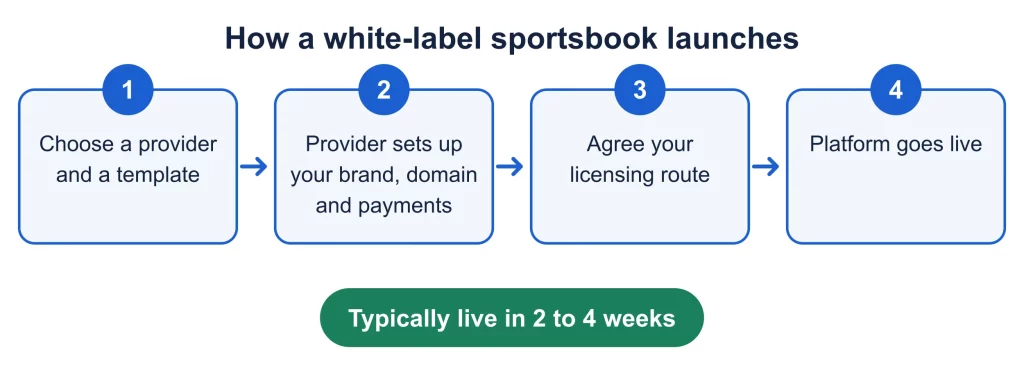
Once you decide white-label is the right fit, the process is simple. It has four steps:
- Choose a white-label sportsbook provider and a template.
- The provider sets up the platform under your brand, including logo, colors, domain and payment methods.
- You agree a licensing route. Depending on your market, this means operating under the provider’s licensing arrangement or getting your own licence.
- The platform goes live, usually within 2 to 4 weeks for a standard build.
What Does the Provider Handle vs. What Do You Handle?
White-Label vs. Turnkey vs. Custom Sportsbook: What's the Difference?
A lot of operators get confused between white-label, turnkey, and custom sportsbooks. Here’s a quick way to think about it:
A white-label sportsbook is a ready-made platform from a provider. You put your brand on it, and you’re live. The provider handles the heavy lifting: infrastructure, odds feeds and back office. You handle the business side.
A turnkey sportsbook takes it a step further. It includes not just the software, but also licensing support, payment processing, and sometimes even operational management. Think of it as “we set everything up, you run it.”
A custom sportsbook is built from scratch to your specs. You own the codebase, control every feature and have the most flexibility, but it takes 3 to 6 months and a larger budget.
Which one’s right for you? If you’re entering the market fast and want to test profitability without heavy upfront investment, white-label is the smartest starting point.
What Types of White-Label Sportsbook Solutions Are Available?
White-label sportsbook solutions can be offered in many different ways depending on the demand and requirements of the betting business. Let’s discuss these types of solutions.
Fully-Handled White-label Sportsbook
As the name suggests, this is fully managed by the sportsbook provider, who has full control over the operational tasks. You can focus more on the marketing and growth of your betting business.
The provider has control over the odds management, customer service, and daily activities on the sportsbook. A fully-handled white-label solution is best suited if you are new to the betting industry or if you want to dedicate your focus to marketing, branding, and building relationships with customers.
Customizable White-Label Sportsbook Solution
Many white-label sportsbook providers offer some limited options for customization in the solution before handing it over to the betting operator. This gives you more control over the sportsbook software by customizing the features.
You can modify different features, including payment systems, user interface, designs, or any new feature to be added. The core mechanism remains the same, but you may make changes to the elements that are on the design or feature part. This white-label solution is best suited to betting providers who have some technical expertise for customization. The sportsbook provider will guide you through the process.
API-Based White-Label Sportsbook Solution
A white-label sportsbook provider also offers an API-based sportsbook that gives operators direct control over their front end and features while using the provider’s core betting engine.
You can design different features and also add them according to your choice. You can even design a new front-end experience for your players. This requires more knowledge in the technical area and is ideal for pre-existing operators.
Top 4 Benefits of White-Label Sportsbook Software
Launching a sportsbook solution can be a daunting task. However, with a white-label sportsbook provider, you can benefit in many ways. Let’s explore the benefits.
Why Is It Faster to Launch?
With a white-label sportsbook, there is no downtime, and one can enter the market quickly. This is a perfect choice for startups or small businesses looking to grow their business in the betting industry.
Instead of wasting years on building the platform from scratch, one can directly enter the sports betting market with this solution. This buys you more time on other important tasks like marketing and sales.
Is It Cost-Effective?
White-label sportsbook providers are a great choice for betting operators who are looking to cut down development costs. White-label is a better choice and a more cost-effective alternative as it cuts down the development costs by a great margin.
Can You Still Customize It?
No matter how fast you want to launch your sports betting platform, customizing it for your business allows you to create a unique brand identity.
With white-label solutions, you will get the option to customize the platform on different levels, like CMS, designs, or the thumbnails on the website. This will allow you to customize your betting platform without having to waste time on development.
What Technology Do You Get Access To?
White-label sportsbook software builds on advanced technologies with all the latest features without the need to develop it in-house.
You will benefit from continuous updates and feature improvements, keeping your platform updated. This includes integrations of features like advanced analytics, odds management, live betting, and more.
Top 6 Must-have features in White-Label Sportsbook Software
Top sports betting operators offer betting platforms that are able to drive player engagement with superb features. The features separate them from other players in the betting industry. Here’s how one can stand out by adding these must-have features to your platform.
Is the Platform Scalable?
When choosing a white-label sportsbook solution, consider the platform’s flexibility and scalability.
Scalability is about seeing if your software can adapt to growth easily and can avoid any downtime. For instance, if you currently have 1000 players and, over time, you gain 100000 players, the platform should be able to manage that number of players swiftly without crashing or slowing down.
Flexibility is equally important as it allows the platform to be flexible to change or update. Keeping both of them as a priority is vital.
How Robust Is the Back Office?
Robust back office and a user-friendly interface are the two most vital features for any sportsbook. A tool-heavy back office is an important feature that one should always look for in a white-label solution. Look for all the basic and advanced tools for management that are required in the back office. It includes:
- Robust risk management tool
- player management
- Live reporting and analytics
- Instant notifications
- Odds management and more
A white label sportsbook provider should be able to provide a user-friendly interface, which is a must as this is where players will interact with the platform. Players should be able to easily navigate the system. The user interface should easily adapt to the screen sizes, and all statistics should be presented clearly without any glitches.
What Can You Customize?
Customization is what turns a generic sportsbook into a unique one that stands out from your competitors. It is not only about designing the logo or customizing the music, but it’s about an overall unique experience that resonates with your brand.
You can start with the basic customization, such as colors, logo, design, and UI/UX. Then, try customizing the sportsbook software more and look for customizations such as:
- Registration process
- Mobile optimization is a must
- Payment gateways
- Promotional and bonus tools
- Different types of bets and odds formats
- Customization in language
Choose a white-label sportsbook provider that can offer enough customization to meet your business and future goals.
Which Betting Markets Are Covered?
A sportsbook is about betting on different sports and in different betting markets. Your sportsbook solution needs to be connected to different betting markets to provide variety to players and offer every game to every player.
Look for a comprehensive betting market solution for your sportsbook. Make sure to offer a wide range of in-play betting for different live markets.
Are Payment Gateways Secure?
When working with a reliable white-label sportsbook provider, make sure to set up an efficient payment gateway system. It not only provides security to users but also builds trust by keeping their information private.
Setting up a secure and reliable payment system is equally important for running a smooth operation on your sportsbook solution. As it handles the payments and withdrawals of your players’ money, it should be secure and provide a seamless experience. You should be able to provide different payment methods such as:
- Credit and debit cards
- Net banking or bank transfers
- E-wallets
- Cryptocurrency
Go for a white-label sportsbook software that provides advanced tech for data protection and standard encryption protocols such as SSL and TLS.
How Fast Are Odds Updated?
Real-time odds updates are the main function of modern sports betting software. They keep the betting game interesting, engaging, and exciting for players. It ensures the sports betting odds are recent, true, and competitive.
Your white-label sportsbook provider should be able to provide information as early as possible to have a positive impact on decision-making. Bettors should be allowed to choose the type of odds they want to view (decimal, fraction, or American odds).
Readers Of This Blog Also Read



Latest Innovations in White-Label Sportsbook Software
Modern white-label sportsbook solutions have evolved a lot in terms of the technology used. Let’s explore the key innovations that make white-label solutions a more preferred choice for any sports betting company.
AI-Driven Risk and Odds Management
Modern sportsbooks use AI to manage the odds and provide live updates of odds. It also analyzes the risk in advance and offers risk management services.
Use of Crypto and Blockchain Technologies
Some sportsbook platforms use blockchain-based payment rails, which can speed up deposits and withdrawals in supported cryptocurrencies, and some add on-chain records for transparency.
Personalization of Sportsbook Software
Every sports betting game is personalized based on players’ preferences, which provides a personalized version of the game. It allows sports betting providers to use personalization strategies to offer a more fulfilling experience to players.
How Much Does White-Label Sportsbook Software Cost?
Cost depends on how much customization, market coverage and payment integration you need. These are the typical GammaStack ranges by delivery model:
These are starting ranges. Your final quote depends on your odds feed, number of markets, payment integrations and branding work.
SaaS Fee, Revenue Share, or Both: How Do Other Providers Charge?
Many providers add an ongoing cost on top of setup. GammaStack does not take a share of your GGR on white-label, turnkey or custom builds. With any provider, compare the full cost over 2 to 3 years, not just the setup price.
What Are the Limitations of White-Label Sportsbook Software?
White-label solutions are fast and cost-effective, but they’re not for everyone. Here’s what to keep in mind before you commit:
- Less flexibility than custom builds. The core engine is shared across operators. Deep technical customizations such as a fully proprietary odds algorithm aren’t usually possible.
- Revenue share or licensing fees. Many white-label providers charge a monthly SaaS fee, a GGR share, or both. GammaStack does not take a revenue share, but always clarify the pricing model with any provider before you sign.
- Shared infrastructure risks. On some platforms, performance issues affecting one operator can impact others. Ask your provider about dedicated hosting options.
- Licensing depends on your market. Running under a provider’s licensing arrangement is not possible everywhere. See the licensing section below.
For most new and mid-size operators, these cons are well worth the speed and savings. But knowing them upfront helps you choose the right provider and negotiate the right deal.
Do You Need Your Own Gambling License?
Some white-label providers let you launch under their existing licensing arrangement. That can speed things up, but it only works where your market and regulator allow it. Here is how it differs in a few key markets:
Before you choose a provider, ask which licences they hold, what those licences cover, and what you must apply for yourself. This is general information, not legal advice. Speak to a gambling lawyer before you choose a licensing route.
How GammaStack Can Help You as a White-Label Sportsbook Provider
Host your online white label sportsbook software with GammaStack to quickly get started in the betting market. With 14+ years of experience creating all types of sportsbook solutions, we offer start-to-finish support including unique UI/UX, seamless integration, risk management, and after-sales service, all in one place.
You can enter the sports betting industry with a white label sportsbook provider that offers extensive customization options and compliance support for the markets you target. GammaStack does not take a revenue share on white-label, turnkey or custom builds. See GammaStack’s full sportsbook solutions overview for the complete range of white-label, turnkey, and custom options.
📌 Bottom Line
- White-label isn’t a compromise. It is a deliberate strategy for operators who want to validate market demand before committing to the cost and timeline of a custom build.
- The pricing model matters as much as the platform. Understand whether you’re on flat SaaS, GGR share or hybrid before signing, because the cost difference compounds as your business scales. GammaStack takes no revenue share.
- Check your licensing route early. Running under a provider’s licensing arrangement is not possible in every market.
- GammaStack’s white-label sportsbook solution combines 14+ years of experience with full customization options and compliance support, giving operators a fast, credible path to market.
Frequently Asked Questions
What is a white-label sportsbook?
A white-label sportsbook is a ready-made betting platform that a provider builds, hosts and maintains, and that you launch under your own brand. It includes the betting engine, odds feeds, risk tools, payment integrations and a back office. Licensing support varies by provider and market.
How does a white-label sportsbook work?
A white-label sportsbook works in four stages: you choose a provider and plan, the platform is configured under your brand, you agree a licensing route, and it goes live, typically in 2 to 4 weeks. After that, the provider manages infrastructure, odds feeds and risk, while you handle marketing and player relationships.
What's the difference between white-label, turnkey, and custom sportsbooks?
A white-label sportsbook is a rebranded, ready-made platform that can go live in 2 to 4 weeks. A turnkey sportsbook adds licensing support, payment setup and operational help, and usually takes 4 to 8 weeks. A custom sportsbook is built to your specification and you own the code, but it takes 3 to 6 months and a larger budget.
How much does white-label sportsbook software cost?
At GammaStack, a white-label sportsbook typically costs $15K to $40K to set up. A turnkey sportsbook costs $40K to $100K and a custom build $100K to $400K+. GammaStack does not take a revenue share on any of the three. Your final cost depends on customization, number of markets, payment integrations and odds feed choices. Other providers may charge a flat SaaS fee, a share of GGR, or both, so compare the full cost over 2 to 3 years, not just the setup price. Contact GammaStack for an exact quote.
How long does it take to launch a white-label sportsbook?
Most white-label sportsbooks go live in 2 to 4 weeks once branding, payment methods and licensing are settled. Turnkey usually takes 4 to 8 weeks and a custom build 3 to 6 months. The usual causes of delay are licensing, payment provider approvals and extra customization, so settle those early. Contact GammaStack for an exact quote.
What are the disadvantages of a white-label sportsbook?
The main cons are less flexibility than a custom build, possible revenue-share or licensing fees depending on the provider, and shared infrastructure. For most new and mid-size operators, the speed and cost savings still outweigh these limitations.
Which type of white-label sportsbook should I choose?
Choose Fully-Handled if you’re new to betting and want to focus purely on marketing. Choose Customizable if you want more control over UI, payments and branding with some technical involvement. Choose API-Based if you have an in-house tech team and want your own front end running on the provider’s betting engine.
What is the best payment option for a white-label sportsbook solution?
There is no single best option. It depends on where your players are. Cards and e-wallets cover most markets, bank transfers and local payment methods suit specific regions, and crypto works where it is legal and your licence allows it. Pick a provider that already has integrations for your target markets and supports KYC and AML checks on every payment route.
Does a white-label sportsbook require its own gambling license?
It depends on the market. In some places a white-label operator can run under the provider’s licensing arrangement, which is faster. In others you must hold your own licence. For example, anyone offering online gambling to people in Great Britain needs a Gambling Commission licence, and Curaçao ended its master and sub-licence system, so new operators there need a direct licence. In the US, licensing is handled state by state. Check the rules for each target market with a gambling lawyer before you sign.
Who owns the player data in a white-label sportsbook?
The platform is shared, so your contract decides who controls player data. Before signing, confirm three things: that you own your player and transaction data, that you can export it in a standard format, and what happens to it if you leave. Also ask where the data is hosted and which data protection rules apply, such as GDPR for European players.
Can I customize the design of a white-label sportsbook?
Yes. Many operators start with white-label to test the market and move to a custom build later. To make that move easier, ask early about data export and API access, and whether the provider also builds custom platforms. GammaStack offers white-label, turnkey and custom builds, so the upgrade path stays with one team.
Can I customize the design of a white-label sportsbook?
Yes. Most white-label providers, including GammaStack, let you customize logos, colors, themes, UI/UX, payment options and promotional tools. The depth depends on the type: Fully-Handled gives the least control, Customizable lets you change UI, features and integrations, and API-Based lets you build your own front end on the provider’s engine.
The Author


India
USA
Malta
Latvia
Let's Work Together. Win Together
Ready to transform your ideas into next-generation solutions? Drop us your details and we’ll get back to you within 48 hours!