A high error rate does not necessarily mean the slot game itself is poorly developed. Operators should check several factors before deciding whether to remove a game. These factors include game code, API, casino platform, wallet, PAM, or the provider’s terms. These factors create higher slot game error rates, leading to poor performance and an unpleasant gaming experience.
After the error is detected, the first step is therefore to determine where the failure is occurring before changing or removing the game. Operators must follow this diagnostic flowchart for a smooth process:
Detect → Classify → Isolate → Fix → Validate → Monitor
This blog explores why high slot game errors matter and how to monitor and improve them to offer an error-free and uninterrupted slot gaming experience.
What Is a Slot Game Error Rate?
A slot game error rate is the total number or percentage of requests that failed during gameplay when they were requested. It can take many forms, including slot game errors, communication errors, game server errors, casino platform errors, and wallet system. It helps operators to understand the issues and correct them before it affects the player experience.
For example:
Error Rate = Failed Requests ÷ Total Requests × 100
Different systems may calculate error rates differently, so operators should define exactly what constitutes an error, such as failed game launches, API timeouts, rejected transactions, or server errors, to ensure consistent monitoring and reporting.
Why High Slot Game Error Rates Matter?
A high error rate can also create a false performance signal. A game may appear to have low player engagement when players are actually unable to start or complete sessions. Why do slot game error rates matter?
- Game availability: Frequent errors during game loading, server errors, or failed API requests can make the game temporarily unavailable for players.
- Player experience: Unexpected errors, failed actions, or frozen screens can create frustration among players and may discourage players from returning.
- Game sessions: Slot game technical issues lead to game session interruptions or prevent players from resuming sessions.
- Transactions: Any type of failed requests in transactions due to wallet or payment errors lead to incomplete bet processing or unresolved deposits and withdrawals.
- Revenue: Game downtime and interrupted sessions can reduce wagering activity and limit revenue opportunities.
- Support workload: Repeated errors lead to continuous interruptions and increased player complaints and troubleshooting tasks.
- Provider relationships: Persistent errors or performance issues can lead to disputes between casino operators, platform providers, and game studios.
Which Slot Game Errors Should Operators Monitor?
| Error type | Example |
|---|---|
| Launch error | Game doesn’t open |
| Authentication error | Player session isn’t validated |
| Wallet error | Balance unavailable |
| Bet error | Wager request fails |
| Win error | Payout isn’t processed |
| Session error | Session expires or disconnects |
| API error | Request fails or times out |
| Configuration error | Incorrect game settings |
| Client-side error | Browser/device issue |
| Server-side error | Backend failure |
Let’s discuss this in detail.
Check Whether Errors Are Game-Specific or Platform-Wide
This should be the first diagnostic question. This can dramatically reduce slot game troubleshooting time.
Compare:
Affected game vs other games
If only one game has elevated errors, investigate:
- Game configuration
- Provider integration
- Game version
- Game-specific code
If many games fail simultaneously, investigate:
- Casino platform
- Wallet
- PAM
- Aggregator
- Infrastructure
- Network
Check the Game Launch Failure Rate
Start at the beginning of the player journey.
Measure:
Lobby impression → Game click → Game launch → Session creation
Track:
- Launch attempts
- Successful launches
- Failed launches
- Failure percentage
- Error codes
Common causes
- Invalid game ID
- Authentication failure
- Incorrect launch URL
- Provider outage
- Configuration problem
- API timeout
Check Slot Game API Error Rates
High slot game error rates can also occur due to failed API requests. Review the game’s API traffic.
Slot game error monitoring includes:
- Response status
- Response time
- Timeout rate
- Error rate
- Request volume
- Failed requests
Compare Error Types
For example:
- 4xx → request/authentication/configuration issue may be involved
- 5xx → server-side failure may be involved
- Timeout → connectivity/performance issue may be involved
Note: Avoid treating HTTP status codes alone as proof of root cause; confirm against the relevant API documentation and logs.
Check Wallet and Transaction Failures
Monitor wallet and transaction logs for failed bets, duplicate transactions, delayed balance updates, and discrepancies between game and player wallet records. Track slot game crashes or API timeouts that lead to incomplete round settlements to identify whether failures originate in the slot game, wallet service, or payment integration.
Check:
- Bet failures
- Win failures
- Rollbacks
- Refunds
- Balance requests
- Duplicate transactions
- Transaction timeouts
Reconcile Transaction Data
Compare:
Game system ↔ Casino platform ↔ Wallet
Look for:
- Missing transactions
- Duplicate transactions
- Incorrect amounts
- Incorrect balances
- Unmatched transaction IDs
Check Player Session and Authentication Errors
This can help distinguish a game problem from an account/session problem. Evaluate these factors for slot game error rates occurring due to players’ account management systems:
- Session creation
- Session expiry
- Authentication
- Token validation
- Reconnection
- Player identity
Common symptoms:
- Game opens but doesn’t start
- Player gets logged out
- Spin fails after inactivity
- Game breaks after reconnecting
Check Whether the Problem Is Device or Browser Specific
If your casino platform shows high errors on one browser, but normal behavior elsewhere. It may point toward a compatibility or client-side issue rather than a universal game failure.
Segment errors by:
- Mobile vs desktop
- iOS vs Android
- Browser
- Screen size
- App vs web where applicable
Check Provider and Aggregator Status
This is where provider-level monitoring becomes important. If the game is supplied through a provider or aggregator, determine:
- Is the provider experiencing an outage?
- Are multiple games from the same provider affected?
- Has an API changed?
- Are maintenance activities underway?
- Are specific markets affected?
Check Recent Releases and Configuration Changes
High slot game error rates often appear after a change. These errors may happen due to recent updates or any type of addition to the casino platform.
Review:
- Game releases
- Platform deployments
- API updates
- Configuration changes
- Server changes
- New integrations
- Game version updates
Compare Before vs After Deployment
Slot game errors need to be verified to compare before vs. after deployment of such an update before making any decision. Check whether error rates increased immediately after a specific release. This helps identify potential regression issues.
Check Game Configuration
Verify that each slot game is configured correctly across the casino platform and game server. Incorrect configuration can cause errors without changing the underlying game code. Check settings such as:
- Game ID
- Provider ID
- Currency
- Language
- Bet limits
- Market availability
- Game version
- Launch URLs
- Feature settings
Check Infrastructure and Performance
Monitor slot game performance and check for factors that are affecting the overall performance and infrastructure to identify infrastructure issues that contribute to slot game errors. Check:
- CPU
- Memory
- Server capacity
- Network latency
- API latency
- Database performance
- Load
- Concurrent sessions
Check Whether Errors Increase During Peak Traffic
A useful analysis is:
Traffic volume vs error rate
If errors rise sharply during traffic spikes, capacity or performance could be contributing to the issue.
Check for Partial or Market-Specific Errors
Analyze slot game error rates by each market to identify issues affecting specific player segments rather than the entire platform. For example, a game may load correctly in one country but may fail to load in another. This may happen due to geolocation restrictions, unsupported currencies, localization issues, provider unavailability, or compliance restrictions.
Don’t assume an error affects everyone. Segment by:
- Country
- Currency
- Language
- Platform
- Operator
- Provider
Check Error Logs and Correlation IDs
Casino game errors may also happen due to system failures or mistakes in correlation IDs. Technical teams should have sufficient logging to connect individual failures across systems.
Check for useful data for slot game troubleshooting:
- Timestamp
- Player/session ID
- Game ID
- Transaction ID
- Request ID/correlation ID
- Endpoint
- Error code
- Response
- Provider
How to Diagnose High Slot Game Error Rates: Step by Step
Diagnosing high slot game error rates may require operators to identify each failed request or where requests fail, determine the underlying cause, and verify that corrective actions resolve the issue. Follow these steps for slot game troubleshooting to troubleshoot errors across game servers.
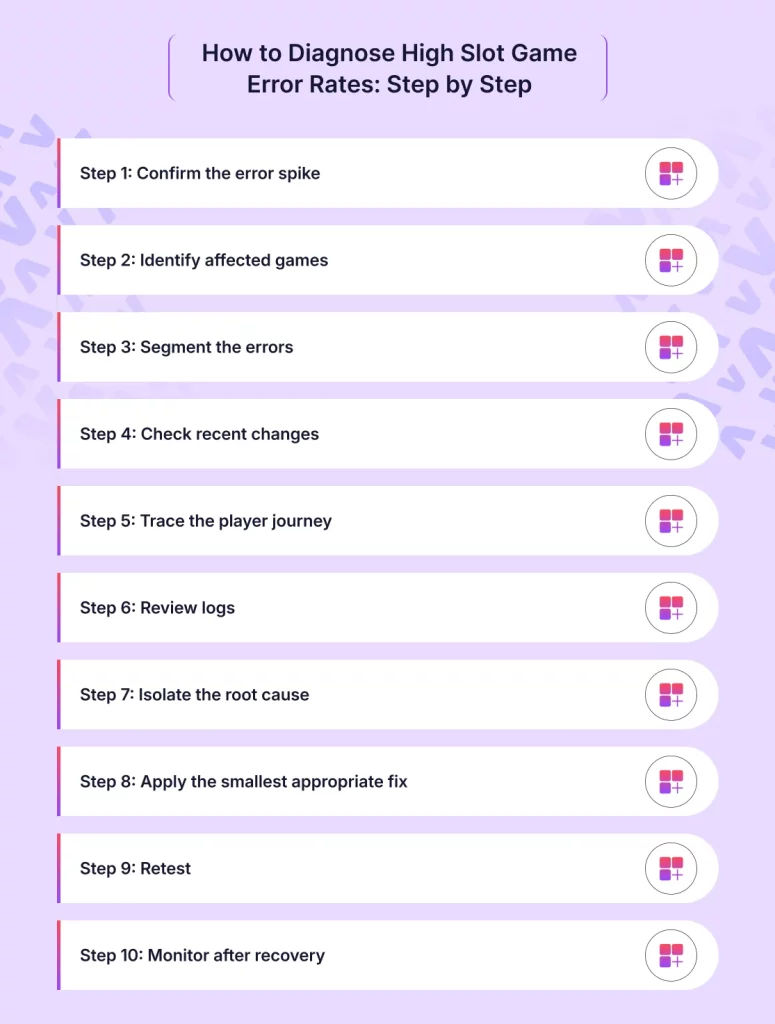
Step 1: Confirm the error spike
High slot game error rates leave a bad impression on players. Compare the current error rate with the normal baseline.
Step 2: Identify affected games
Check whether the error is affecting all the games or just some. This enables operators to understand the root cause of the problem and correct it.
Step 3: Segment the errors
Divide the slot game errors into different segments to identify the main cause of multiple errors and make a priority to work on the same. Break down by:
- Provider
- Platform
- Device
- Market
- API
- Error type
Step 4: Check recent changes
Online casino technical issues may also occur due to any new additions or changes made to the platform. Review:
- Releases
- API updates
- Configuration
- Infrastructure
Step 5: Trace the player journey
Track the player journey to understand whether it’s smooth or not and manage accordingly. Operators can follow a process to determine slot game errors in the player journey. It includes:
Launch → Session → Bet → Game result → Wallet
Step 6: Review logs
Use request and transaction identifiers to trace failures based on logs. This helps correlate the problem with the exact ID to identify when and where the request has failed.
Step 7: Isolate the root cause
Slot game error rates may be corrected by isolating the root cause and determining whether the issue is:
Game → API → Platform → Wallet → Provider → Infrastructure
Step 8: Apply the smallest appropriate fix
Even a small slot game failure can be corrected by applying a small fix rather than going for multiple fixes. Avoid changing multiple systems simultaneously unless required.
Step 9: Retest
After the slot game troubleshooting is done, retest the platform to identify error repetitions and verify the same failure scenario.
Step 10: Monitor after recovery
Keep track of the slot game error to monitor and confirm that the error rate returns to normal.
How to Build a Slot Game Error Monitoring Dashboard?
| Metric | Why monitor it |
|---|---|
| Game launch success | Detect access failures |
| API error rate | Monitor integration health |
| API latency | Detect slow systems |
| Bet failures | Protect wagering flow |
| Win failures | Protect payout flow |
| Session failures | Detect player interruptions |
| Wallet errors | Protect balances |
| Error rate by provider | Identify provider issues |
| Error rate by market | Detect regional issues |
| Error rate by device | Detect compatibility issues |
How to Prioritize Slot Game Errors?
Prioritize slot game errors based on their type of priority, based on the damage done by a specific error. Divide them into different categories of errors; incorrect balances, failed settlements, or security vulnerabilities should receive immediate attention, while minor errors can be solved later through slot game troubleshooting.
Not every error needs the same response. Categorize slot game error rates into different groups, such as:
Critical
- Financial transaction failures
- Large-scale game unavailability
- Incorrect balances
- Widespread authentication failure
High
- Major game-launch failures
- Provider-wide problems
- Mobile-specific failures affecting a significant audience
Medium
- Limited market/device issue
Low
- Non-critical UI or reporting issue
Note: The exact thresholds of error should be defined by the operator.
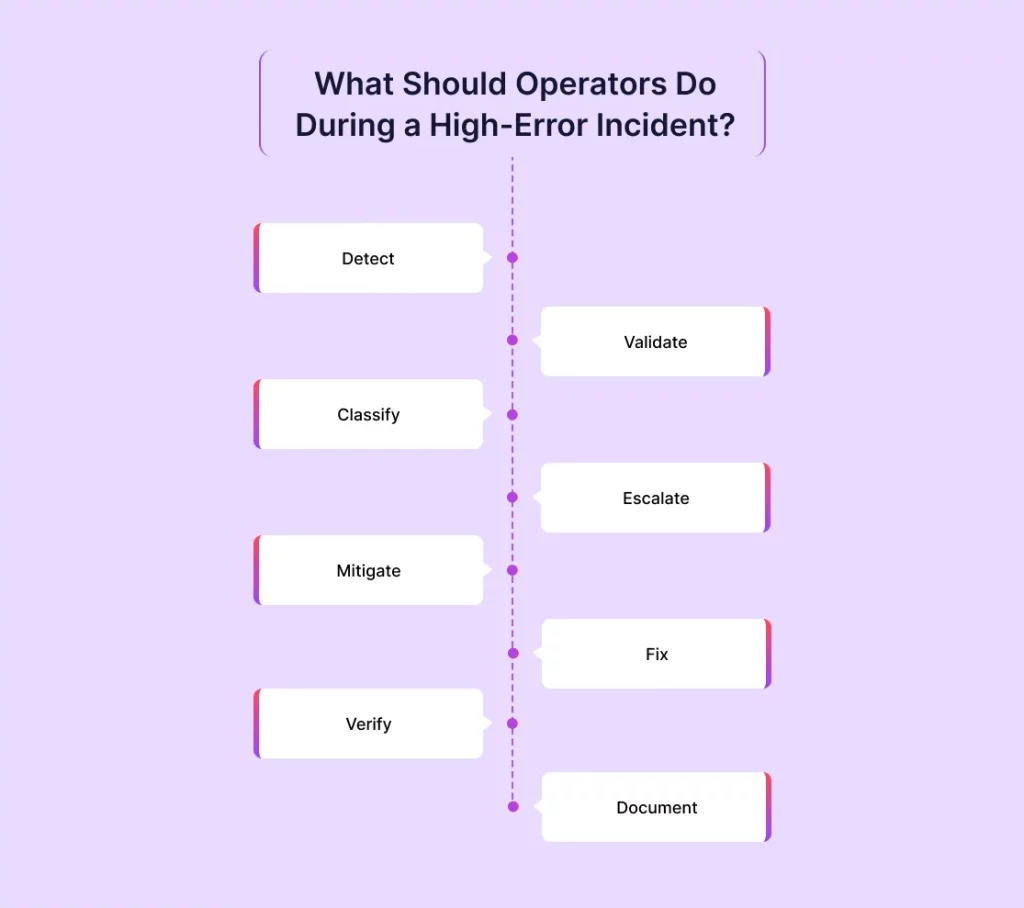
What Should Operators Do During a High-Error Incident?
During high slot game error rates, operators should limit player usage, protect the company’s integrity, and identify the root cause. A structured incident response gives a clear view of the problem and slot game technical issues.
Casino operators should follow this process:
Detect
↓
Validate
↓
Classify
↓
Escalate
↓
Mitigate
↓
Fix
↓
Verify
↓
Document
Temporary Mitigation
Depending on the issue, operators may:
- Temporarily hide an affected game
- Restrict affected markets
- Disable a faulty feature
- Route traffic differently where supported
- Notify the provider
Note: Any temporary action involving game availability should consider regulatory and operational requirements.
When Should an Operator Disable a Slot Game?
An operator should temporarily disable a slot game when slot game launch errors is repeating and creating significant risks to the platform. The decision should be based on the severity of the issue, its impact, and whether it can be contained without taking the game offline. After disabling it, study and correct the error, then try restoring the game.
Consider temporarily disabling it when:
- Transaction integrity is at risk
- Players cannot reliably play
- Errors are widespread
- The issue cannot be quickly mitigated
- Continuing to offer the game creates additional risk
How to Prevent Recurring Slot Game Errors?
Slot game error monitoring is a crucial process to identify errors and rectify them. After resolution, conduct a root-cause review.
Ask:
- What caused the error?
- Why wasn’t it detected earlier?
- Why did it affect players?
- Why did recovery take as long as it did?
- What system/process change prevents recurrence?
Some of the possible improvements that should be made include automated monitoring, better alerts, automated testing, API validation, capacity planning, configuration management, provider SLAs, and release controls.
How Slot Game Error Rates Affect Business Performance?
High slot game error rates can affect the overall performance of the business and can affect the casino’s revenue. This has an impact on player retention, operational efficiency, and provider relationships. Frequent technical failures can disrupt the operator’s image in the market, leading to an unpleasant player experience.
High errors can affect business ROI, including metrics:
- Game launches
- Sessions
- Bets
- GGR
- NGR
- Retention
- Support tickets
Note: But avoid assuming every error directly equals lost revenue.
Instead, measure:
Errors → failed sessions → failed transactions → player impact → business impact
Slot Game Error Investigation Checklist
Game
- Game ID checked
- Game version checked
- Configuration reviewed
- Game-specific logs reviewed
API
- Error rate checked
- Latency checked
- Timeouts checked
- Authentication checked
Transactions
- Bet failures checked
- Win failures checked
- Refunds checked
- Rollbacks checked
- Reconciliation completed
Platform
- PAM checked
- Wallet checked
- Aggregator checked
- Infrastructure checked
Segmentation
- Market
- Currency
- Device
- Browser
- Provider
Response
- Severity assigned
- Provider notified
- Mitigation applied
- Root cause identified
- Fix validated
- Monitoring restored
Common Mistakes When Troubleshooting Slot Game Errors
Some of the common mistakes operators should avoid during slot game troubleshooting include:
- Assuming the game itself is the problem
- Looking only at average error rate
- Ignoring segmentation
- Ignoring transaction failures
- Checking server status but not the player journey
- Not comparing against a baseline
- Ignoring recent releases
- Not checking provider/aggregator status
- Disabling a game before identifying the cause
- Fixing the issue without addressing recurrence
- Not monitoring after recovery
Readers Of This Blog Also Read



Final Takeaway
High slot game error rates are a symptom, not necessarily the root cause.
Operators should investigate the complete chain:
Player → Casino Platform → Game API → Provider → Wallet/PAM → Infrastructure
Then use:
Detect → Segment → Trace → Fix → Validate → Monitor
This lets operators distinguish between a game-specific problem, integration problem, provider outage, configuration issue, infrastructure problem, or market/device-specific issue before deciding what action to take.
FAQ section
What causes high error rates in slot games?
There could be various reasons for high slot game error rates, such as game availability, player experience, game sessions, transactions, revenue, support workload, and provider relationships.
How do operators monitor slot game errors?
Operators use slot game monitoring dashboards, server logs, API response codes, and transaction records to track failed requests, game crashes, and wallet issues.
What is a normal slot game error rate?
There is no universal benchmark for a normal slot game error rate. It depends on the system type, error type, and monitoring method. Slot game operators should establish baselines and investigate unexpected increases in critical errors.
How can operators reduce slot game errors?
Operators can reduce slot game error rates by regular QA testing, slot game troubleshooting, integration monitoring, infrastructure optimization, and configuration checks.
How do you troubleshoot slot game API errors?
In order to tackle slot game API errors, check API response codes, request and server logs, authentication credentials, network connectivity, and timeout settings. Trace failed requests across the game server, casino platform, and wallet system to identify the source.
What should operators do when a slot game keeps failing?
When a slot game keeps failing, review error logs, assess player and transaction impact, and escalate recurring issues to the game provider or technical team. Temporarily disable the game if failures threaten the game’s integrity.
How can operators distinguish game errors from platform errors?
Compare logs from the game client, game server, platform APIs, and wallet system to determine where failures originate. Then identify the error as a game error or platform error based on the type of failure.
Can high slot game errors cause revenue loss?
Yes, High slot game error rates can affect the overall performance of the business and can affect the casino’s revenue. This has an impact on player retention, operational efficiency, and provider relationships. Frequent technical failures can disrupt an operator’s image in the market, leading to an unpleasant player experience.
When should an operator temporarily disable a slot game?
Operators should consider temporarily disabling the slot game when:
- Transaction integrity is at risk
- Players cannot reliably play
- Errors are widespread
- The issue cannot be quickly mitigated
- Continuing to offer the game creates additional risk

India
USA
Malta
Latvia
Let's Work Together. Win Together
Ready to transform your ideas into next-generation solutions? Drop us your details and we’ll get back to you within 48 hours!