
⚡ Quick Answer
A slot game with high traffic but low revenue means the game attracts players and earns strong visibility, but fails to convert that attention into proportional commercial returns like average bet, GGR, and NGR. Casino operators need to evaluate traffic and monetization metrics together instead of assuming a popular game is automatically profitable. Slot game performance analysis relies on tracking key metrics — including game launches, active players, sessions, session duration, spins per session, average bet, total wagers, GGR, NGR, repeat players, and retention — to understand how a game is actually performing and generating revenue. When a game shows high traffic but low revenue, operators should investigate across the entire player journey, from visibility and launches through wagering, payouts, and repeat play, to pinpoint exactly where the funnel breaks down. Fixes should be treated as informed suggestions rather than guaranteed solutions, with operators focused on identifying the root cause before committing to a change, and measuring results by comparing performance before and after the intervention while controlling for traffic source, market, device, seasonality, and promotional exposure.
🔑 Key Takeaways
- High traffic with low revenue signals a monetization gap, not a popularity problem: the game attracts players and gets good visibility, but is unable to generate much proportional commercial return — so operators must evaluate traffic and monetization metrics together rather than assuming popularity equals profitability.
- 11 key metrics define slot game performance tracking: game launches, active players, sessions, session duration, spins per session, average bet, total wagers, GGR, NGR, repeat players, and retention.
- Diagnosis requires examining the full player journey, from game visibility and launches through wagering, payouts, and repeat play, to find where high traffic fails to convert into revenue.
- Proposed fixes are suggestions, not guarantees: operators should prioritize finding the root cause of the high-traffic, low-revenue pattern before finalizing any solution.
- Optimization impact should be measured through controlled before-and-after comparison, accounting for traffic source, market, device, seasonality, and promotional exposure to isolate the true effect of any change.
- Before changing or removing a game, locate the exact funnel bottleneck first — only once the specific breakdown point is identified can operators decide on the appropriate next step.
The demand for online casino games has grown over the years, and slot game development stands at the forefront of this evolution. The global online gambling market stands at USD 78.66 billion in 2024 and is expected to reach USD 153.6 billion by 2030, as per a report by Grand View Research. Operators receive higher traffic compared to before, as slot games have gained popularity among other casino games.
However, A slot game receiving high traffic can appear successful, but traffic alone doesn’t tell an operator whether the game is creating sufficient commercial value. An operator’s real success lies in the revenue generated by the platform and not just creating user engagement with no actual spend. A game may have many game launches and large numbers of sessions but relatively low average bet, GGR, and NGR. The problem of slot games with high traffic and low revenue is not rare, and many operators fail to understand how to tackle it.
So the right question is not:
“Why isn’t this popular?”
It is:
“Why is a game attracting players but generating less revenue than expected?”
Let’s find out. In this blog, we will cover why this happens and how to bring back your revenue.
What Does High Traffic but Low Revenue Mean for a Slot Game?
A slot game with high traffic but low revenue means that the game is able to attract players and get good visibility, but is unable to generate much proportional commercial returns. Casino operators need to evaluate traffic and monetization metrics instead of assuming that a popular game is automatically profitable.
Traffic Metrics vs Monetization Metrics
Traffic metrics are metrics that indicate the traffic on the slot game platform and show how much attention and activity a slot receives. These metrics include game launches, impressions, search results, player visits, and overall visibility.
High traffic can mean:
- Many game launches
- High impressions
- Strong lobby visibility
- High search interest
Slot game monetization metrics show the actual revenue generation, and it includes average bet, GGR, NGR, wagering volume, session value, and repeat play.
Low revenue can mean:
- Lower wagering volume
- Low average bet
- Short sessions
- Low repeat play
- High payout relative to wager volume
- Low contribution after applicable costs
Notes: High traffic is not the same as high commercial performance.
Which Metrics Should Operators Compare for Slot Game Revenue Analysis?
| Metric | What it tells you |
|---|---|
| Game launches | Initial interest |
| Active players | Reach |
| Sessions | Usage |
| Session duration | Depth of engagement |
| Spins per session | Gameplay activity |
| Average bet | Wager value |
| Total wagers | Betting volume |
| GGR | Gross gaming contribution |
| NGR | Contribution after relevant deductions |
| Repeat players | Continued interest |
| Retention | Longer-term value |
Top 10 Ways For Slot Game Performance Analysis
Slot game performance analysis is done by tracking some key metrics to know how the game is performing and generating revenue.
Check Whether Players Are Starting the Game but Leaving Quickly
A high traffic low revenue casino game may receive high traffic because it’s featured prominently, but players may exit after a few spins.
Analyze:
Lobby impression → Game launch → First spin → Extended session → Repeat visit
Look for:
- Short sessions
- High early exits
- Low repeat visits
- Low spins per session
What to Check
- Loading time
- First-time user experience
- UI clarity
- Game rules
- Bonus explanation
- Mobile usability
Slot game optimization is needed to ensure that the game gets the attention it deserves by utilizing new engagement strategies.
Check the Average Bet
High player volume and slot game performance don’t necessarily mean high wagering volume.
For example:
10,000 players × low average wager
can produce less wagering activity than:
2,000 players × higher average wager
Don’t frame higher bets as inherently better. The operator should evaluate the game’s intended audience, betting range, and player behavior.
Compare:
- Average bet
- Bets per session
- Bets per player
- Total wagers
Check Session Length and Spin Frequency
A game might attract many players but generate limited slot game revenue if sessions are very short. A slot game with high traffic and low revenue may have various reasons.
Analyze:
- Average session duration
- Spins per session
- Sessions per player
- Repeat sessions
Possible explanations
- Poor onboarding
- Weak gameplay loop
- Technical friction
- Low feature engagement
- Slow loading
- Player preference mismatch
This helps move from traffic diagnosis to product diagnosis.
Review Slot Game RTP and Game Mathematics
Wrong calculation of slot game RTP and slot game mathematics can lead to a slot game with low revenue. Operators need to handle it carefully and evaluate:
- Slot RTP
- Slot Volatility
- Hit frequency
- Win distribution
- Slot game average bet range
Slot game revenue depends on the relationship between how much players wager and how much is paid back to them as winnings. A slot can attract high traffic, but if wagering volume is low or player payouts are relatively high, the resulting gross revenue may remain limited. Therefore, operators should assess wagering activity and payout levels together rather than using traffic alone to measure commercial performance.
However:
A high RTP isn’t automatically evidence of a poorly performing game, and changing RTP simply to increase revenue should not be presented as a universal solution.
Also consider whether the mathematical profile is appropriate for:
- Target audience
- Casino portfolio
- Market
- Game positioning
Check Whether High Traffic Is Coming From Promotions
This is an important hidden factor in slot game high traffic, low revenue.
A game may have high traffic because it is:
- Featured on the homepage
- Included in promotions
- Newly launched
- Recommended to many users
- Included in a campaign
Separate:
Organic demand
from:
Promotional traffic
Then compare performance after promotional visibility changes. This helps determine whether the game genuinely attracts players or simply receives exposure.
Analyze Player Segments
Don’t evaluate all players together for slot game sessions.
Break down slot game performance by:
- New vs returning players
- Mobile vs desktop
- Market
- Acquisition source
- Player value segment
- Device
- Session type
You may discover:
High traffic comes from new players, but repeat activity is low.
or:
Mobile traffic is high, but mobile revenue per player is significantly lower.
This can point toward a specific slot game optimization opportunity.
Check Whether the Game Has a Strong Click-to-Play Rate but Weak Gameplay Performance
For slot game revenue analysis, separate two stages:
Discovery performance
from:
Gameplay performance
For example:
1,000,000 lobby impressions → 100,000 game launches → 10,000 repeat sessions
The game may be excellent at getting clicks but weak at retaining players. This is a strong slot game funnel-based analysis.
Review Mobile Performance
- A game can have high mobile traffic but poor slot game monetization because it is not mobile-optimized. Analyze:
- Slow loading
- Poor controls
- Small UI elements
- Performance problems
- Poor orientation handling
- Animation issues
Compare:
Desktop vs mobile
for:
- Session duration
- Bets
- Revenue
- Errors
- Repeat sessions
Check Whether the Game Is Too Similar to Other Games
A high-traffic, low-revenue casino game is also a result of too many similar games in the lobby. High traffic does not guarantee differentiation. Study if there are many games with:
- Similar themes
- Similar mechanics
- Similar volatility
- Similar bonus structures
Players may move between games rather than repeatedly playing one. Evaluate the game’s position within the portfolio.
Review the Game's Contribution After Costs
The revenue generated by the platform isn’t the same as profit. Operators need to differentiate between revenue and what is the actual profit through slot game revenue analysis.
Consider:
GGR → applicable deductions → content/provider costs → promotional costs → operating costs
A game may have reasonable slot game GGR but weak economic contribution and ROI because of its associated costs.
How to Diagnose High Traffic but Low Revenue: Step by Step
Slot game high traffic, low revenue should be investigated across multiple areas, including the complete player journey, from game visibility and launches to wagering, payouts, and repeat play.
Here is a step-by-step review that can help operators identify where profits are not generated.
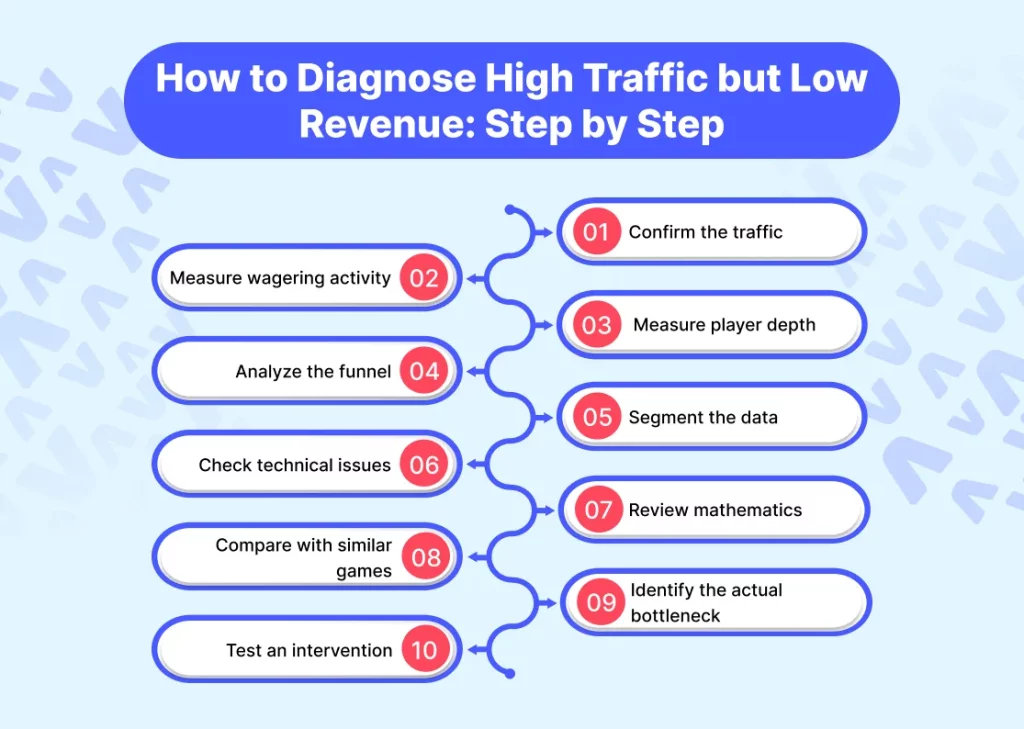
Step 1: Confirm the traffic
Start by confirming whether the traffic reported is genuine and where it is coming from. Check aspects such as:
- Game launches: How often players are actually opening the game.
- Unique players: How many new players are signing up for the title.
- Sessions: How often players start and return to the platform.
Step 2: Measure wagering activity
The next step is determining whether the traffic is translating into actual bets. Review:
- Bets: Total number of wagers placed.
- Average bet: Average amount wagered per bet or player.
- Bets per session: Total number of wagers placed in one session.
Step 3: Measure player depth
Player engagement is key to understanding slot games with high traffic but low revenue. Check:
- Session duration: How long players are active and playing.
- Spins: Total number of spins completed per session or player.
- Repeat play: Whether players are returning to the platform after a session.
Step 4: Analyze the funnel
Analyze the slot game funnel and map the player journey. This helps identify where players are dropping off.
Impression → Click → Launch → First spin → Extended session → Repeat
Study this funnel to understand where players drop off and how many return for repeat play.
Step 5: Segment the data
Avoid relying only on portfolio-wide averages. Break the data down by:
- Device: Compare desktop, mobile, and tablet performance.
- Market: Study which jurisdictions or countries are performing better.
- New/returning: Determine how many players are new and how many are returning to the game.
- Acquisition source: Compare organic, paid, affiliate, promotional, or other traffic sources.
Step 6: Check technical issues
Technical problems in the gameplay may create unnecessary traffic. Review:
- Errors: Any technical error arising during the gaming session.
- Loading: The speed of loading or how slow the game is launching.
- API failures: Problems with API integrations such as game, wallet, payment, or platform integrations.
- Wallet issues: Payment issues arising during the payment process.
Step 7: Review mathematics
Slot game mathematics play a vital role in creating traffic to the platform. Review the game mathematics to understand any underlying problem.
Check for:
- RTP: Slot RTP is the expected return profile with actual performance.
- Volatility: Slot volatility is the risk factor that should align with the target audience.
- Payout distribution: How the paylines work during the final payout to players.
Step 8: Compare with similar games
Compare the slot game performance analysis with similar slot titles rather than the entire portfolio.
Benchmark against games with:
- Similar theme
- Similar mechanic
- Similar audience
Step 9: Identify the actual bottleneck
Bring the findings together and identify where the player journey is breaking down. This gives an understanding of the slot game conversion rate.
Determine whether it’s:
Traffic → Conversion → Gameplay → Retention → Wagering → Economics
Step 10: Test an intervention
Once the bottleneck is identified, aim for targeted slot game monetization strategies. Depending on the issue, this could involve adjusting visibility, improving UX, resolving technical problems, refining promotional placement, or testing different market-specific presentations. Change one or more appropriate variables and monitor the result.
What Should Operators Do After Identifying the Problem?
| Problem | Possible Response |
|---|---|
| High impressions, low launches | Improve discovery/presentation |
| High launches, short sessions | Investigate UX/gameplay |
| High sessions, low wagers | Review betting behavior and game positioning |
| High traffic, low mobile contribution | Optimize mobile experience |
| High revenue, high costs | Review commercial terms |
| High traffic, low repeat play | Investigate retention |
| Technical errors | Fix integration/performance |
| Weak market fit | Reposition/localize |
Important Note: These are not guaranteed fixes but suggestions for the problems. Casino operators should focus on finding the root cause of slot game high traffic, low revenue and then finalize the solution.
When Should Operators Optimize the Game Instead of Removing It?
Slot game removal should be the final decision after every strategy is utilized.
Aim for Slot Game Optimization first when:
- Traffic is strong
- Players show interest
- The problem is identifiable
- Technical issues are fixable
- Portfolio value is high
Consider Slot Game Replacement/Removal when:
- Performance remains weak
- Strategic value is low
- Costs remain high
- Similar content performs better
- Optimization attempts haven’t resolved the issue
How to Measure Whether Slot Game Optimization Worked?
A useful way to measure slot game optimization is to compare the slot’s performance before and after the intervention, while controlling for factors such as traffic source, market, device, seasonality, and promotional exposure. Key metrics for measuring before vs. after are:
- Game launches
- Session duration
- Bets
- Average bet
- Repeat players
- GGR
- NGR
- Errors
- Mobile performance
Note: Where possible, use controlled testing rather than assuming improvement came from one change.
High Traffic but Low Revenue Casino Game: Example Analysis
Here is a hypothetical example of the situation and how metrics act as a major element to compare before vs. after.
| Metric | Before | After Optimization |
|---|---|---|
| Game launches | 100,000 | 100,000 |
| Average session | 3.2 min | 4.5 min |
| Bets/session | 12 | 18 |
| Repeat players | 12% | 17% |
| GGR | $100 | $150 |
It can be estimated that each metric shows a different before-and-after situation, and in this case, after the slot game optimization, the gross gaming revenue has increased, making the optimization a success.
Common Mistakes When Diagnosing Slot Game Low Revenue
Some of the common mistakes operators make while diagnosing low slot game revenue include:
- Looking at traffic alone
- Assuming low revenue means low demand
- Changing RTP without broader analysis
- Ignoring average bet
- Ignoring session duration
- Ignoring mobile
- Ignoring promotional traffic
- Ignoring player segments
- Comparing unrelated games
- Removing a game before diagnosing the problem
- Focusing on GGR while ignoring costs
- Making multiple changes simultaneously
Readers Of This Blog Also Read



Slot Game Revenue Diagnosis Checklist
Traffic
- Game launches checked
- Unique players checked
- Traffic sources analyzed
Engagement
- Session duration
- Spins/session
- Repeat sessions
- Retention
Monetization
- Average bet
- Total wagers
- GGR
- NGR
Technical
- Game errors
- API failures
- Loading performance
- Mobile performance
Product
- Theme
- Mechanics
- RTP
- Volatility
- Portfolio positioning
Business
- Provider/content costs
- Promotional costs
- Commercial terms
- Strategic value
How Does GammaStack Help Improve Slot Game Performance?
As a slot game development company, GammaStack supports operators by improving slot game performance optimization by combining technical expertise in game development, analyzing game reports, utilizing an expert team of developers, and offering games that are aimed at the target audience. GammaStack’s approach to rebuilding the platform helps operators identify performance gaps and make targeted improvements across gameplay, UX, technology, and portfolio management.
Final Takeaway
High traffic is a signal of interest, not proof of commercial success.
Before changing or removing a game, operators should determine where the problem sits in the funnel:
Discovery → Launch → Gameplay → Engagement → Wagering → Revenue → Net contribution
Once the bottleneck is identified, the operator can decide whether to:
Improve → Reposition → Renegotiate → Replace → Retire
FAQ section
Why does a slot game have high traffic but low revenue?
A slot game high traffic and low revenue is a common problem that may occur when the platform is getting enough traffic, but this traffic is not being converted into revenue. Many players launch the game without generating enough wagering activity.
How can casino operators analyze underperforming slot games?
Casino operators can analyze underperforming slot games by reviewing some of the key slot game performance metrics such as player engagement, wagering, retention, revenue, and technical performance together rather than relying on a single metric.
What metrics should operators check when slot revenue is low?
Some metrics operators should analyze for slot game low revenue include:
- Game launches
- Active players
- Sessions
- Session duration
- Spins per session
- Average bet
- Total wagers
- GGR
- NGR
Can high traffic indicate a problem with slot monetization?
Yes, high traffic can indicate slot game monetization problems when strong player presence and high game launches do not translate into proportional wagering or the required.
Does RTP affect slot game revenue?
Yes, slot game RTP affects slot game revenue, as the total percentage of money wagred which may be returned to players has an effect on the gameplay and players’ experience.
How does average bet affect slot game revenue?
Average bet influences the total wagering value generated by each player or session. A slot game with high traffic but low revenue is also a result of players consistently placing small wagers.
Why can mobile slot traffic generate lower revenue?
Mobile players have shorter session durations and smaller bets compared to desktop users. Any type of technical errors or poor mobile UX can lead to exits, which reduces wagering activity, leading to low revenue.
Should an operator remove a high-traffic slot with low revenue?
Not really. Operators should first determine whether low revenue is caused by short sessions, low bets, technical issues, poor positioning, market mismatch, or other factors. After the slot game revenue analysis is done, only then should the decision of removal.
How can operators improve the revenue performance of a slot game?
Before changing or removing a game, operators should determine where the problem sits in the funnel. Once the bottleneck is identified, the operator can address the problem and act on it in a specific set of steps.

India
USA
Malta
Latvia
Let's Work Together. Win Together
Ready to transform your ideas into next-generation solutions? Drop us your details and we’ll get back to you within 48 hours!