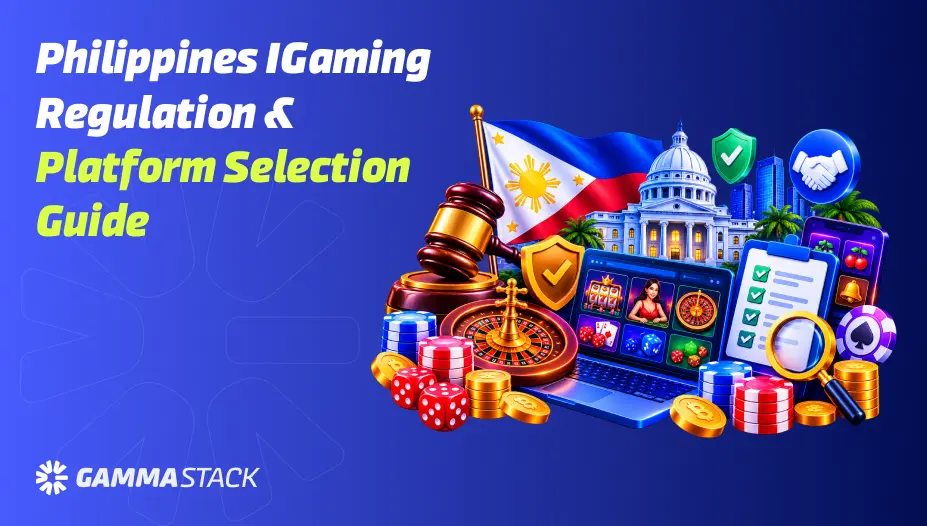
Planning technology for a Philippines-focused gaming project?
This guide outlines the local electronic gaming framework described by PAGCOR, the platform capabilities B2B teams may need to evaluate, and the questions to resolve with the regulator, qualified Philippine counsel, and prospective vendors.
Important: This guide is general business information, not legal advice. Philippine gaming requirements can change and may vary by business model, venue, game, and role
Confirm the current rules and approvals with PAGCOR and qualified Philippine counsel before making commercial or launch decisions. This guide does not establish that any operator, platform, game, brand, domain, or service provider is authorized to operate.
How local electronic gaming works
PAGCOR’s Electronic Gaming Licensing Department (EGLD) describes its oversight of local gaming operations that include traditional bingo, electronic bingo, electronic casino games, sports betting, specialty games, online poker, and numeric games.
The EGLD says these operations involve on-site gaming venues and their associated online platforms. It also describes the platform and games as requiring evaluation and approval, with remote or online play offered as an adjunct service for registered players of the relevant gaming venue. This is a description of PAGCOR’s published framework, not a complete legal conclusion for every possible business mode.
A prospective business should establish its intended operating model before choosing technology. Do not assume that a software platform, offshore licence, or white-label arrangement by itself authorizes a business to offer gaming in the Philippines.
Confirm the applicable approvals for the operator, venue, platform, games, brands, domains, and service providers
Local and offshore gaming are different questions
This guide focuses on local electronic gaming operations described by PAGCOR’s EGLD. PAGCOR separately states that Internet Gaming Licensees and Authorized Providers were cancelled effective December 15, 2024, following Executive Order 74.
Do not treat an offshore licence or a vendor’s overseas experience as authorization for Philippine operations; check the current position directly with PAGCOR and qualified Philippine counsel.
Who may be involved?
| Participant | Typical role | Questions to resolve |
|---|---|---|
| Gaming venue operator or licensee | Operates an approved venue and activities within its authorization | Which venue, game, and player-channel approvals apply? |
| Gaming System Administrator (GSA) or technology provider | Supplies or operates technology under the applicable PAGCOR framework | What accreditation, system approvals, technical standards, and reporting duties apply? |
| Game content provider or aggregator | Supplies or connects game content, where permitted | Are the provider, games, and integrations approved for the intended use? |
| Brand or commercial operator | Manages the customer-facing brand and commercial experience, depending on the approved structure | Is the proposed brand and domain arrangement allowed, and who holds each regulatory responsibility? |
| Payment, identity, and other service providers | Support deposits, withdrawals, verification, monitoring, and other operations | Are the providers and workflows suitable and permitted for the proposed operation? |
These roles may overlap or be structured differently. Confirm each party’s legal and contractual responsibilities rather than relying on generic labels such as “operator,” “white label,” or “turnkey.”
Market evidence
This guide focuses on regulation and platform selection, not market sizing. If adding market data, use a dated primary or otherwise credible source and state exactly what the figure measures—for example, total gaming revenue, electronic gaming revenue, operator revenue, platform-provider revenue, or a forecast. These measures are not interchangeable.
PAGCOR’s official publications and announcements can provide starting points for regulatory and market context. Add a statistic only when its period, segment, definition, and source are clear.
Why consider GammaStack?
GammaStack publicly describes iGaming software offerings that include casino, sportsbook, and lottery-related solutions. Those public product descriptions do not establish that a product, integration, game, or business model is suitable or approved for a particular Philippine operation.
For a Philippines-focused project, discuss the intended business model, product scope, integrations, and regulatory responsibilities with the GammaStack team.
Ask for a demonstration of the specific functions relevant to the project and written clarification of:
- Which features are available now
- Which features require integrations or customization
- Which third-party services and fees apply
- What implementation, support, and maintenance include
- What contractual terms govern data, source code, intellectual property, and exit assistance
- Which regulatory responsibilities remain with the operator or other parties
Do not treat a software demonstration or vendor statement as confirmation of regulatory eligibility. Confirm applicable requirements independently with PAGCOR and qualified Philippine counsel.
Planning a Philippines iGaming project? Contact GammaStack to discuss platform requirements and request a feature-by-feature demonstration.
PAGCOR regulation: What platform buyers should check
PAGCOR publishes frameworks for areas including gaming venue operations, accreditation of Gaming System Administrators, gaming affiliates and support service providers, fees, and other regulatory matters.
The EGLD’s published information describes its role in processing service-provider applications and evaluating requests relating to electronic platforms, systems, games, and content.
PAGCOR’s framework pages include amendments as well as underlying regulatory documents. For that reason, do not rely on one framework in isolation: check the current document, relevant amendments, announcements, transition guidance, and requirements specific to the proposed operation.
Official starting points
PAGCOR regulatory frameworks and amendmentspagcor
PAGCOR Electronic Gaming Licensing Departmentpagcor
PAGCOR Electronic Gaming Licensing Department announcementspagcor
PAGCOR Gaming Licensing and Development Department announcementspagcor
PAGCOR responsible gaming informationpagcor
Build a requirements matrix
The topics below are areas to verify—not a declaration that every requirement applies identically to every business.
Ask legal and compliance advisers to map each applicable rule to its current official source, the responsible party, the required evidence, and the platform function that supports it.
| Area | Questions for legal and compliance review | Platform capabilities to evaluate |
|---|---|---|
| Authorization and operating model | Which operator, venue, platform, game, brand, and domain approvals apply? | Configurable access and deployment controls; documentation of approved integrations |
| Player eligibility | Which age, identity, declaration, and restricted-person checks apply? | Configurable registration checks, verification workflows, and audit trails |
| Geographic access | Which territorial or access restrictions apply to the proposed operation? | Location and IP controls where required, exception handling, and testable logs |
| Identity verification | When must verification occur, and what evidence must be retained? | Suitable verification-provider integrations, review queues, and account restrictions |
| Payments | Which payment channels and transaction flows are permitted? | Configurable cashier, reconciliation, transaction monitoring, and audit records |
| Responsible gaming | Which notices, limits, exclusions, reminders, and interventions apply? | Player-limit controls, exclusion workflows, messaging, and reporting |
| Game content | What approvals apply to providers, games, versions, and deployments? | Game catalogue controls, provider-level configuration, and deployment records |
| Records and reporting | Which reports, logs, retention periods, and regulator-access procedures apply? | Exportable reports, role-based access, traceable changes, and retention controls |
| Security and resilience | Which security, testing, certification, uptime, and incident procedures apply? | Access controls, monitoring, backup and recovery, release management, and testing evidence |
| Marketing and brands | What restrictions apply to brands, domains, affiliates, and promotions? | Brand and domain configuration, approval workflows, and marketing controls |
Practical rule:
Ask the vendor to label each requested feature as:
(1) available now,
(2) available through a named third-party integration,
(3) requiring configuration, or
(4) requiring custom development. Request evidence or a demonstration for critical functions.
iGaming software for a Philippines-focused project
The right technology stack depends on the approved business model and the games the operator intends to offer. A provider should explain how its platform supports the required player journey, operational controls, integrations, and reporting—without implying that software alone guarantees regulatory compliance.
Casino software
A casino platform may include:
- Player registration and account management
- Game lobby and game-session management
- Cashier and transaction records
- Promotions and bonus configuration, where permitted
- Player support and account administration
- Reporting for player activity, game performance, and financial reconciliation
- Responsible-gaming and eligibility controls appropriate to the approved operation
Ask which games and providers can be deployed for the intended operation and what approvals, certifications, or integrations are required.
PAGCOR publishes information about approved games and related operations; verify the relevant status against current official information rather than relying only on a vendor statement.
Read more on:
Online Casino Software Providers in Philippines
How To Start A Casino Business In Philippines
Sports betting software
A sportsbook may include:
- Pre-match and live betting interfaces
- Sports data and odds-feed integrations
- Bet placement, settlement, and account history
- Risk and liability monitoring
- Market suspension, voiding, and settlement rules
- Trader and administrator permissions
- Operational and financial reports
Confirm the availability, scope, and commercial terms of every data feed and trading service. Demonstrate settlement, suspended-event handling, dispute investigation, and audit logging before launch.
Read more on: How to Start a Betting Business in the Philippines
Live casino and other game content
Live casino and other game content may involve separate providers, integrations, and approval requirements. Evaluate:
- Provider and game availability for the intended market and operating structure
- Integration and certification responsibilities
- Session, transaction, and game-history records
- Responsible-gaming controls that apply across game types
- Service availability, support arrangements, and incident escalation
Do not describe a provider or game as approved for Philippine use unless that status has been checked against the applicable official information.
Player management and back office
The back office is often central to day-to-day operations. Evaluate whether it supports:
- Role-based access and administrative permissions
- Player verification and account restrictions
- Transaction reconciliation and reporting
- Customer-support workflows
- Audit trails for material changes
- Configurable limits and responsible-gaming workflows
- Brand, venue, or business-unit reporting where permitted and required
Request a live demonstration using realistic operational scenarios, not just screenshots or a feature list.
Lottery, bingo, and other gaming categories
PAGCOR’s published information identifies multiple local gaming categories, including bingo, specialty games, online poker, and numeric games.
If the proposed business involves lottery, bingo, numeric games, or another specialty category, verify the precise product classification and approval route before assuming that a casino or sportsbook setup can be reused.
Include a category in the project scope only when it aligns with the operator’s intended authorization and the software provider’s actual offering.
White-label, turnkey, or custom?
These are commercial descriptions, not substitutes for regulatory approval. Contract terms and responsibilities vary by vendor, so compare the actual scope rather than the package name.
| Model | Potential fit | Questions to ask |
|---|---|---|
| White-label | A business wants a branded experience using an existing platform | Who contracts with the operator? Who controls the platform, data, integrations, and updates? What can be changed? Who handles each compliance task? |
| Turnkey | A business wants a broader package of platform components and integrations | Which components are included? Who operates each one? What remains the customer’s responsibility? |
| Custom development | A business has specific workflows, integrations, or product requirements | What must be built and tested? What is the delivery plan? Who owns the code and related assets? |
Compare the full cost
Request a written breakdown of:
- Initial setup and implementation fees
- Recurring platform or licence fees
- Revenue share or minimum commercial commitments
- Game, data-feed, and third-party integration costs
- Hosting, security, maintenance, and support
- Customization, testing, and certification costs
- Migration, exit assistance, and data export
- Source-code, intellectual-property, and database rights, if relevant
Ask for the total expected cost over a defined period. Identify which costs may change as traffic, brands, game content, or transaction volumes grow.
Payments, identity, and responsible gaming
Payment, verification, and player-protection requirements should be confirmed for the specific operating model with qualified local compliance advice. Avoid selecting providers solely because they are popular in another country.
Payments and reconciliation
Ask:
- Which payment methods and providers are permitted for this business?
- What restrictions apply to deposits, withdrawals, payment instruments, and account ownership?
- How are failed, reversed, disputed, and suspicious transactions handled?
- Can each transaction be traced to the relevant player account and operational record?
- What reconciliation reports can finance and compliance teams export?
Require a demonstration of the full transaction lifecycle, including exceptions and refunds where applicable.
Identity and player eligibility
Map the required verification steps before implementation. Check which identity documents and declarations are required, when verification must be completed, what happens when a check fails, and how records are protected and retained.
The vendor should document integrations and responsibilities rather than simply claiming that its platform is “KYC compliant.”
Responsible gaming and restricted persons
PAGCOR publishes responsible-gaming information and responsible-gaming requirements. Its official announcements page should also be checked for current advisories and directions that may affect operators, suppliers, or gaming-related communications. Confirm which current requirements and technical processes apply to the proposed operation.pagcor+1
Evaluate whether the platform can support applicable notices, limits, reminders, exclusion procedures, account restrictions, and reporting. Test what happens when an excluded or otherwise restricted person attempts to register, deposit, log in, or play.
The exact controls should follow current applicable rules and the operator’s approved procedures.
How to evaluate an iGaming software provider
Use a structured scorecard so the selection is based on evidence rather than sales claims.
| Evaluation area | Evidence to request |
|---|---|
| Regulatory fit | Written details of the provider’s role, relevant accreditation or approvals, and responsibilities; verify official status independently |
| Product readiness | Live demonstration of required workflows and a feature-by-feature status list |
| Integrations | Named providers, integration scope, dependencies, fees, and support ownership |
| Security and reliability | Security documentation, incident procedures, backup and recovery details, monitoring information, and service commitments |
| Reporting and auditability | Sample reports, transaction traceability, change logs, and export demonstrations |
| Scalability and operations | Architecture overview, capacity assumptions, release process, and support escalation procedure |
| Commercial terms | Full fee schedule, implementation plan, service levels, and exit costs |
| Ownership and portability | Contractual treatment of code, data, configurations, documentation, and migration assistance |
| Delivery confidence | Named project roles, milestones, dependencies, acceptance criteria, and references where available |
Questions to ask during a demo
- Which functions are available today, and which require custom work?
- Which third-party services are mandatory, and who contracts with them?
- What approvals or certifications are needed before deployment?
- Can you demonstrate registration, verification, deposits, withdrawals, and account restrictions end to end?
- Can you show how transactions and administrative changes are audited?
- Which reports can be exported, and in what formats?
- What happens during an outage, failed payment, disputed bet, or provider incident?
- What exactly do we own, and what happens if we change vendors?
- What is excluded from the quoted price?
- Who is responsible for each compliance task, and how is that responsibility documented?
A practical launch-readiness roadmap
Use this as a planning sequence, not as a substitute for a regulator’s application or approval process.
- Define the business model. Document the proposed role, game categories, customer journey, venue relationship, and intended operating scope.
- Confirm the regulatory pathway. Obtain advice on the required operator, venue, platform, game, brand, and service-provider approvals.
- Map responsibilities. Identify which obligations belong to the operator, technology provider, venue, content providers, and other partners.
- Build a requirements matrix. Link each applicable requirement to an owner, platform capability, evidence, and test case.
- Shortlist providers. Evaluate product fit, approvals, integrations, security, reporting, support, and total cost.
- Validate the platform. Run demonstrations and test scenarios for eligibility, verification, payments, restrictions, responsible gaming, and reporting.
- Complete implementation and review. Resolve gaps, document configurations, test integrations, and obtain the necessary approvals before launch.
- Prepare ongoing operations. Assign owners for monitoring, support, reconciliation, security, rule updates, reporting, and incident handling.
Do not set a launch date until the necessary approvals, dependencies, testing, and operational responsibilities have been confirmed.
Common selection mistakes
- Treating a white-label platform as automatic permission to operate. Verify the authorization required for the specific operator, venue, platform, games, brand, and domain.
- Relying on a sales deck as proof of compliance. Request evidence, test critical workflows, and have the compliance team validate claims.
- Assuming all integrations are included. Obtain a list of third-party dependencies, fees, lead times, and responsible parties.
- Comparing vendors only by setup cost. Compare total cost, recurring fees, custom work, support, and exit costs.
- Leaving reporting and audit requirements until late in the project. Define reports, records, access, and retention requirements during platform selection.
- Failing to plan for rule changes. Assign an owner to monitor official updates and assess their impact on product, process, and content.
- Publishing unverified product claims. Confirm each claim with product, engineering, and commercial stakeholders before publication.
Regulatory status checked: October 10, 2026. PAGCOR’s published frameworks and announcements include amendments and advisories; check the latest official materials before relying on this guide.
Frequently asked questions
Is online gaming permitted in the Philippines?
PAGCOR publishes a framework for local gaming operations that includes on-site gaming venues and associated online platforms. Whether a specific business can operate depends on its activity, venue, licence, platform, games, and applicable approvals. Confirm current requirements with PAGCOR and qualified Philippine counsel.
What should I verify before choosing a Philippine iGaming platform?
Confirm the regulatory pathway for your business, the provider’s role and approvals, the availability of required games and integrations, player-verification and responsible-gaming workflows, reporting, security, support, and total cost.
Should I choose white-label, turnkey, or custom software?
That depends on your operating model, required control, integrations, budget, timeline, and internal capabilities. Compare the actual scope and responsibilities in writing; the model label alone does not determine regulatory compliance.
What features should an iGaming platform include?
Depending on the approved operation, relevant features may include player accounts, cashier and reconciliation, verification integrations, game or sportsbook management, risk controls, customer support, reporting, audit trails, and responsible-gaming workflows. Confirm applicable requirements before finalizing the specification.
How much does an iGaming platform cost?
Costs vary with product scope, game and data integrations, customization, hosting, support, commercial model, testing, and other third-party services. Ask vendors for a written breakdown of initial and recurring costs and compare them over the same period.
Can one platform support casino, sportsbook, and lottery products?
Possibly, but do not assume one platform or approval covers every category. Verify the provider’s actual capabilities, required integrations, and approvals applicable to each product.
India
USA
Malta
Latvia
Let's Work Together. Win Together
Ready to transform your ideas into next-generation solutions? Drop us your details and we’ll get back to you within 48 hours!