Why the Right iLottery Software Provider Matters
Choosing an iLottery software provider is more than finding a platform with the right features. The wrong choice can create problems even long after launch, from compliance gaps and integration issues to downtime and expensive platform changes.
This matters even more as digital lottery continues to grow in the U.S. Michigan’s iLottery platform surpassed USD 1 billion in annual sales in 2025, showing how significant digital channels can become for established lottery operations.
Hence, operators should make iLottery vendor evaluation an important part of the planning process. You need to know whether the provider can support your current operation while also handling new states, iLottery games, integrations, and player demand as you grow.
The right lottery operator software should not just work well on day one. It should give you the technology, flexibility, security, and support needed to operate confidently over the long term.
So, what should you actually look for? The table below breaks down the key criteria and the questions worth asking every provider.
Comparison Table: Evaluation Criteria at a Glance
| Evaluation Criteria | Why It Matters | Questions to Ask the Provider |
|---|---|---|
| Regulatory Compliance | Avoids legal/licensing risk | Which US states are you already certified in? |
| RNG Certification | Ensures fair, auditable draws | Is your RNG certified by GLI or iTech Labs? |
| Scalability | Supports multi-state growth | Can the platform expand without a rebuild? |
| Game Portfolio | Impacts player engagement | Do you support draw, instant, and subscription games? |
| Payment & POS Integration | Enables retail + digital sync | Does this integrate with our existing lottery systems? |
| Player Engagement Tools | Drives retention/revenue | What analytics and personalization tools are included? |
| Support & SLAs | Prevents downtime during draws | What’s your guaranteed uptime and support response time? |
| Cost Structure | Impacts long-term ROI | Is pricing license-based, revenue-share, or hybrid? |
The Operator's Checklist — Detailed Sections
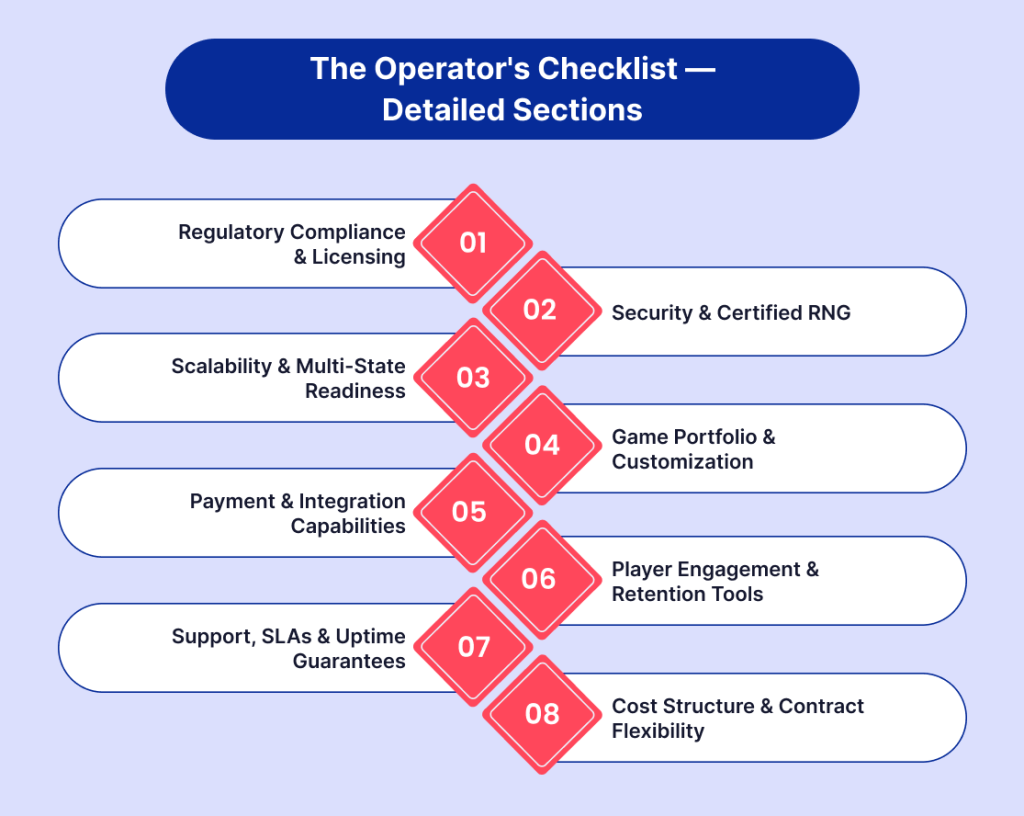
Regulatory Compliance & Licensing
Compliance is the baseline and not a feature. It comes first when evaluating an iLottery software provider, despite how good the iLottery platform looks. Always ask for proof of licensing in every state they claim to operate in. Ensure the platform supports the regulations of every state you plan to operate in, including requirements like player age, geolocation, responsible gaming, reporting, and data handling.
Also ask how they manage a new state entry, like whether they have a repeatable certification playbook or if every launch starts from scratch. A provider that understands state-specific requirements can help reduce regulatory risks and avoid costly changes later.
Security & Certified RNG
Security and game integrity are crucial for building player trust. The provider should protect player accounts, payment information, and other sensitive data — there’s no room for compromise here. Apart from that, verify whether the platform uses a certified RNG that has been tested independently.
Ask the provider specifically whether their random number generator is certified by iTech Labs or GLI (Gaming Laboratories International), and insist on seeing current certification documents rather than relying on verbal confirmation. Understanding how often they retest is just as important as the certificate itself.
Scalability & Multi-State Readiness
Your first platform should not force you into another rebuild as your business grows. Planning for expansion is key. Ask whether the platform’s architecture supports adding new states, game types, or higher transaction volumes without requiring a full rebuild.
A lottery platform built on rigid, single-state infrastructure could leave you facing a costly replatforming decision down the line, something operators want to avoid. Ask vendors for real examples of how they have scaled existing clients rather than relying on theoretical answers.
Game Portfolio & Customization
Modern players want variety. A traditional draw game alone may not be enough to keep them engaged. A wide range of draw, instant, and subscription games can help operators attract and retain today’s players. Ask whether the provider supports these games natively or requires separate integrations or third-party add-ons.
Customization is another crucial factor to check. Find out whether you can alter prize structures, themes, or mechanics to suit your player base or whether you are limited to a fixed catalogue. A limited or rigid game portfolio can make it harder to drive engagement, regardless of your marketing efforts. A flexible portfolio allows operators to test different game types and adjust their offering as player preferences change.
Payment & Integration Capabilities
An iLottery platform cannot work in isolation. It needs to integrate smoothly with your existing retail POS systems, payment processors, and any other subscription infrastructure that is already in place. Ask which APIs are available and whether the provider has experience working with your existing technology stack.
Poor integration creates friction for players moving between retail and digital channels and can complicate day-to-day operations. Thus, it is important to clarify who manages integration work and ongoing maintenance. Well-planned integrations can reduce operational complexity and create a smoother experience across digital and retail channels.
Player Engagement & Retention Tools
A robust game portfolio is only part of the equation. It doesn’t help you understand player behaviour. You need tools like analytics dashboards, segmentation tools, and personalized features that may come with an extra cost. Double-check what tools are included as standard and which require third-party integrations.
Responsible gambling tools (deposit limits, self-exclusion, cooling-off periods) also come under this category, both as a compliance requirement and a trust signal to players. The goal is to have enough data and engagement tools to make informed decisions rather than relying on guesswork.
Support, SLAs & Uptime Guarantees
Technical issues during a major draw or peak traffic period can quickly affect player trust and revenue. That makes support and Service Level Agreements (SLAs) an important part of your evaluation. Check the provider’s guaranteed uptime, support availability, response times, and issue resolution commitments.
Ask whether support is available 24/7 and how critical issues are managed. You should also review planned maintenance terms and how downtime is communicated. Do not focus only on the headline uptime figure. Ensure the SLA clearly explains what happens when the provider fails to meet its commitments.
Cost Structure & Contract Flexibility
The lowest quoted price doesn’t necessarily mean the lowest overall cost. Pricing models vary significantly across providers, including license-based, revenue-share, and hybrid models. Hence, always ask the provider to explain every detail of the pricing structure, including licensing, implementation, integrations, maintenance, support, and additional development.
Contract flexibility is also equally important. Check the exit terms if the partnership fails, such as the notice period or any penalties involved. A cost structure that looks attractive upfront can quickly become expensive if it includes hidden fees or restrictive exit terms.
Common Mistakes Operators Make During Evaluation
Even experienced operators can overlook important details when comparing providers. Some common mistakes include:
Over-indexing on demo polish
A well-rehearsed, polished demo can be impressive, but it will not show how the platform performs under high transaction volumes or during a live draw. Look beyond the demo script and ask about the underlying technology, scalability, and support.
Ignoring multi-state architecture
If you’re launching in just one state, it’s easy to overlook scalability and expansion. But when you’re ready to enter another state, you may find that the platform can’t support it without major changes or even a complete rebuild.
Skipping reference checks
Provider case studies are useful, but speaking directly with existing clients can give you a clearer view of reliability, support, and day-to-day performance.
Underestimating integration timelines
Integrations with payment systems, POS infrastructure, identity verification, and other tools can take longer than expected. Confirm timelines and responsibilities before signing.
Ignoring exit terms
Do not focus only on launch and pricing. Review notice periods, termination fees, data ownership, and other exit conditions in case the partnership does not work out.
Red Flags to Watch For
Even when an iLottery software provider looks good on paper, certain warning signs demand attention. Watch for these during your evaluation:
Vague compliance answers
If a Lottery software vendor cannot clearly explain which states it supports, what certifications it holds, or who handles compliance updates, treat that as a clear warning sign.
No certified RNG
A provider who can’t produce current RNG certification from GLI or iTech Labs shouldn’t be considered, regardless of how strong the rest of their pitch is.
No case studies or references
Providers should be willing to share relevant examples of their work. If they cannot provide references or existing clients you can speak with, it becomes harder to assess their real performance.
Unclear SLAs
If the agreement is vague about uptime or support response times, you may have little protection when something goes wrong.
Undisclosed or shifting fees
Pricing that changes after the sales conversation, or fees that only surface in the fine print, are early signs of a difficult long-term partnership.
Readers Of This Blog Also Read



How GammaStack Fits This Checklist
GammaStack’s experience across lottery and iGaming operations directly aligns with the checklist. With 14+ years of experience and projects across 45+ countries, its iLottery platform is designed to support operators in different markets.
On certified RNG, GammaStack has iTech Labs certifications and supports regulated gaming environments, helping ensure fair and auditable game outcomes.
On scalability, GammaStack offers products across multiple gaming verticals, including casino, sports betting, lottery, and slots. Its platform supports diverse products and game types, giving operators the flexibility to expand their offering and accommodate growing player volumes as their business develops.
On engagement tools, GammaStack’s lottery platform includes configurable game formats and back-office analytics, giving operators tools to monitor player activity and make informed decisions about their offering.
On compliance, GammaStack’s lottery platform is built with regulatory requirements in mind and supports compliance-ready operations across regulated gaming environments. This gives operators a foundation for meeting jurisdiction-specific requirements as they expand into new markets.
Final Thoughts
Choosing an iLottery software provider is a long-term partnership decision, not a one-time purchase. The right provider should be able to support your operation beyond launch, from compliance and integrations to game management, scalability, and ongoing support. Taking the time to compare these areas can help you avoid major changes later and choose a platform that can grow with your business.
Frequently Asked Questions
What does an iLottery software provider do?
An iLottery software provider builds and maintains the technology that runs a state lottery’s digital operations, including ticket sales, draw and instant games, player accounts, payments, and back-office reporting. They may also support certifications such as RNG testing and provide the compliance features needed to operate in regulated gaming markets.
How much does iLottery software cost?
The cost significantly varies based on the platform type, game portfolio, integrations, customization, licensing, and support requirements. White-label solutions generally cost less than fully custom iLottery platforms, while complex projects require a larger investment.
Is iLottery legal in all US states?
No. As of 2025, only 11 US states allow iLottery sales, according to Mordor Intelligence, meaning legality and specific requirements vary significantly by state.
What’s the difference between white-label and custom iLottery platforms?
A white-label platform uses pre-built technology that can be branded and launched faster. A custom platform is developed around specific business requirements and offers greater control over features, integrations, and user experience.
How long does it take to launch an iLottery platform?
Launch time depends on the platform type, customization, integrations, compliance requirements, and game portfolio. A white-label solution can typically launch faster, while a custom platform may take several months to develop and deploy.
The Author