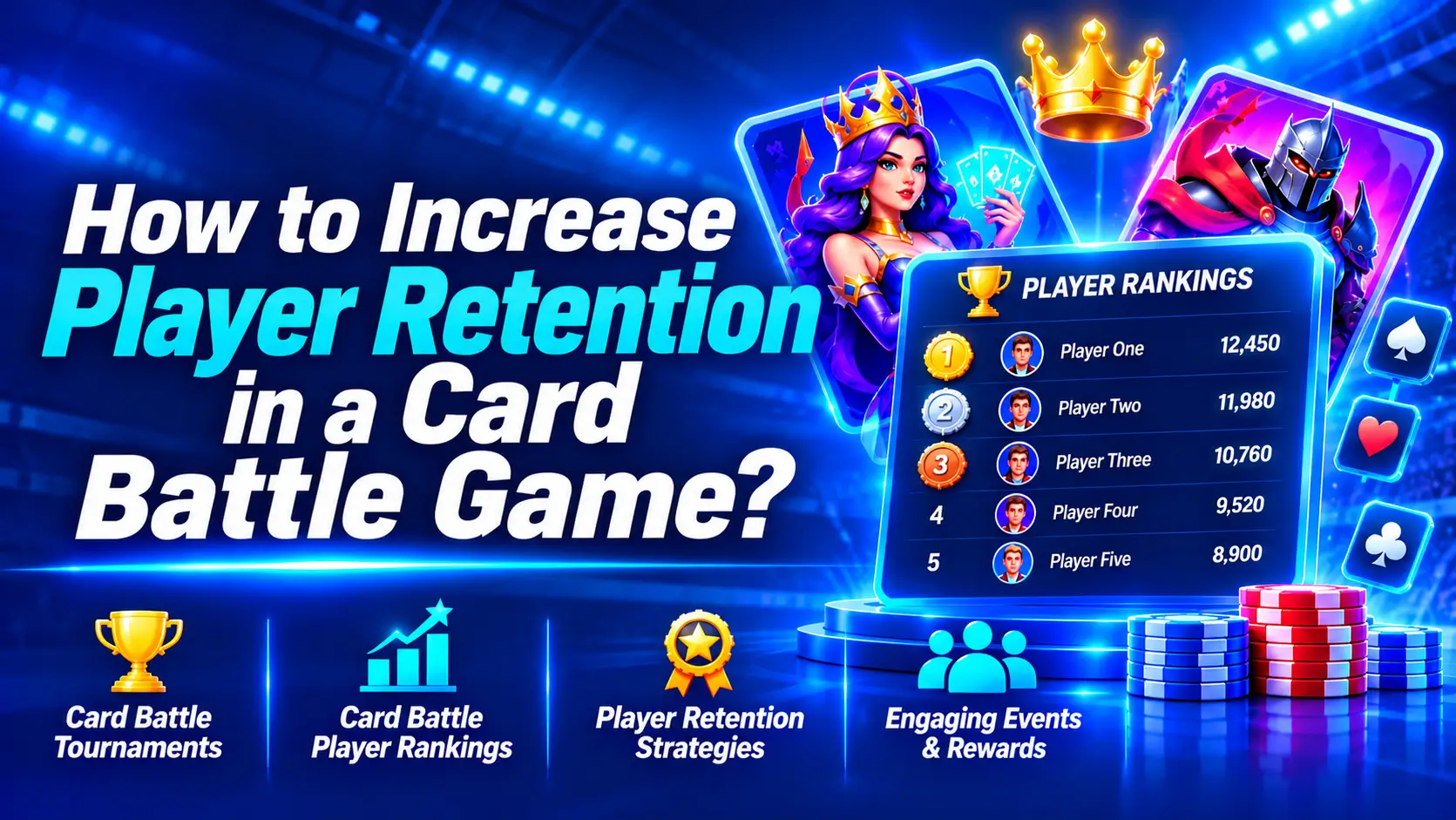
Imagine this scenario: a new player discovers your platform and signs up. They finish the tutorial and collect a free mystery box. On day 2, they return for a daily battle challenge and to improve their position on the leaderboard. On day 3, he may have a chance to win a top-tier card while participating in another battle.
This anticipation and gratification keep the player hooked, making them return every day.
Player retention in card battle games is important because it supports cash flow, steady income generation, and lower customer attrition. Card battle games have taken the iGaming sector by storm with their strategic, skill-based gameplay and lower regulatory oversight.
Are you planning on launching your own battle card platform or wanting to improve player engagement in card games? We discuss top strategies to ensure your end-users are hooked on the game. Launch your business today with GammaStack’s advanced card battle software. Book a demo to learn more.
Player Retention in Card Battle Games - A Complete Overview
Player retention, in general terms, refers to gamers who return to your platform after their first session. It is usually measured as Day 1, Day 7, or Day 30 (D1, D7, or D30).
Many operators struggle to balance the three key metrics: acquisition, engagement, and retention. If you find yourself in the same boat, here is a quick comparison to help you understand.
| Metrics | Customer Acquisition | Customer Retention | Customer Engagement |
|---|---|---|---|
| Definition | How many new players are being onboarded? | Do players return to the game after leaving it? | How actively do players engage during a single session or period? |
| Key metrics | Customer acquisition cost (CAC), customer lifetime value (CLTV), conversion rate (CVR) | Customer retention rate (CRR), customer churn rate (CCR), net promoter score (NPS) | Daily active users (DAU), session length, customer satisfaction score (CSAT) |
| Intent | Helps to measure the effectiveness, cost, and efficiency of marketing campaigns turning leads into paying customers | Helps to measure customer loyalty, income scope, and long-term growth | Helps to measure how frequently customers interact on your platform |
Customer retention is essential, as repeat players are more valuable than acquiring new ones. Research from Bain & Company has shown that a 5% increase in retention rate can increase profitability by 25-95%. Acquiring new customers costs 5-25x more than retaining one.
Importance of Card Battle Game Player Retention For Operators
- Longer player lifecycles: Players who spend more time on the platform are more likely to make in-app purchases, refer other players, and build habits like deck building and regular battles.
- Higher engagement: Existing players are more likely to play more sessions and matches, increasing engagement and monetization opportunities.
- More opportunities for monetization: When players regularly engage on the platform, they are more likely to purchase mystery boxes and card decks.
- Stronger loyalty: As players progress on leaderboards through repeated battles, they develop loyalty and become brand advocates.
Improved player lifetime value: Higher retention and lower customer acquisition cost.
7 Player Retention Strategies for iGaming
How to increase player retention in games of card battle? We’ve explored the top seven strategies:
Give Players Reasons to Return Every Day
Habit formation is a key psychological factor behind retention. Operators should focus on strategies that encourage daily logins. This can be achieved through:
- Daily login rewards that scale with consecutive days
- Daily missions and battles to maintain engagement
- Limited-time events to build anticipation
- Streak bonus to complement consistency
Introduce Competitive Card Battles
PvP battles and house tournaments keep players coming back daily, making them a top strategy for player retention in card battle games. There are several ways to introduce competition in a card battle game:
- Ranked leaderboard
- Head-to-head battles that ensure engagement
- Players can compete at specific difficulty levels
- RNG and advanced algorithms used to ensure fairness in battles
Use Leaderboards for Long-term Engagement
Progressing on the leaderboard can turn one-off matches into ongoing financial goals. To retain players, introduce daily, weekly, and seasonal leaderboard goals. Introduce meaningful rewards that will entice players to revisit the platform and participate in battles.
Operators should recognize improvements, not just top ranks.
Reward Players for Progression and Loyalty
Players love gratification, especially something that feels immediate. Make leaderboard progression seamless and easy; an overly complicated process might make them rethink their journey on the platform.
Loyalty programs work best when every tier and achievement feels acknowledged.
The following reward system can help improve card battle game player retention:
- Visible progression on the leaderboard with meaningful rewards at the end
- Milestone rewards in the middle of ongoing battles to ensure engagement
- Daily bonuses for rewarding consistency
Use Mystery Boxes and Card Collection Mechanics
Mystery boxes add surprise, anticipation, excitement, and goal-setting. Players can receive them by completing quests, winning battles, and logging in daily.
Mystery boxes help players in battle because they often contain rare cards that are hard to get through normal gameplay.
Introduce Fresh Gameplay
Do you find your platform having a high attrition rate? Wondering how to increase player retention in games? People get bored with the same gameplay every time, which becomes monotonous and loses the thrill of winning and strategizing.
You can plan a gameplay calendar around:
- Seasonal themes around festivals and important events
- Limited time formats
- Introducing new card sets
Sometimes, small updates can also bring lapsed players back to your platform.
Improve First-Time Player Experience
Player onboarding plays an important role in their experience and retention. A difficult first-time introduction can make players wary. If the player doesn’t understand the game within the first 5-15 minutes, they are more likely to move on.
Here is what you can do:
- Add a quick demo of the game
- Teach the game through gamification instead of long-drawn guides
- Let the player win an introductory battle within the first few minutes
- Introduce what can be achieved (leaderboard progression, mystery boxes, rare cards, and more)
- Do not ask for too many details right at the onset, like banking or financial details, or asking them to sign up for paid access
Best Practices for Improving Card Battle Game Engagement
- Simplify the gameplay
- Provide short-term and long-term goals
- Create meaningful progression
- Introduce recurring daily activities
- Keep the competition fair
- Introduce new content
- Personalize themes and rewards (where possible)
- Track retention metrics
Launch a Scalable Card Battle Game Platform With GammaStack
Player retention in card battle games works best with an advanced user experience, fair play, regulatory compliance, and data security. At GammaStack, we hold GLI-33 and ISO accreditation for our Random Number Generator and algorithms, allowing operators to offer end users a modern battle card gaming experience.
As a leading iGaming software provider, we have 15 years of experience helping businesses launch successful platforms. Our flexible, scalable platform lets you launch faster, measure retention metrics, and adapt as player demands change.
Our bespoke software supports leaderboard, PvP, and house-led battles, daily rewards, live content updates, and progression systems.
To learn more about our solution, book a demo today.
The Author