⚡ Quick Answer
Lottery platform development is the process of building the technology infrastructure needed to run a lottery operation — ticket sales, draws, instant games, payments, player accounts, and compliance reporting — and is distinct from lottery game development, which focuses on building individual games like draw-based titles, instant-win games, or scratch cards. Success depends on bringing three things together from day one: player-facing features, backend systems powering draws and payments, and the compliance work needed for regulatory approval; skipping any one leads to delays, failed certifications, or an expensive rebuild. A modern platform needs 8 core features — draw/instant game engines, certified RNG, player account management, payment gateway integration, retail/POS integration, an admin/reporting dashboard, player engagement tools, and multi-state/jurisdiction support — built through a 7-stage development process: discovery, architecture planning, UI/UX design, core development/integrations, compliance testing/certification, QA/security testing, and launch with post-launch support. US operators face state-by-state regulatory variation, requiring responsible gaming tools, age/geolocation verification, and awareness of frameworks like the NCLGS Model Internet Gaming Act. Operators must also choose between white-label (faster, cheaper, less flexible) and custom (slower, pricier, fully controlled) platforms, while avoiding common mistakes like treating compliance as an afterthought, underestimating multi-state scalability, skipping peak-traffic load testing, and choosing a vendor without certified RNG credentials.
🔑 Key Takeaways
- Lottery platform development and lottery game development are two separate disciplines: platform development builds the underlying technology (player management, payments, reporting, security, scalability), while game development focuses on individual products — draw-based games, instant-win games, scratch cards — and their rules/mechanics.
- 8 core features define a modern lottery platform: draw & instant game engines, certified RNG, player account management (KYC, age/geolocation checks), payment gateway integration, retail/POS integration, an admin & reporting dashboard, player engagement tools, and multi-state/multi-jurisdiction support.
- The development process runs through 7 stages: discovery & requirements gathering, architecture & technology planning, UI/UX & game design, core development & integrations, compliance testing & certification, QA & security testing, and launch with post-launch support.
- Security and load testing must simulate real peak conditions — a platform that works fine on a normal day can still fail under the traffic surge of a major jackpot draw like a $1 billion Powerball run.
- 4 compliance considerations are essential for US operators: state-by-state variation in gaming law, responsible gaming tools (self-exclusion, deposit/spending limits), age and geolocation verification, and the NCLGS Model Internet Gaming Act as a useful (but non-binding) reference framework.
Building a lottery platform is much more than building a website or an app. It involves real money, strict state regulations, and systems that can’t afford downtime, especially during a live draw. So, the main challenge is not just launching the platform but launching one that is compliant, secure, and scalable from day one.
Lottery platform development is all about bringing three things into a single build. The first is the player-facing features. The next is the backend systems that are needed to power draws and payments. The third, arguably the most critical: the compliance work needed to get regulatory approval. If all three of these factors are taken care of perfectly, your platform can go live on schedule and even expand into new states without a rebuild. If not done properly, it will lead to delays, failed certifications, and an expensive rebuild later on.
What is Lottery Platform Development?
Lottery platform development involves building the technology infrastructure needed to run a lottery operation. It includes the systems required to sell tickets, run draws, manage instant games, process payments, maintain player accounts, and generate operational and compliance reports. Depending on the business model, the platform can support online sales, retail sales, or both, through connected digital and point-of-sale channels.
The platform can also connect with services for payments, player verification, location checks, retail sales, and other operational requirements. Security, responsible gambling controls, data management, and compliance aren’t separate add-ons. They need to be built in from the start, not layered on later.
Building the platform and creating the individual lottery games are two separate areas of development. Game development focuses on creating individual lottery products, such as draw-based games, instant-win games, or scratch cards, including their rules and mechanics. On the other hand, platform development provides the underlying technology that allows operators to launch, manage, sell, and monitor those games. The lottery platform features support the whole operation, from player management and payments to reporting, security, and scalability.
Core Features of a Modern Lottery Platform
A modern lottery platform should support the operator fully, from game and ticket management to payments, reporting, and regulatory controls. These lottery platform features help operators manage digital and retail lottery operations from a single platform.
| Feature | What it Does |
|---|---|
| Draw & Instant Game Engines | Supports different lottery formats, including draw-based games, instant-win games, and subscriptions. Operators can configure game rules, schedules, ticket sales, and prize structures from the platform. |
| Certified RNG | Generates random outcomes for eligible lottery games and supports fair, auditable results. Certification from an approved testing laboratory can help meet applicable regulatory requirements. |
| Player Account Management | Handles registration, player profiles, KYC, age verification, and geolocation checks. Operators can also manage account limits, transactions, preferences, and responsible gambling settings. |
| Payment Gateway Integration | Connects the platform with payment providers to process deposits, withdrawals, ticket purchases, and prize payments. Support for multiple payment methods and digital wallets gives operators more payment flexibility. |
| Retail/POS Integration | Connects digital lottery operations with retail points of sale where both channels are supported. This helps operators manage ticket sales and transaction data across online and physical locations. |
| Admin & Reporting Dashboard | Gives operators a central view of sales, revenue, player activity, game performance, and transactions. Reporting tools can also support operational monitoring and compliance reporting. |
| Player Engagement Tools | Supports loyalty programs, notifications, promotions, and personalized player experiences. Operators can use these tools to communicate with players and encourage repeat participation within applicable rules. |
| Multi-State/Multi-Jurisdiction Support | Allows operators to configure different rules, products, access controls, and compliance requirements for multiple markets. Planning this functionality early can reduce the need for major platform changes as the business expands. |
The Lottery Platform Development Process (Step-by-Step)
A well-planned iLottery development process starts with business requirements and technical planning to development, certification, testing, and launch. Each stage should align with the operator’s target market, platform requirements, and regulatory obligations.
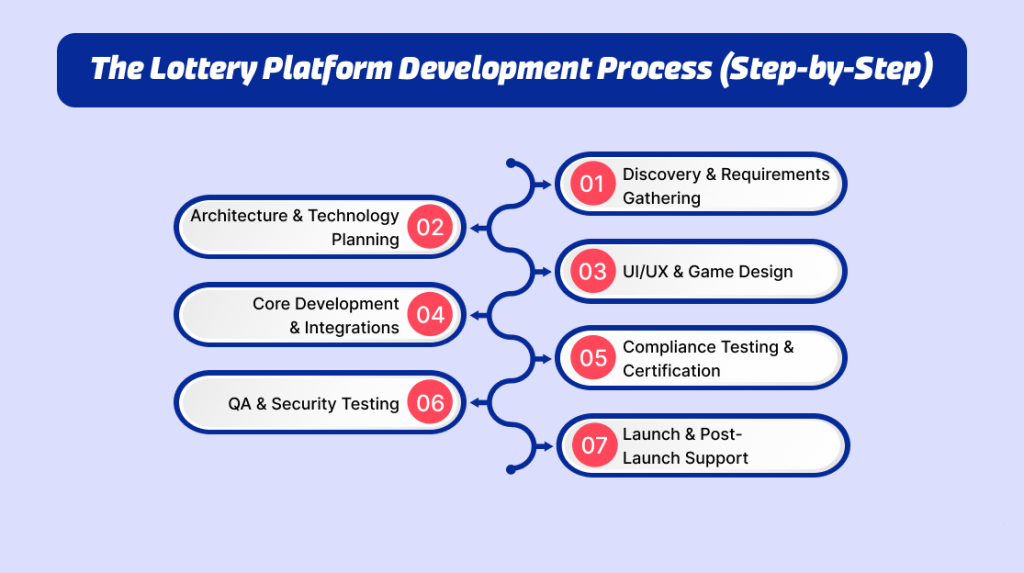
Discovery & Requirements Gathering
The first step is to define what the platform needs to support. This includes game types, ticketing models, target states or jurisdictions, payment methods, player journeys, retail requirements, and the operator’s long-term expansion plans.
Architecture & Technology Planning
The development team defines the platform architecture, technology stack, integrations, security requirements, and infrastructure needed to support expected traffic. Operators also decide whether a white-label or custom lottery platform development approach better fits their timeline, budget, and level of control.
UI/UX & Game Design
This stage focuses on the player experience across web, mobile, and retail kiosks. The aim is to keep the experience simple and consistent across all channels, so players can easily use the platform wherever they access it.
Core Development & Integrations
Developers build the platform’s core modules and connect the required third-party systems. This can include RNG services, payment gateways, KYC and geolocation providers, POS systems, legacy lottery systems, notifications, and reporting tools.
Compliance Testing & Certification
Lottery platform compliance has to be addressed before the platform goes live. This may include independent RNG verification and certification through laboratories such as GLI or iTech Labs, along with required state-level regulatory reviews and approvals.
QA & Security Testing
Apart from functional testing, the platform needs penetration testing to catch security vulnerabilities and load testing to confirm it can handle high-traffic moments like a major jackpot draw. A platform that works fine on a normal day but struggles under the load during a $1 billion Powerball run isn’t ready to launch.
Launch & Post-Launch Support
After testing and required approvals are complete, the platform is deployed to production and closely monitored. Ongoing support covers performance monitoring, security updates, issue resolution, SLA management, regulatory changes, and new feature releases.
Compliance Considerations for US Operators
Launching a lottery platform in the US requires operators to understand the state-specific rules, as US lottery operations are regulated state-wise. It is highly recommended that operators invest enough time to understand the rules that apply to the state they plan to enter. In short, consider compliance from the beginning rather than as a last step.
State-by-state Variation in Gaming Law
Gaming laws can affect how lottery products are offered, who can access them, and which controls the platform needs. Building these requirements into the platform from the beginning makes it easier to adjust the system when entering new states. It also reduces the risk of making major changes later in the development process.
Responsible Gaming Tools
Responsible gambling tools should be integrated into the player account system. Features such as self-exclusion, deposit limits, spending limits, and player notifications give operators practical ways to support responsible play among their players. Operators can apply such needed controls in their preferred target markets.
Age and Geolocation Verification Requirements
Age and geolocation verification are crucial for controlling access to online lottery products. The platform should verify that players meet the applicable age requirements and are physically located within an approved jurisdiction before allowing restricted activities. These checks make your lottery platform trustworthy. Besides, keeping registration and login straightforward is equally important for player experience.
NCLGS Model Internet Gaming Act
The NCLGS Model Internet Gaming Act can provide a useful reference when reviewing regulatory and operational requirements. It covers crucial areas like responsible gaming, player identification, cybersecurity, and internet lottery games. However, it is a model framework, not a single set of rules that applies across every US state. Operators should still need to review the specific laws and regulations of each jurisdiction.
White Label vs Custom Lottery Platform Development
Choosing between a white-label and a custom lottery platform depends on how quickly you need to launch and how much control you want over the platform. Both approaches can support a lottery business, but they involve different trade-offs
| Factor | White-Label Lottery Platform | Custom Lottery Platform |
|---|---|---|
| Cost | Lower upfront investment because the core platform is prebuilt. | Higher investment as the platform is developed around specific requirements. |
| Time to Market | Faster launch with an existing infrastructure and prebuilt features. | Takes longer because the platform has to be designed, developed, tested, and certified. |
| Flexibility | Limited to the features and configurations supported by the provider. | Greater flexibility to define features, workflows, integrations, and user experiences. |
| Control | The provider typically manages much of the underlying technology. | The operator has greater control over the platform architecture and future changes. |
| Scalability | Suitable for operators with standard requirements and a defined scope. | Better suited to businesses planning complex requirements or expansion into multiple markets. |
Common Mistakes in Lottery Platform Development
A few development decisions can create problems later if they are not addressed early. Operators should watch for these common mistakes when planning a lottery platform.
Treating compliance as an afterthought
Building the platform first and addressing regulatory requirements later can lead to redesigns, testing delays, and additional development costs.
Underestimating multi-state scalability
Even if the initial launch targets one state, the platform may need to support different rules, products, and access controls as the business expands. A lottery platform development company should account for these requirements during the initial planning stage.
Skipping load testing for peak draw traffic
Normal traffic does not show how a platform will perform during a major draw. Load testing helps identify performance issues before large numbers of players access the platform at the same time.
Choosing a vendor without certified RNG credentials
RNG technology needs to meet applicable standards and may require independent testing and certification. Operators should verify the vendor’s testing credentials and certification history before selecting a platform.
How GammaStack Approaches Lottery Platform Development
GammaStack approaches lottery platform development by combining the right technology with each operator’s business model, target markets, and growth plans. We start by understanding the scope of the platform, required game types, payment methods, third-party integrations, and regulatory requirements before development begins.
From there, our team plans the platform architecture and develops the core systems for managing games, players, payments, reporting, and administration. We can also integrate payment gateways, KYC and geolocation services, retail systems, and other tools based on the operator’s requirements.
Before launch, the platform goes through functional, security, performance, and reliability testing. Compliance and certification requirements are considered throughout development, helping identify potential issues early rather than dealing with them later.
For operators looking for a top lottery platform development company, GammaStack offers both white-label and custom solutions based on their timeline, budget, and level of control. We also provide post-launch support for maintenance, updates, performance monitoring, and ongoing platform improvements.
Conclusion
A successful lottery platform needs more than popular games and a player-facing website. Operators need reliable technology, secure payments, scalable infrastructure, strong player controls, and compliance built into the platform from the start. The right development approach also depends on how quickly you want to launch, how much control you need, and whether you plan to expand into additional markets.
Whether you choose a white-label solution, custom lottery platform development, or DeFi lottery platform development, having a clear plan for technology, testing, and future growth can help avoid costly changes later.
Readers Of This Blog Also Read


![Everything You Need to Know About Online Lottery Jackpots[1]](https://codeigniter-storage.s3.us-east-1.amazonaws.com/uploads/2026/01/Everything_You_Need_to_Know_About_Online_Lottery_Jackpots1-300x170.webp)
Frequently Asked Questions
How long does lottery platform development take?
The timeline depends on the platform scope, game types, integrations, certification requirements, and level of customization. A white-label platform can usually launch faster, while custom lottery platform development may take several months.
How much does it cost to build a lottery platform?
The cost varies based on factors such as platform type, game modules, integrations, payment methods, compliance requirements, and customization. A white-label solution generally requires less upfront investment, while a custom platform costs more because it is built around specific business and technical requirements.
What compliance certifications does a lottery platform need?
Requirements vary by state and the type of lottery products offered. Depending on the platform, operators will require independent testing and RNG certification, security assessments, geolocation and age verification controls, and other regulatory approvals. The applicable state lottery authority and regulations determine the specific requirements.
Can a lottery platform support multiple states?
Yes. A lottery platform can be designed to support multiple states by allowing operators to configure state-specific products, rules, player eligibility, geolocation controls, and responsible gambling requirements. Planning for multi-state operations early can make expansion easier and reduce major platform changes later.
What's the difference between lottery platform development and lottery game development?
Lottery platform development focuses on the infrastructure used to run the overall operation, including player accounts, payments, game management, reporting, security, and administration. Lottery game development focuses on creating individual products, such as draw-based games, instant-win games, or scratch games, including their rules, mechanics, and outcomes.
The Author


India
USA
Malta
Latvia
Let's Work Together. Win Together
Ready to transform your ideas into next-generation solutions? Drop us your details and we’ll get back to you within 48 hours!