
Share it
TABLE OF CONTENTS
Sports Data Feeds: The Complete Guide for Sportsbooks
A goal is scored. Within milliseconds, the odds shift, and your bettors react. That kind of speed is only possible when your sportsbook is powered by accurate, real-time sports data feeds.
Without one? Your platform is running blind. Stale odds, delayed scores, and frustrated players who leave and don’t come back.
Sports data feeds push live scores, player stats, in-play events, and odds updates straight to your sportsbook, automatically, with near-zero lag. No manual work. No guesswork. Just clean, reliable data that keeps your players engaged and your books balanced.
In this guide, we break down 15 powerful reasons sports data feeds are critical for any modern sportsbook, and exactly what to look for when choosing a provider.
What are Sports Data Feeds?
Sports data feeds give real-time updates on sports, scores, player stats, and more. Betting platforms use this data to set odds and show live results. Live data is used by your players to place in-play bets. Trusted sources fuel these sports data feeds. They ensure fast and accurate information. For instance, in a football match, when a goal happens, the sportsbook data feed sends an update to the sportsbook right away. This helps players place smart bets and keeps the platform up to date.
In short, sports data feeds are the heartbeat of live betting.
Types of Sports Data Feeds
Not all sports data feeds do the same job. Depending on what your sportsbook needs, you’ll work with one or more of these feed types. Here’s a simple breakdown:
Live Score & Match Data Feeds This is the most common type. It sends real-time scores, goals, fouls, corners, substitutions, basically everything happening in a match, as it happens. This is what powers your in-play betting markets and keeps your platform’s scoreboard accurate to the second.
Odds Feeds Instead of sending match events, this feed sends pre-match and live odds directly to your sportsbook. It’s useful for operators who want ready-made odds rather than calculating them in-house. Many sportsbooks use odds feeds alongside their own risk models.
Player & Team Statistics Feeds These feeds go deeper, career stats, form guides, head-to-head records, injury updates, lineups, and detailed player performance data. Great for building richer betting markets and giving bettors more context before they place a wager.
In-Play Event Feeds Focused specifically on live action triggers, yellow cards, penalties, injuries, substitutions, timeouts. These events directly affect live odds, so the faster they arrive, the better your in-play markets perform.
Historical Data Feeds This is past data going back seasons or even decades. You’d use this to build your own odds models, power analytics dashboards, or offer bettors historical match statistics. It’s especially valuable for operators running their own trading desks.
Which Type Does Your Sportsbook Need? Most modern sportsbooks use a combination of live score, in-play event, and player stats feeds. If you’re just getting started, a combined live data + odds feed is the fastest route to launch. As you scale, layering in historical data and player stats helps you build smarter, more competitive markets.
Readers of this blog also read
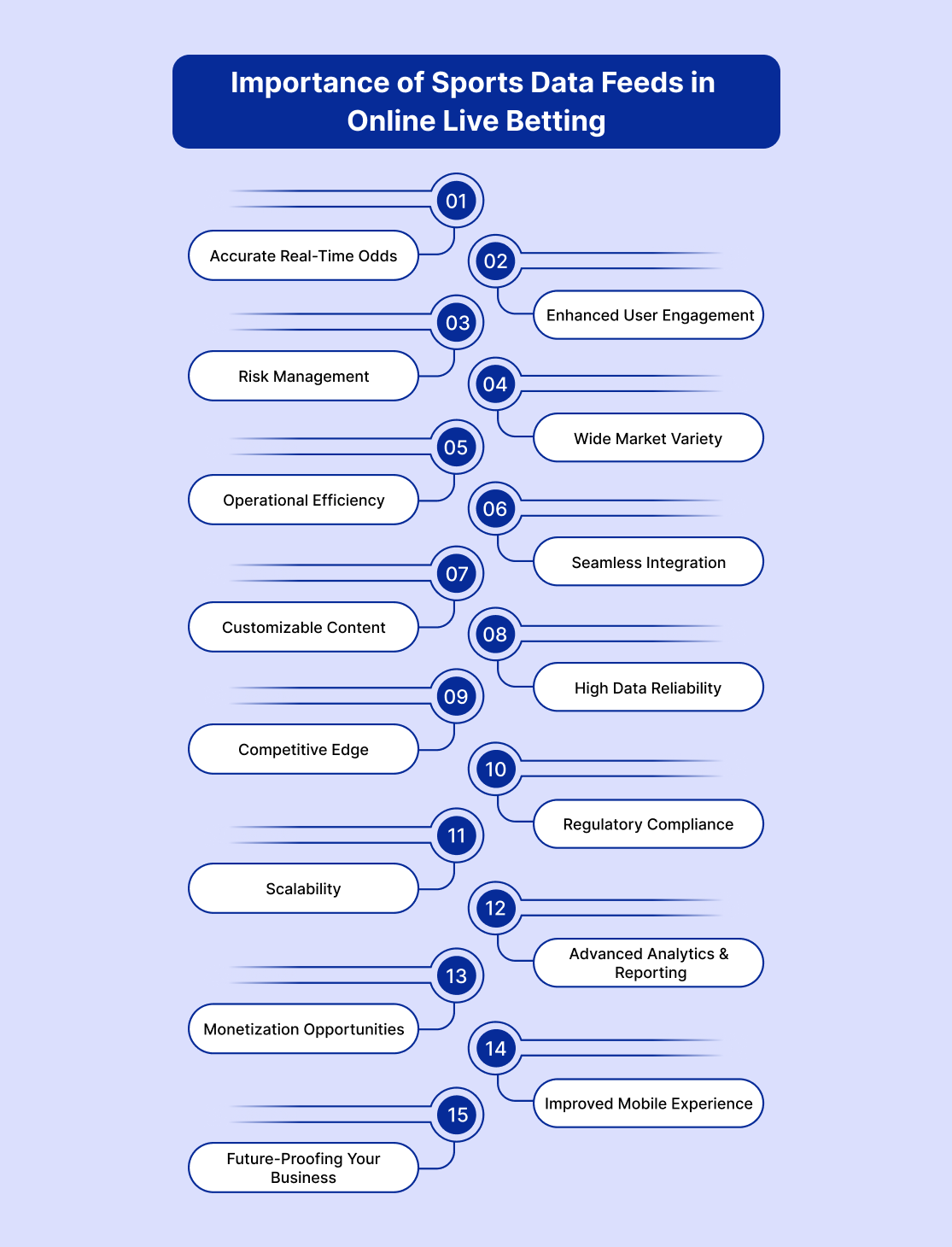
Importance of Sports Data Feeds in Online Live Betting

Accurate Real-Time Odds
Sports data feeds give live scores and stats. They update every second. This makes your odds precise. Precise odds build trust. Trust keeps players on your platform.

Enhanced User Engagement
Fans love up-to-the-second info. Live stats through sportsbook data feed make games more thrilling. Players can bet as the action unfolds. This keeps them on your site longer. More time means more bets.

Risk Management
Accurate data helps you see trends fast. You can adjust odds to balance your book. This cuts down your losses. It also protects you from sudden swings in play.

Wide Market Variety
A sports betting data feed covers many sports and leagues. You can offer niche markets and big events alike. This variety appeals to a broader audience. More markets mean more betting options.

Operational Efficiency
Automated data feeds cut down manual work. You no longer need teams to enter data by hand. This saves time and money. It also lowers human error.

Seamless Integration
Modern feeds use clear formats like JSON or XML. This makes it easy to plug them into your platform. Quick setup means you can go live faster. Fast launches give you a market edge.

Customizable Content
You can pick which stats to show. Custom feeds let you tailor content to your brand. Unique content draws more users.

High Data Reliability
Top sports betting data provider use multiple sources. They have backup systems to avoid downtime. This gives you near-100% uptime. Reliable data keeps your service running smoothly.

Competitive Edge
Not all sportsbooks offer the same depth of data. With rich feeds, you stand out. You become the go-to place for live betting. Better data wins more players.

Regulatory Compliance
Some regulators require data logs and audit trails. Data feeds can supply detailed time stamps for every event. This makes audits simpler. It also helps you meet legal rules.

Scalability
As your user base grows, so do your data needs. Good feed services scale with you. They handle high loads in big events. You won’t need to swap providers at peak times.

Advanced Analytics & Reporting
Raw data can feed into your analytics tools. You learn which bets are most popular. You spot new trends early. These insights guide your marketing and risk teams.

Monetization Opportunities
Some feeds let you offer premium data to players. You might sell deep stats or expert picks. This opens new revenue streams. It also boosts user satisfaction.

Improved Mobile Experience
Live data keeps mobile users engaged. Quick updates show instantly on small screens. Players get the thrill of the game in their hands. This drives app downloads and usage.

Future-Proofing Your Business
Data feeds evolve with new sports tech. They add new stats like player tracking or in-play graphics. By choosing a modern feed, you stay ready for tomorrow. Your platform grows as the market grows.

EXPLORE MORE BLOGS FROM VARIOUS CATEGORIES
How Do Sports Data Feeds Work?
It sounds complex, but the process is actually pretty straightforward. Here’s exactly how data gets from a live match into your sportsbook in under a second.
Step 1: Data Collection at the Source It starts at the venue. Official data providers station trained scouts at matches, or tap into automated tracking systems cameras, player sensors, chip-embedded balls, to capture every event in real time. For major leagues like the Premier League, NBA, or NFL, this data comes directly from official league partnerships, which guarantees accuracy and speed.
Step 2: Processing and Quality Checks Raw event data gets processed through the provider’s central system. Duplicate events get filtered. Timestamps get attached to every action. The data is cross-checked for accuracy before it moves to the next step. This all happens in milliseconds, not seconds.
Step 3: Push to Your Sportsbook via API or SSE Once processed, the data is pushed to your platform through two main delivery methods:
- Server-Sent Events (SSE): The server streams updates to your platform in real time, the moment something happens. No request needed, the data just arrives.
- REST or WebSocket APIs: Your system makes requests to pull data, or holds an open connection for continuous updates.
Top providers deliver updates in under 200-500 milliseconds for high-demand leagues. That’s the difference between sharp bettors finding exploitable odds and your platform staying one step ahead.
Step 4: Odds Engine Reacts Your sportsbook’s odds engine reads the incoming data, say, a goal in a 60th-minute Premier League match, and immediately recalculates the live odds for all active markets. This happens automatically, with no manual input from your trading team.
Step 5: Bettor Sees the Updated Market Within roughly one second of the goal being scored, your bettors see updated odds on their screen. They react. They bet. Your platform stays accurate, competitive, and trusted.
The key takeaway for operators: The weaker your data feed provider’s latency, the more exposure you carry in live markets. A 3-second delay sounds small but it’s more than enough time for sharp bettors to exploit stale odds. When you’re evaluating providers, always ask for documented latency SLAs, not just marketing claims.
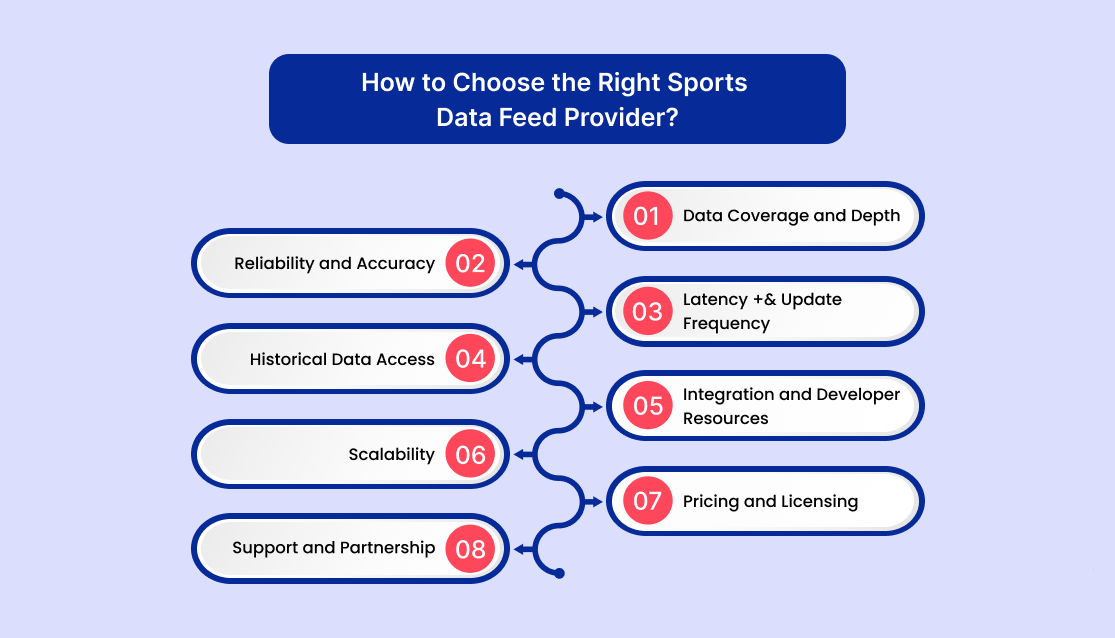
How to Choose the Right Sports Data Feed Provider?

Data Coverage and Depth
Choosing the right provider starts with sport and market coverage. You need feeds that include all leagues and competitions you plan to offer. Look for providers that let you pick specific sports, leagues, teams, or player stats to match your product’s scope. Depth matters too. Ensure the feed offers granular data — live scores, line-ups, player performance, and advanced metrics — so you can build richer features

Reliability and Accuracy
Downtime or wrong data can harm your reputation fast. Opt for providers with high uptime guarantees and near-zero error rates. Check if they publish real-time accuracy figures or third-party audits. Established firms often back their feeds with service-level agreements (SLAs) that promise quick issue resolution. Ask for client references to confirm they deliver on these promises.

Latency and Update Frequency
Speed is critical for live betting and in-play markets. You need feeds that update in milliseconds, not seconds. Compare odds feed providers’ average latencies and their methods for data collection — automated versus manual scouting — to see which matches your needs. Lower latency gives you a competitive edge, as bettors expect instant odds and score updates.

Historical Data Access
A robust archive of past seasons fuels analytics, trend spotting, and model training. Make sure your provider offers historical data that spans multiple years and supports bulk downloads or API queries. This empowers your data science team to build better predictive models and personalized experiences.

Integration and Developer Resources
Smooth integration saves time and reduces costs. Choose a sportsbook feed provider with clear API documentation, SDKs in your tech stack, and example code snippets. Look for sandbox environments or test data to validate your setup before going live. Good developer support — dedicated portals, forums, or account managers — can make all the difference.

Scalability
As your user base grows, your data needs will too. Confirm that the odds feed provider can scale feed volumes and user requests without extra latency or unplanned downtimes. Ask about their infrastructure — CDNs, cloud redundancy, and load-balancing — to ensure consistent performance.

Pricing and Licensing
Budget constraints are real, especially for startups. Compare pricing models: pay-per-request, tiered subscriptions, or revenue share. Beware of hidden fees — look for charges on extra markets, users, or data points. Confirm licensing terms cover your use cases, whether it’s public display, white-label apps, or proprietary risk models.

Support and Partnership
Your provider should be more than a vendor; they should be a partner. Evaluate their customer service — response times, dedicated contacts, and escalation paths. Check if they offer professional services, such as data analysis support, custom data solutions, or integration help.
Searching For The Reliable & Accurate Sports Betting Data Provider?
Top Sports Data Feed Providers for Sportsbooks
Now that you know what to look for, here’s a quick rundown of the major sports data feed providers in the market today. Each has strengths worth knowing before you make a decision.
Sportradar Sportradar is the largest sports data company in the world. They cover over 750,000 sporting events per year across 80+ sports, and hold official data partnerships with major leagues including the NBA, NFL, NHL, and FIFA. If you need the broadest coverage with the highest reliability, Sportradar is the industry benchmark. They’re best suited for mid-to-large sportsbook operators with significant volume.
Genius Sports Genius Sports is the official data and technology partner of the NFL, making them the go-to choice for operators targeting the US market. Beyond American football, they cover a wide range of global sports with a strong focus on integrity monitoring alongside data delivery. If the US is your primary market, Genius Sports deserves serious consideration.
Stats Perform (Opta) Stats Perform is best known for the depth of its analytics. Their Opta data is widely considered the gold standard for player and team statistics. If your sportsbook strategy involves building richer features, detailed player performance markets, AI-driven predictions, or advanced pre-match analytics, Stats Perform is worth looking at.
LSports LSports has built a strong reputation as a cost-effective, high-coverage alternative to the bigger players. They cover 120+ sports and 60,000+ events per year, with competitive latency for in-play markets. For startup sportsbooks or operators scaling in emerging markets, LSports offers a good balance of coverage and price.
IMG Arena IMG Arena specialises in sports that others often underserve, tennis, golf, combat sports, and esports. If your sportsbook targets niche or emerging sports markets, IMG Arena is one of the strongest options available.
| Provider | Sports Coverage | Best For | Pricing Model |
|---|---|---|---|
| Sportradar | 80+ sports, 750K+ events | Large operators, official data | Custom enterprise |
| Genius Sports | Focus on NFL + global sports | US-market sportsbooks | Custom enterprise |
| Stats Perform | Deep analytics, 300K+ events | Analytics-heavy platforms | Subscription/custom |
| LSports | 120+ sports, 60K+ events | Startups, emerging markets | Tiered subscription |
| IMG Arena | Niche sports (tennis, golf, esports) | Niche-market operators | Revenue share/custom |
A quick note: GammaStack integrates with your choice of data feed provider. So rather than being locked into one feed, you can pick the provider that best fits your market, budget, and sports coverage needs, and GammaStack handles the integration for you.
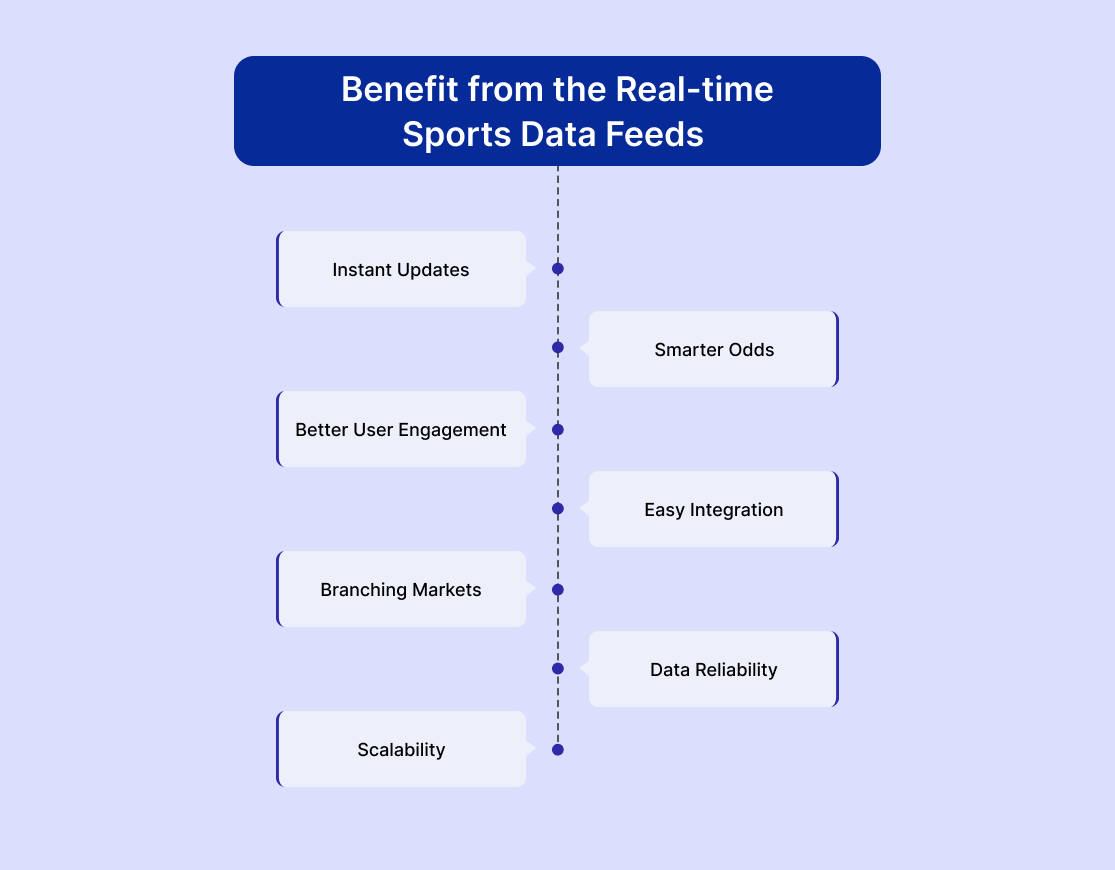
Benefit from the Real-time Sports Data Feeds
- Instant Updates: Know scores the moment they change. This keeps users glued to your site.
- Smarter Odds: Use live stats to set fair odds right away. This lowers your risk.
- Better User Engagement: Fans see updates in real time. They stay longer and bet more.
- Easy Integration: Our sports betting feeds fit into your system with little work. You spend less time on setup.
- Branching Markets: Offer new bet types based on live events. This attracts more players.
- Data Reliability: Strong servers ensure you get data with no delays or errors.
- Scalability: Scalable systems handle more games without slowing down.
How GammaStack Can Help You Get The Best Odds
Here’s something most sportsbook software providers won’t tell you: going directly to a data feed provider and managing the integration yourself is complicated, expensive, and slow.
You need to negotiate contracts, handle API documentation, build the connection to your odds engine, manage uptime issues, and scale it as your user base grows, all before you’ve even focused on growing your sportsbook.
GammaStack takes all of that off your plate.
As a sportsbook software provider with 14+ years of experience, we’ve built and launched 80+ sportsbooks across 45+ countries. Our platform is already integrated with leading sports data feed providers, which means instead of spending months on technical setup, you choose the provider that fits your market and we handle the rest.
Here’s what that looks like in practice:
- Your choice of data feed provider – we don’t lock you in. Pick from Sportradar, Genius Sports, LSports, or others based on your target market and budget.
- Pre-built integrations – no lengthy development cycles. Our platform connects to your chosen feed provider quickly, so you go live faster.
- Real-time odds engine – incoming feed data feeds directly into our odds engine, keeping all live and pre-match markets accurate and competitive.
- 100% source code ownership – you own your platform. No revenue share, no hidden dependencies.
- Ongoing support – our team monitors feed performance and handles issues, so your platform stays live even during peak events.
Whether you’re launching your first sportsbook or scaling an existing one, GammaStack gives you the data infrastructure of an enterprise operator, without needing to build it from scratch.
Ready to see it in action? Talk to our team today. We’ll walk you through exactly which data feed setup makes sense for your market, your volume, and your growth plans.
Frequently Asked Questions (FAQs)
Yes, data analysis helps bettors make smarter choices. By studying past games, player stats, and trends, bettors can spot patterns and make informed bets. This approach through sports betting feeds moves betting from guesswork to a more calculated strategy.
Data analysis is key because it reveals patterns that aren't obvious. It helps bettors and sportsbooks predict outcomes, set fair odds, and manage risks. Using sportsbook feed data leads to better decisions and can improve chances of winning.
GammaStack offers reliable sports betting statistics software. It provides detailed match insights, player stats, and betting history, helping operators and bettors make informed decisions.
GammaStack is a leading provider of sports betting software. Our platform offers customizable solutions, real-time odds, and comprehensive analytics, making it a top choice for sportsbooks.
A sportsbook feed provides real-time information like scores and player stats. This helps sportsbooks update odds quickly and allows bettors to make timely decisions. Accurate data feeds make betting more exciting and fair.